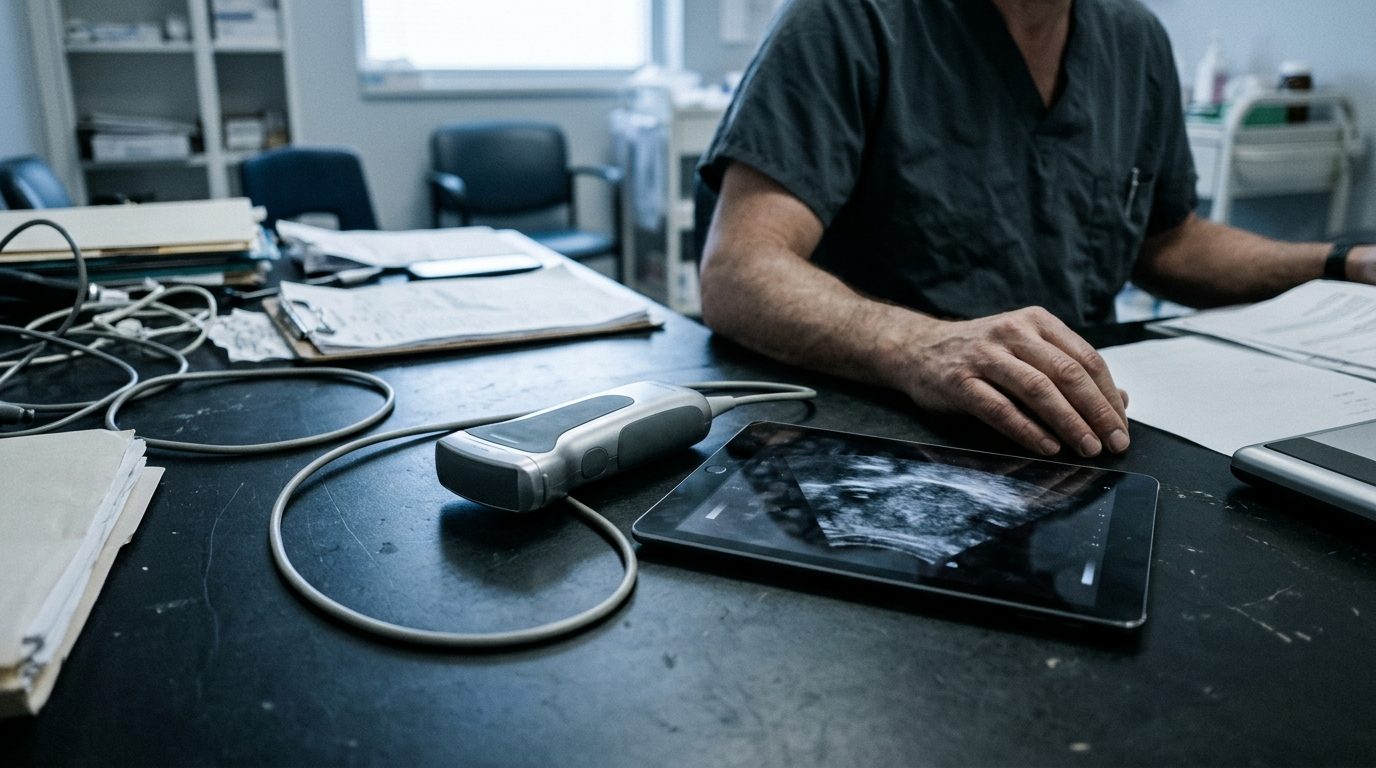
GE HealthCare has introduced two new software functions for its Vscan Air SL portable ultrasound system: Lung Guidance and AutoAS. These algorithms handle routine navigation and primary organ evaluation, reducing the historical requirement for years of specialized practice down to following on-screen prompts.
Embedding computation directly into the diagnostic probe erases the qualification barrier between different medical specialties. In primary care, staff time and qualification levels directly drive the unit cost of every examination. By moving algorithmic analysis into a compact form factor, GE HealthCare attempts to offload stationary ultrasound clinics and compress overhead.
Automated lung scan protocol
The Lung Guidance feature assists practitioners in performing lung ultrasounds by guiding them through a standardized eight-zone examination protocol. During the procedure, the software identifies the pleural line, A-lines, rib shadows, and the diaphragm, while instructing the operator on correct probe placement.
"The software identifies the pleural line, A-lines, rib shadows, and the diaphragm, guides probe placement, and automatically saves the clip once specified quality criteria are met."
The device automatically saves a video clip the moment predefined quality criteria are satisfied. The algorithm also incorporates B-line detection and counting, eliminating subjective variance in manual marker tallying.
Accuracy without expert training
The inflection point lies in GE HealthCare's internal validation testing data. Non-expert users—including general practitioners and cardiologists—acquired diagnostic-quality images in 95.2% of cases. By comparison, experienced specialists achieved 96.8% under identical conditions.
"In the company's validation testing, users WITHOUT expert training (general practitioners, cardiologists) obtained diagnostic-quality images in 95.2% of cases. For experienced specialists, the figure stood at 96.8%."
The performance gap between years of dedicated clinical tenure and a basic instructional brief narrowed to 1.6 percentage points. A second function, AutoAS, estimates the probability of moderate or severe aortic stenosis from standard two-dimensional cardiac views. The software processes a minimum of two suitable echocardiographic slices, returning pathology indicators alongside an algorithm confidence score.
Economics of point-of-care screening
The objective of AutoAS is to support primary care providers or mobile clinicians when full echocardiography is immediately inaccessible. Medical equipment manufacturers are increasingly packaging these computational workloads into closed portable systems.
The primary pushback from clinics centers on the risk of overlooked pathologies by practitioners lacking narrow cardiological training. However, the algorithm does not issue definitive diagnoses; it filters the inbound patient flow and flags confidence levels regarding stenosis markers. The pocket scanner replaces years of practice with a five-minute on-screen protocol, leaving ultimate liability for misinterpretation with the on-duty physician.
The catch
Complex medical diagnostics has depended on scarce specialist skills for years, yet smart hardware now delegates that expertise directly to onboard software. According to GE HealthCare, non-expert users operating the Vscan Air SL achieved diagnostic quality in 95.2% of cases, virtually matching seasoned practitioners. Functions like Lung Guidance and AutoAS turn the handheld scanner into a real-time bedside tutor for general practitioners. GE HealthCare is effectively selling clinics a shortcut around staffing costs by outsourcing initial diagnostic screening to portable algorithms.