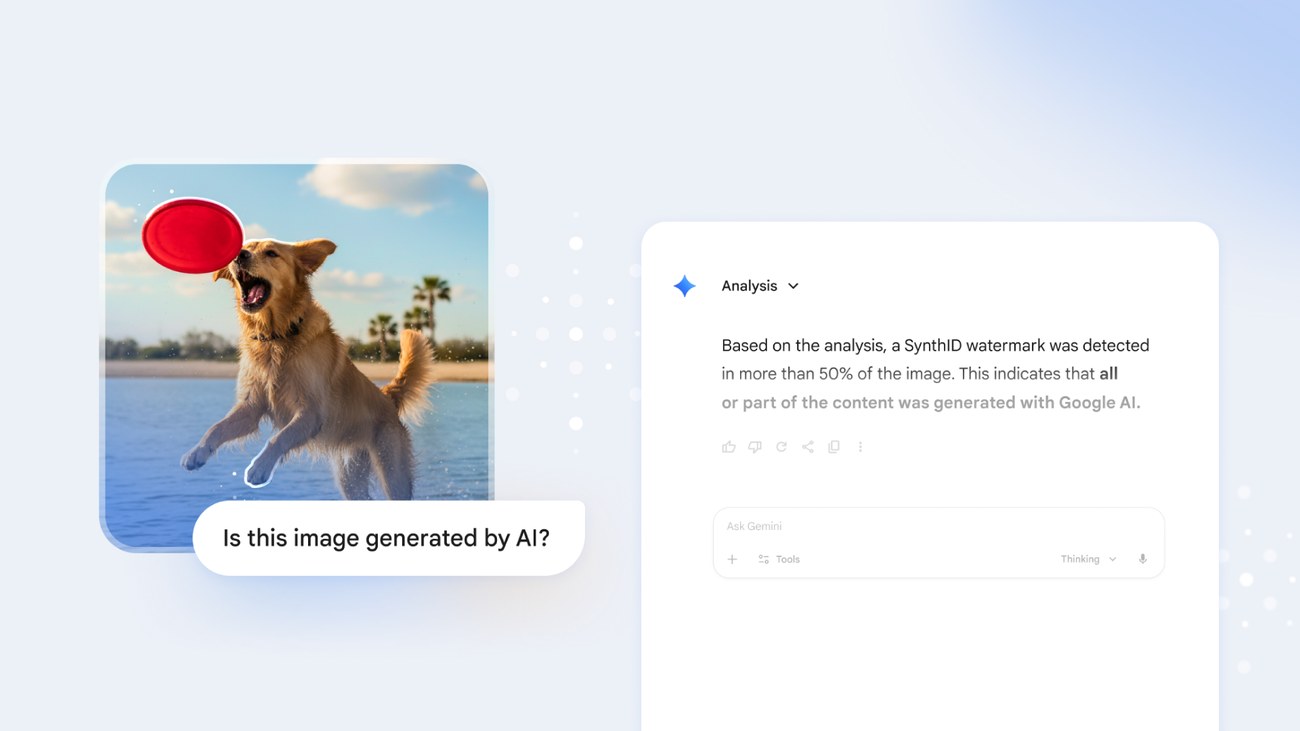
Google DeepMind has introduced a new capability to its AI arsenal: Gemini can now identify images that have been generated or edited using Google's own tools. The SynthID technology, a digital watermark that Google has been promoting since last year, is now more deeply integrated. Users can upload an image to Gemini, and it will provide an assessment of whether it was generated or modified by Google AI or not. Google claims that over 20 billion images have already been marked with this digital identifier. This initiative appears to be aimed at increasing transparency and combating deepfakes, or perhaps at asserting greater control over content within Google's ecosystem.
Google's stated goal is to "provide users with more context" and "help determine how content was created." This framing positions the technology as an ideal public relations move in the fight against misinformation. However, the underlying strategy, as is often the case in the AI landscape, appears to be driven by calculated business interests. SynthID, at present, is primarily focused on controlling Google's *own* content. Gemini can only detect Google's proprietary watermarks, and its responses are purely informational, without any directive actions. Google is currently conducting trials of SynthID Detector with journalists and media experts, a move that can be seen as an effort to lay the groundwork for establishing an industry standard, where Google would naturally aim to set the pace.
The core issue is that Google emphasizes transparency, but only for its own generated content. Gemini remains unable to detect images generated by other AI platforms. Google has plans to expand SynthID to video and audio content, as well as to support the open C2PA (Coalition for Content Provenance and Authenticity) standard. These plans suggest a much larger strategic play. If Google fully commits to C2PA, it could solidify its position as the primary gatekeeper of digital content authenticity. For now, these remain future plans, which can be interpreted as an attempt to secure a dominant position in the evolving market.
This development means that for your business, particularly if you operate in media, marketing, or creative fields, the integration of SynthID into Gemini presents a new tool for assessing the authenticity of content generated by Google AI. It is crucial to recognize that this is merely an initial step. Google is clearly aiming for broader adoption of its content identification technologies and, in essence, seeks to define the rules of engagement for the entire industry. You should closely monitor the development of these standards, where Google is actively pursuing a leading role, and evaluate how these changes will impact the reliability of the information your business relies upon.