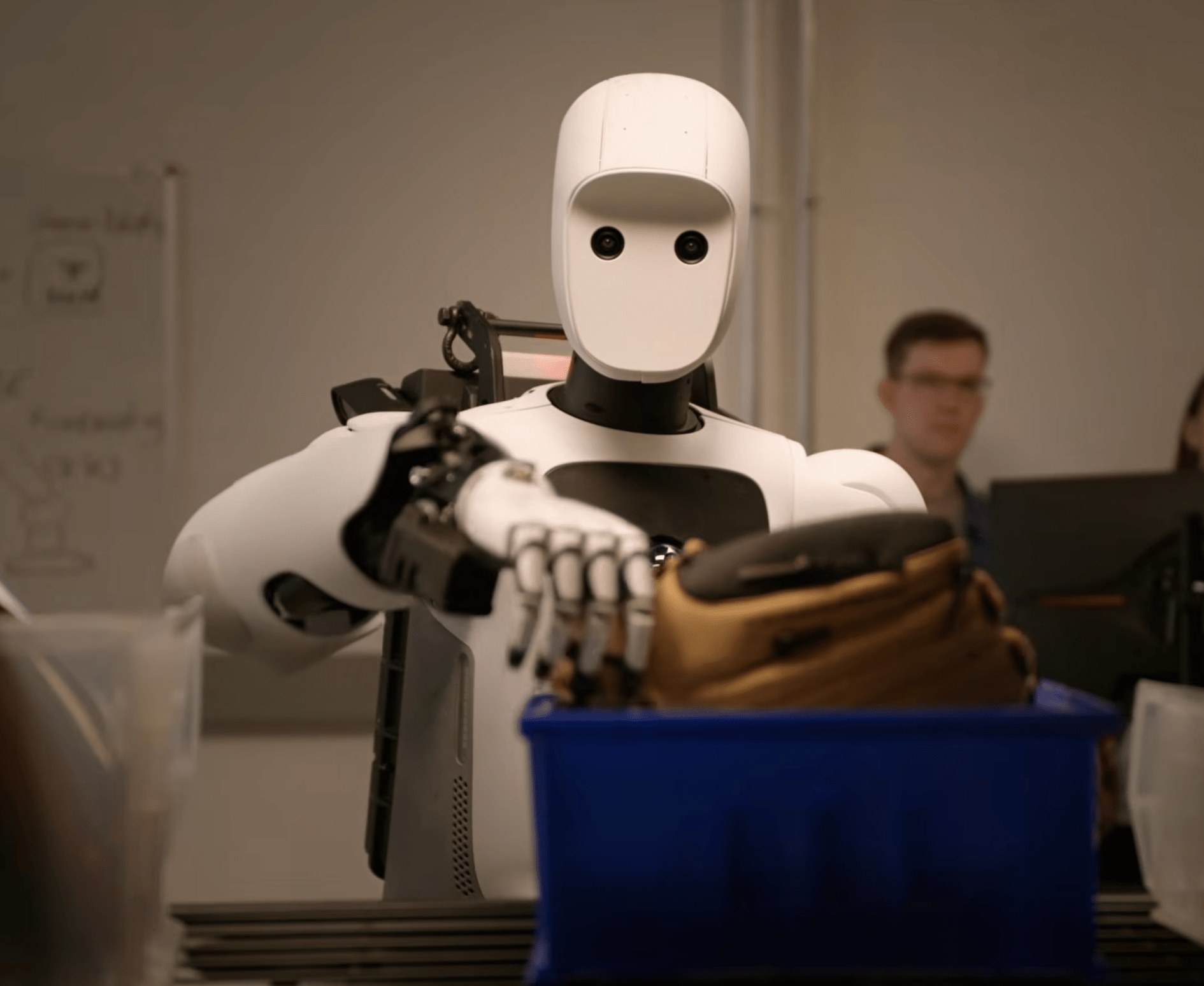
Google DeepMind is rolling out Gemini Robotics 2, effectively signing the death warrant for traditional, fragmented control systems. Developers have finally committed to a unified architecture that takes command of a humanoid’s entire body—from its feet to its fingertips.
Key points
The shift to an end-to-end architecture replaces disjointed software stacks with a single neural network. The Apptronik Apollo 2 robot has gained fluid movement and the ability to perform complex tasks like tying trash bags. Integrating high-level logic with motor control allows machines to coordinate actions with one another. Local model execution (On-Device) eliminates latency and dependence on cloud infrastructure.
Where the industry previously struggled to bridge the gap between navigation and manipulation using disparate software stacks, everything is now consolidated into one neural network. In practice, this transforms the Apptronik Apollo 2 from a jerky manipulator into a fully autonomous agent capable of transitioning smoothly from walking to squatting and performing precision work with five-fingered hands. Tying a trash bag or unscrewing a lightbulb—tasks that once required hard-coded workarounds—are now handled within a generalized motor control framework.
Strategic context
The technical breakthrough lies in integrating Gemini’s high-level planning with real-time, low-level motor response. Additionally, DeepMind has updated its embodied reasoning model, Gemini Robotics ER 2. Now, the robot doesn’t just execute a command; it understands the context and timing of multi-step instructions.
This synergy at the logic level removes the need to script every step of an interaction: Apollo 2 can independently coordinate tasks with other robots on-site.
Of course, switching to end-to-end control doesn't just eliminate redundant code; it also means planning errors translate directly into physical movement. If the neural network hallucinations occur in spatial reasoning, the robot could simply plow into an obstacle. To prevent Apollo 2 from becoming an unguided projectile, DeepMind implemented a safety system that forcibly halts the machine if a human is detected in dangerous proximity. Crucially, this all runs locally as an On-Device Model. For industrial applications, relying on the cloud and internet latency to manage a multi-ton piece of hardware is an unaffordable luxury.
The bottom line
This radical simplification of the development stack finally allows engineers to focus on objectives rather than patching incompatible libraries. While movement speeds are still far from human-like, merging reasoning and motors into a single framework moves robots out of sterile labs and into the chaos of the real world. With the ability to run local inference on consumer-grade hardware and adapt to various sensors, Gemini Robotics 2 is the first credible contender for the title of an operating system for autonomous hardware, where control is no longer a collection of disconnected scripts.