AI · This text was generated with artificial intelligence
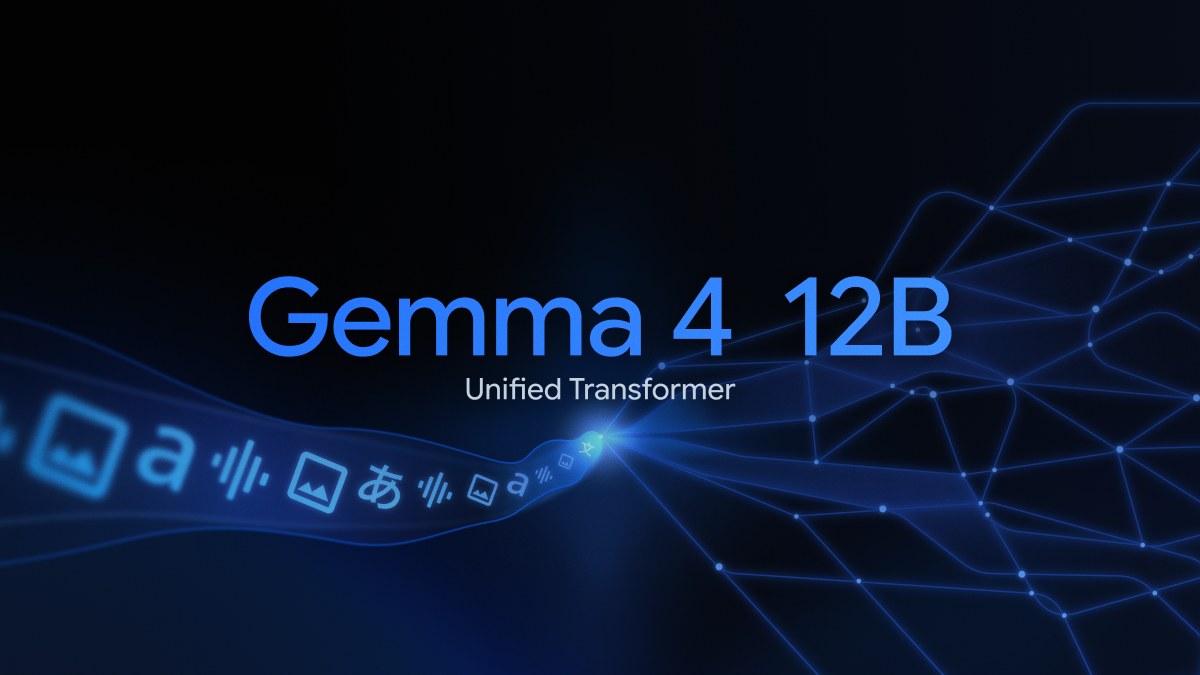
The era of multimodal 'Frankenstein's monsters'—stitched together from disparate visual and audio encoders—has officially come to an end. The traditional approach, where every signal type is first translated by an encoder 'interpreter' before being fed into a language core, has always been the primary performance killer for local devices. With the release of Gemma 4 12B, Google is cutting out the middleman: a unified, encoder-free architecture allows visual and audio data to flow directly into the model’s backbone. This isn't just about saving memory; it’s a radical reduction in latency, without which autonomous agents on laptops remained nothing more than a pipe dream.
Architecture on a Total Diet
Instead of heavyweight structures, engineers have implemented an aggressive streamlining of the pipeline. Vision is now handled by a lightweight embedding module—essentially a single multiplication matrix and normalization. They went even further with audio: the encoder has been excised entirely, with raw signals projected directly into the same feature space as text. This 'technical kung-fu' serves a clear business objective: packing sophisticated reasoning into a 16GB VRAM limit. In Google’s lineup, the 12B model has become the 'Goldilocks' solution between the mobile 4B version and the excessively massive 26B MoE. It fits perfectly into the memory of a high-end corporate laptop without causing the system to choke during inference.
"Gemma 4 12B delivers performance comparable to our 26B MoE while consuming less than half the memory. This transforms multimodal intelligence from a cloud service into a local tool," Google emphasized.
Agents in the Loop: Privacy Without the Lag
The primary value for business here is the shift from cloud-based chats to local autonomous systems. Thanks to Multi-Token Prediction (MTP) support, generation speeds allow for the creation of voice assistants and document analyzers that don't 'freeze' while waiting for a server response. The entire workflow—from processing calls to parsing confidential PDFs—remains within the company perimeter. This resolves data security concerns and eliminates dependence on internet connectivity, which invariably fails at the most critical moments.
Market Landscape and Real-World Hardware
Amidst the expansion of small models from Meta and specialized solutions from Mistral or Apple, Google is betting on accessibility. An Apache 2.0 license and native support in LM Studio and Ollama lower the entry barrier to zero. More importantly, the architectural unity allows a prototype built locally to scale seamlessly into enterprise solutions without rewriting code for new APIs.
The future of corporate AI clearly lies not in a race for trillions of parameters, but in the architectural audacity that allows complex systems to run on standard hardware. By unifying audio, video, and text in a single space, Google makes private, fast, and intelligent agents a commercial reality today. The 12B model is the new benchmark for any business planning to move multimodal processes from the cloud to their employees' desks.