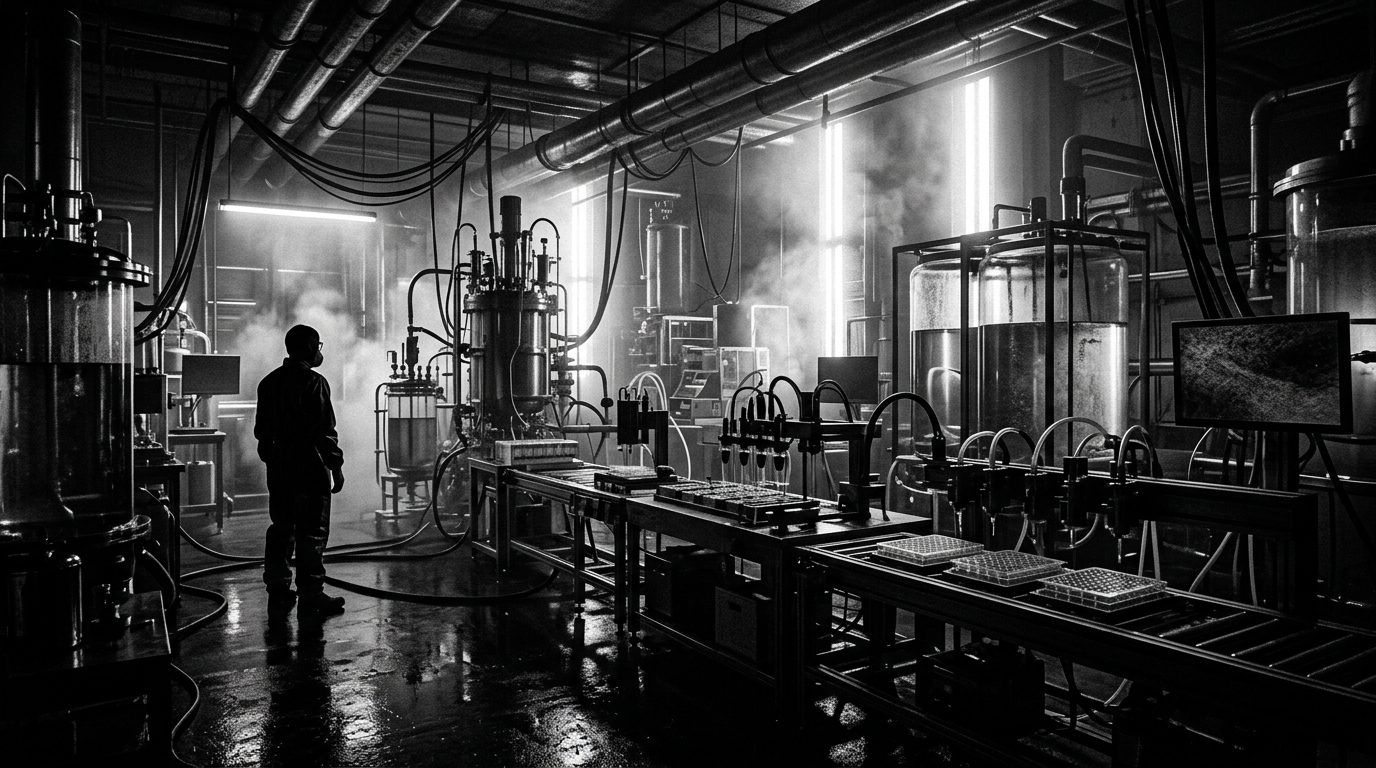
Frontier AI systems operate within vast combinatorial spaces where a single 100-amino-acid protein spans at least $20^{100}$ possible sequences, creating a severe bottleneck when bridging high-level computational reasoning with physical laboratory experiments. As Google research scientists Pooja Rao and Annalisa Pawlosky, alongside software engineer Petar Sirkovic, reported, overcoming this friction requires moving AI agents out of pure digital environments and grounding them directly in physical lab robotics.
Realizing closed-loop molecular discovery requires solving two intertwined challenges because frontier models still do not reason reliably about three-dimensional geometry and physical state while real-world wet-lab experiments have not kept pace. To connect agent reasoning with physical reality, Google Research introduced the VERified Infrastructure for Discovery Laboratories framework, serving as a semantic digital twin of the laboratory workcell as a live, stateful three-dimensional volumetric entity tree.
Built on top of the open-source PyLabRobot framework, VERID provides four core capabilities including live three-dimensional state tracking, fast virtual dry runs, hardware safety checks, and synchronized video and action logs. These functions allow agents to check deck layout, well volumes, and available tips before acting, while simulating protocols in seconds to catch collisions or empty wells before touching reagents. It reads as a practical shift from hand-waving digital speculation to rigorous, error-checked physical execution.
During closed-loop self-play campaigns, agents iteratively designed and ran robot experiments to reconstruct blinded dye mixtures from overhead camera images, improving accuracy more than fivefold. In aptamer sandbox projects where protein-binding DNA aptamers prototype the lab in a closed loop, complete design-test-analyze cycles take just 7 to 10 days because DNA can be chemically synthesized in pooled libraries and read out directly by sequencing.
Across three rounds on two protein targets with varying difficulty levels, AI-driven rational and de novo design raised confirmed on-target hit rates to 33.5% for myoglobin and 42.1% for $\alpha$-thrombin. On $\alpha$-thrombin, Round 1 yielded 0% binders because fixed primer overhangs disrupted folding in 48% of sequences, illustrating the necessity of empirical feedback over purely in-silico exploration.
When examining the underlying R&D economics, the cost of combinatorial search failures in traditional biotech pipelines has historically crippled capital allocation, with millions wasted on dead-end physical iterations driven by flawed in-silico assumptions. By catching mechanical collisions, pipetting errors, and structural folding flaws in virtual dry runs before touching expensive reagents, frameworks like VERID directly protect profit margins from the catastrophic waste of blind biological screening. For enterprise R&D budgets, this transition from protracted trial-and-error to rapid, closed-loop empirical self-correction translates into significant capital preservation, shortening development cycles and fundamentally restructuring how pharmaceutical and biotech organizations allocate high-risk capital.