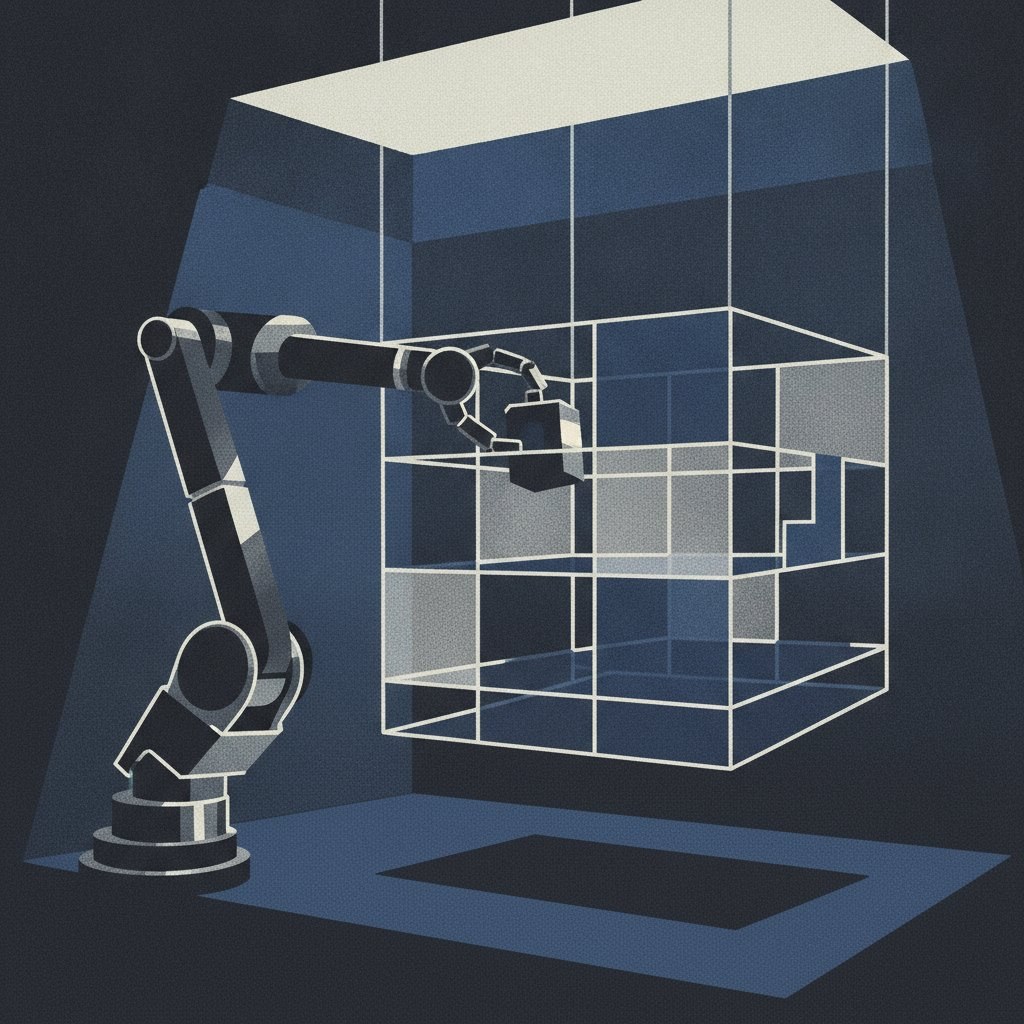
Google DeepMind is once again shifting the goalposts in the artificial intelligence race. While the market remains captivated by neural networks generating cinematic clips, Demis Hassabis’s team has used the Genie 3 release to pivot toward "world models." This represents a fundamental shift: instead of predicting the next pixel in a static video, the system learns to simulate the physical consequences of actions. The result is not just a 720p video, but an interactive environment running at 24 frames per second. This isn't entertainment; it is the infrastructure for an economy of autonomous agents.
The Economics of Synthetic Environments
For business, Genie 3 primarily represents a radical reduction in the cost of failure. Traditionally, training robots or autonomous vehicles required a choice between expensive real-world hardware testing or rigid, hand-coded simulations. DeepMind offers a third way: an automated curriculum where environments are generated via text prompts. Within these worlds, an AI agent can pursue objectives while the world model calculates the future on the fly based on its maneuvers. Effectively, one neural network creates the training grounds for other systems, solving the data scarcity problem for embodied AI.
"World models are a key milestone on the path to AGI, as they allow AI agents to be trained in an unlimited stream of complex simulated environments."
According to DeepMind’s report, real-time interactivity allows for the testing of counterfactual scenarios—the "what if" questions critical for safety. This enables developers to prepare agents for edge cases without risking expensive equipment in the physical world.
Solving the Consistency Problem
The primary technical chasm between video generation and maintaining a stable world is the accumulation of errors. In autoregressive models, inaccuracies quickly turn an image into visual noise. DeepMind claims Genie 3 has cleared this hurdle: the system’s visual memory extends back one minute, maintaining the physical logic of the environment for several minutes. If an agent returns to a location after 60 seconds, the model references the movement trajectory to ensure the scene remains unchanged. The world is generated frame-by-frame, relying solely on descriptions and user input.
"Achieving a high degree of controllability and real-time interactivity required significant technical breakthroughs."
At first glance, a few minutes of stability may seem modest. However, compared to previous iterations of Genie, it is a giant leap. This window is already sufficient for testing complex maneuvers, studying animal behavior in ecosystems, or observing interactions with natural phenomena like water and lighting. The image clarity is secondary to the fact that the model understands intuitive physics well enough to react to user input dozens of times per second.
Google DeepMind is decisively moving away from the "next-token prediction" concept toward the simulation of physical reality. AI is evolving from a creative assistant into a safe laboratory for autonomous systems. For industries tied to automation and logistics, this means the primary bottleneck will soon shift from data collection to the speed at which you can model scenarios to capture the market.