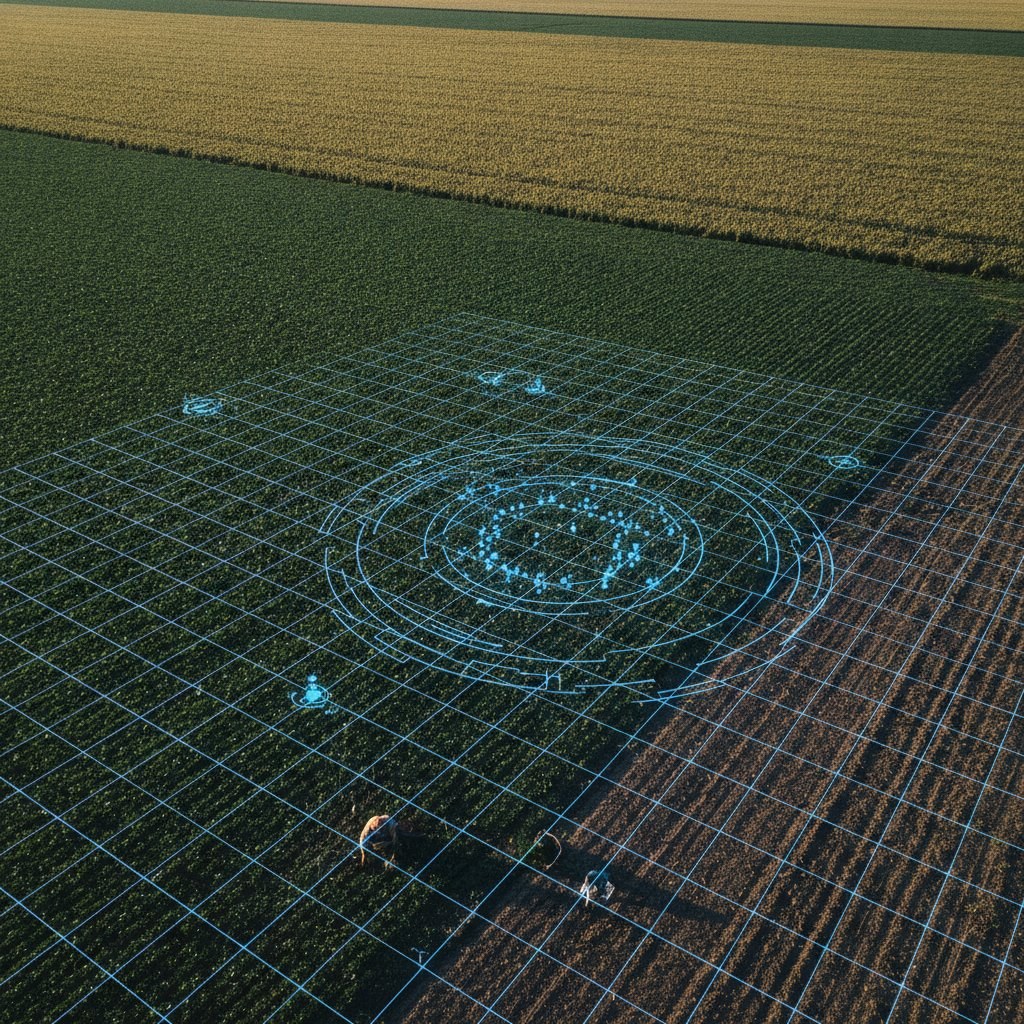
Google Research has finally decided to squint at the planet through a high-resolution deep learning lens, unveiling a framework that detects the 'invisible' ecological features standard satellite monitoring habitually ignores. While legacy systems see agricultural land as a monolith, the new model by Michelangelo Conserva and Charlotte Stanton identifies the granular details of the landscape—hedgerows, copses, and shelterbelts—woven into working farms. This is not just a cosmetic upgrade; it is a shift from blurry raster pixels to a precise vectorized dataset that effectively turns every bush into a line item.
The Google Research team explains that agricultural topologies are notoriously complex, particularly in fragmented regions like the British countryside. By programmatically classifying these fine-scale features, the system enables landowners to build an actionable inventory of ecological assets. On our view, this marks the end of 'coarse estimation' and the beginning of a more cynical, yet necessary, era of precise carbon accounting. For the C-suite and investors, the message is clear: what was once considered 'unproductive' scrubland is now a quantifiable financial instrument.
This technology provides a pragmatic pathway to address carbon sequestration without the traditional 'leakage'—the loss of productivity associated with large-scale land conversion. By identifying woody features that sequester carbon and support biodiversity right in the middle of active fields, companies can integrate conservation without sacrificing food security or yields. It bridges the gap between environmental responsibility and the balance sheet, proving that nature restoration can be a companion to crop production rather than a competitor for space.
If you manage land assets, the era of vague sustainability claims is over. The ability to measure and classify every stone wall and hedgerow throughout the UK means that your carbon units and biodiversity credits are no longer based on hope, but on hard data. We are moving toward a world where 'natural capital' is no longer a buzzword, but a ledger-ready asset that can be tracked, audited, and monetized with the same rigor as a bushel of wheat.