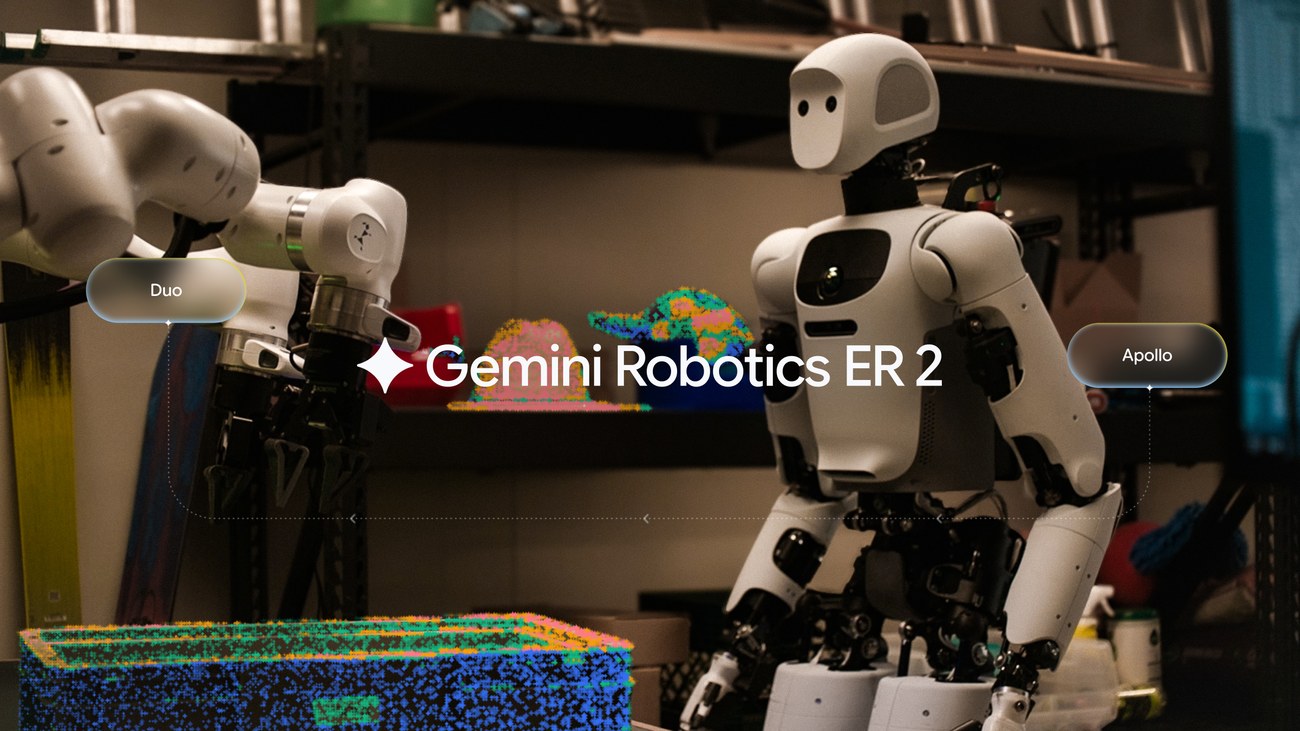
For too long, robotics has been paying a "thinking tax"—those awkward pauses where a machine freezes to process its next move. The release of Gemini Robotics ER 2 (Embodied Reasoning) declares war on this cognitive stupor. The architectural shift here is fundamental: Google has finally conceded that forcing a single model to juggle complex logic while managing motors at a millisecond level is a dead end. Instead, Gemini ER 2 acts as a high-level dispatcher, delegating physical execution to specialized VLA (Vision-Language-Action) models or navigation APIs. For business, this marks the end of hard-coding every gesture. Instead of writing rigid scripts, the industry is moving toward context-based management where the machine understands the physical world and plans multi-step tasks on the fly.
Temporal Intelligence and Video Over Scripts
The primary pain point in industrial automation isn't starting a task; it's knowing when it is actually finished. In Gemini ER 2, video analytics has evolved from analyzing freeze-frames to processing a continuous stream. The model tracks progress in real-time, allowing the robot to course-correct if something goes wrong rather than blindly hitting a wall according to a pre-set script. If a specific stage fails, the system initiates a retry of that step without restarting the entire work cycle. In high-stakes environments like warehouses and service zones, this situational awareness is the only way to avoid chaos.
Global Integration and Fleet Orchestration
Scaling automation no longer hits a wall at the local database. Gemini ER 2 natively accesses external tools, including Google Search, to find solutions for scenarios not covered in its training. In tests with Boston Dynamics' Spot, this looked like a fully interactive loop: the model called navigation and manipulator APIs itself, adapting to incoming data. However, the true potential lies in multi-agent orchestration. The system allows groups of robots to share space and distribute segments of a complex assembly line among themselves.
By integrating with the Gemini Live API and its two-way data streaming, developers have slashed latency to the point where reasoning and action occur almost in sync.
Compared to version ER 1.6, this new iteration shows significantly better results in both simulations and real-world hardware control. For supply chain owners, the signal is clear: it is time to move from rigid programming to an agent-based framework. Developers simply need to define control interfaces as tools and broadcast the video feed directly into the model's "brain." We are witnessing the transformation of robots from programmed tools into full-fledged physical agents. Delegating roles rather than automating tasks provides the exact scale the industry has been missing.
Improved Latency: Two-way streaming enables near-instant reaction times. Contextual Recovery: Robots can retry failed steps without a full system reboot. Tool Use: Native integration with external APIs and Google Search for problem-solving. Multi-Agent Support: Coordinated orchestration for fleets of robots in shared environments.