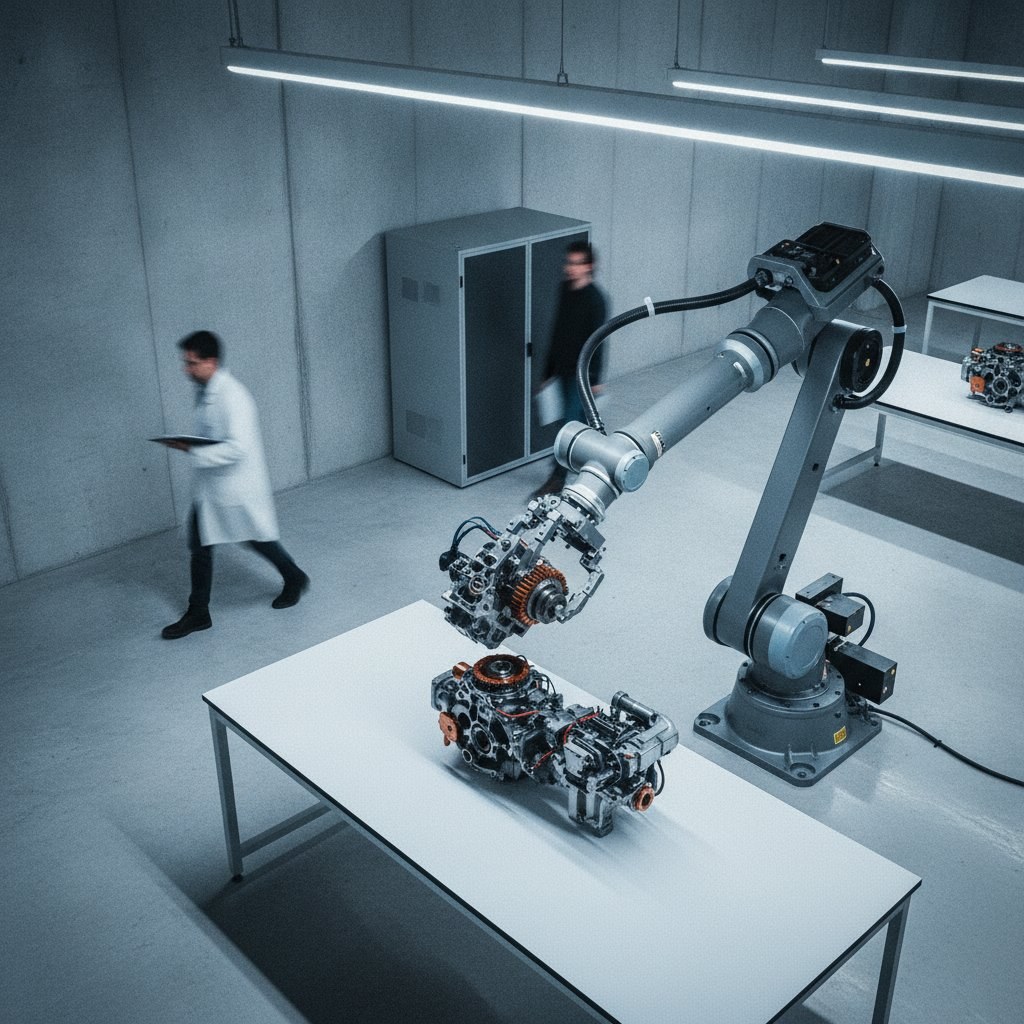
Google has finally acknowledged the obvious: trying to cram high-level planning and motor reflexes into a single neural network box is a recipe for failure. The new Gemini Robotics ER 2 architecture represents a deliberate move away from monolithic models toward a hierarchical structure. While older models would freeze at the slightest change in conditions, ER 2 operates like an efficient manager: it handles the "brain" (reasoning and planning) while delegating the "grunt work" of actuator control to low-level VLA (Vision-Language-Action) models. This approach solves the primary headache in robotics—those awkward "thinking" pauses that turned every movement into a jerky slideshow.
Integration via the Gemini Live API with bidirectional streaming allows the robot to process video feeds without lag. Essentially, Google has provided agents with the fluidity they previously lacked to work safely alongside humans. This is no longer just a reactive machine, but a physical agent capable of anticipating its next move without interrupting its current action.
Solving Latency Through Hierarchical Intelligence
The key differentiator for ER 2 over version 1.6 is its ability to "think on the move." In tests with the Boston Dynamics Spot robot dog, the system demonstrated split cognitive processes: while the legs manage navigation, ER 2 is already planning the use of the robotic arm. This removes the computational barrier where a robot was forced to stop to recalculate its trajectory.
Gemini Robotics ER 2 allows the robot to plan its next step directly while executing the current task.
For developers, this translates to tool access through Google AI Studio and the Gemini Enterprise Agent Platform. Low-level control interfaces are now treated as standard tools (Tool Use). The model can do more than just move hardware; it can call external APIs—for instance, checking Google Search to clarify task context or finding instructions for an unfamiliar object mid-mission.
Temporal Intelligence and Machine Cooperation
Another historical pain point is temporal awareness. Robots often struggle to understand whether an action is complete or exactly when a failure occurred. ER 2 introduces precise progress classification: the system verifies task status in real time and can independently initiate a retry if something goes wrong, without rebooting the entire cycle.
ER 2 consistently outperforms version 1.6 in tool orchestration across all modes: real-world VLA, simulation, and teleoperation.
This efficiency paves the way for multi-robot systems. Instead of programming rigid loops for each device, engineers gain an environment where robots can share space and tasks dynamically. For business, this means a radical reduction in TCO: rather than an army of hyper-specialized machines, warehouses and factories can deploy universal agents capable of adapting to the chaos of the real world.
Google is transforming robots from programmable calculators into proactive agents. Decoupling planning and execution eliminates the computational bottlenecks that previously made AI hardware deployments economically unviable for enterprises. With the ability to use digital tools and work in teams, robots are finally starting to move at the speed of human environments rather than the speed of slow inference.