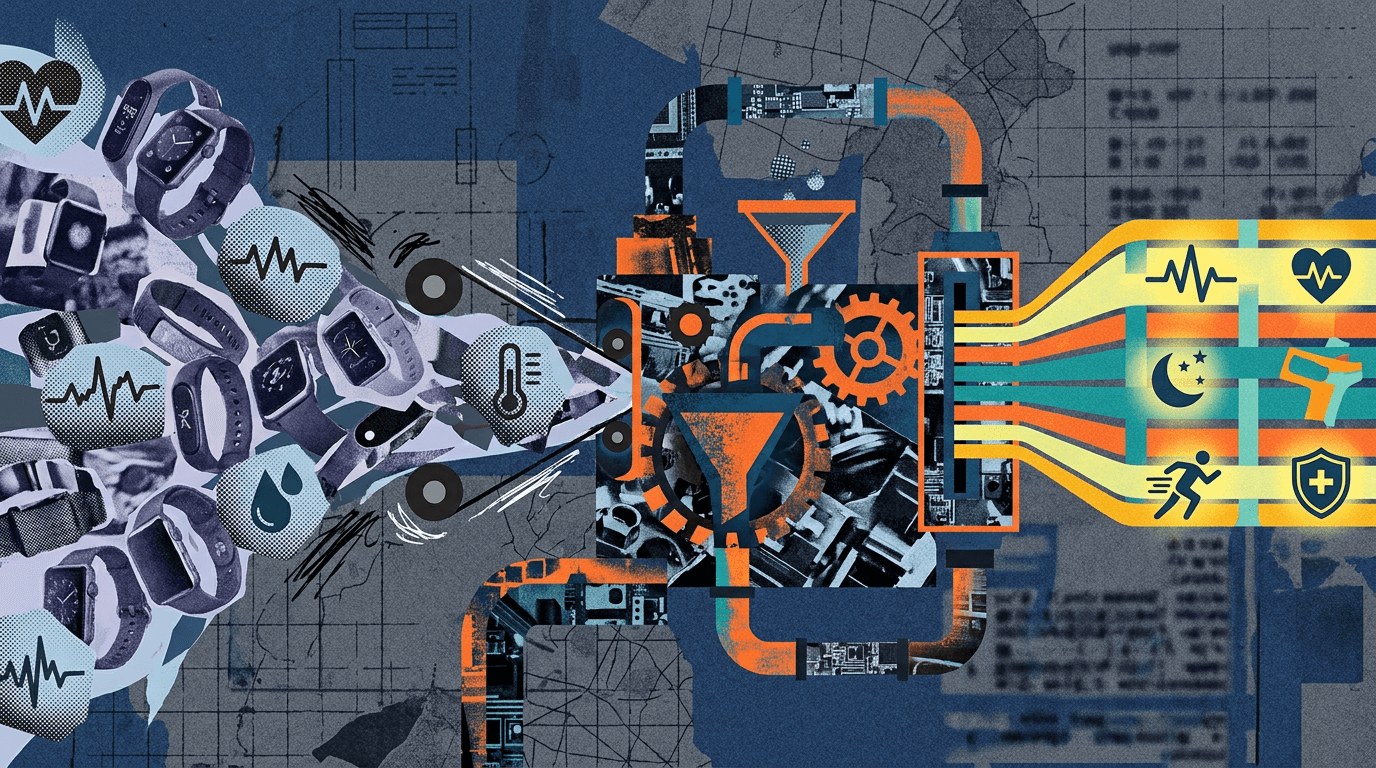
The wearable market has long been plagued by fragmentation: every metric—from sleep cycles to stress levels—required its own isolated model. Google Research is set to end this era of "siloed" analysis with SensorFM. This is more than a software update; it is an ambitious move to create a universal "health intelligence" layer that translates raw, often noisy wrist-based data into the language of clinical diagnostics. By standardizing signals from five million users, Google is effectively transforming biometric noise into an interpretable physiological map.
The Economy of a Trillion Minutes
SensorFM’s primary asset—and its competitive moat—is sheer scale. The model was trained on one trillion minutes of unlabeled, multimodal data from Fitbit and Pixel Watch users. According to Google Research, the dataset spans 100 countries and more than 20 device models. At the technical core of the system lies a self-supervised learning method called Adaptive and Inherited Masking (AIM). This allows the model to "fill in" missing data points, learning to distinguish between genuine signal gaps and hardware interference.
Google discovered a direct correlation: system performance scales proportionally with the combination of data volume and model size. Reaching a peak of 100 million parameters, SensorFM demonstrated phenomenal learning efficiency—it requires minimal labeled examples to master a complex new task. For the business world, the signal is clear: value has definitively shifted from hardware to the foundation model capable of extracting meaning even from imperfect sensors.
The Death of Niche Algorithms
SensorFM is a direct challenge to the industry standard of hand-crafted feature engineering. In benchmarks, Google’s development outperformed specialized models in 34 out of 35 tasks, covering cardiovascular health, metabolic markers, and sleep stages. The system doesn’t just predict known metrics better; it identifies subtle states that were previously beyond the reach of consumer electronics.
SensorFM outperformed supervised baseline models with manual tuning in 34 out of 35 tasks, adapting to new scenarios with minimal labeled data.
Integrating SensorFM into a personal AI assistant revealed that users rate health summaries based on this model significantly higher than standard reports. This paves a direct path toward deep integration with health insurance and hospital systems. If one neural network performs better than 35 narrow algorithms, competitive advantage now depends solely on access to massive physiological datasets. Apple and Samsung find themselves playing catch-up: while they polish their sensors, Google is building the operating system for human biology. The era of selling pedometers is officially over; the battle for the "intellectual layer" of the human body has begun.