AI · This text was generated with artificial intelligence
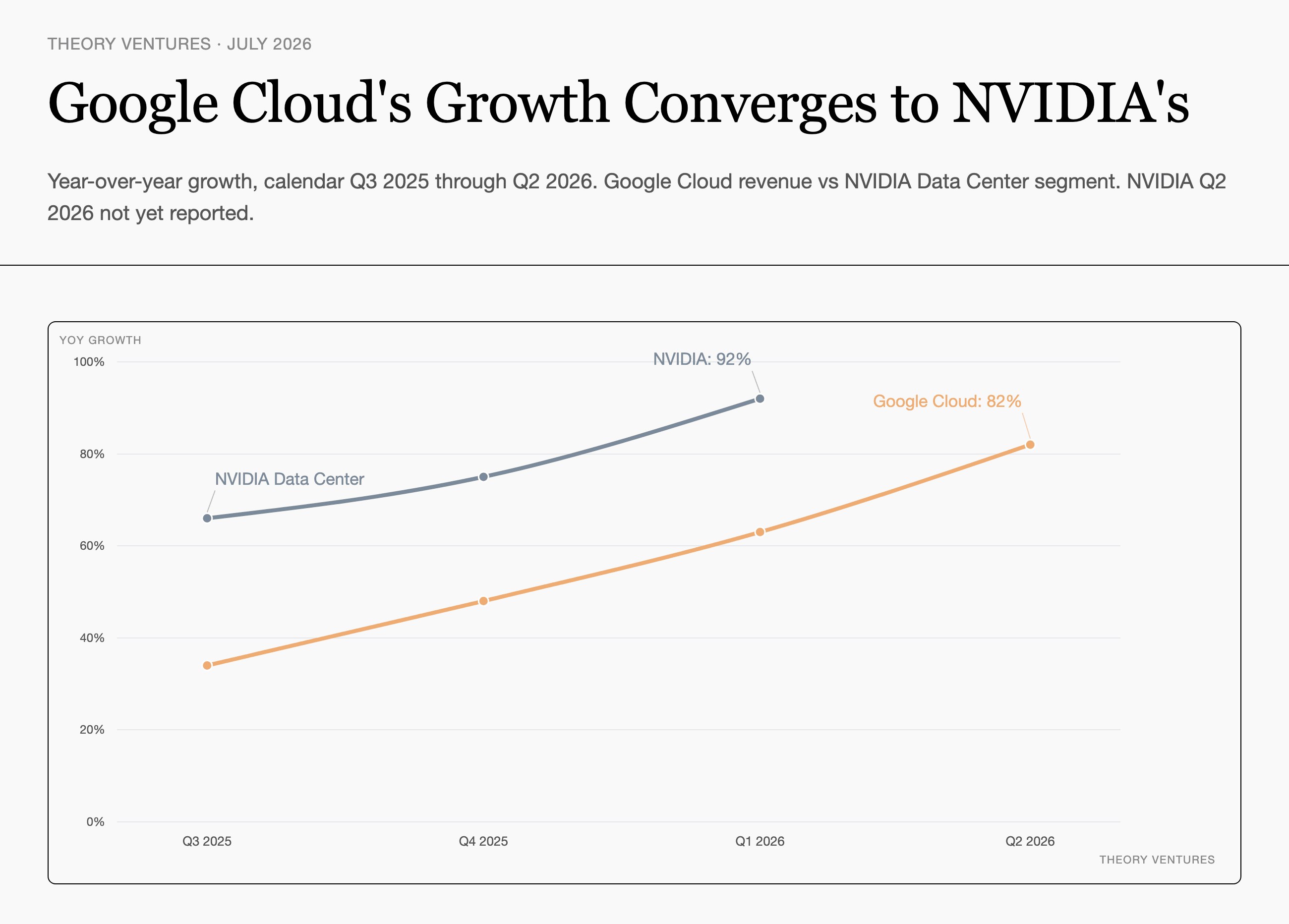
Google Cloud is no longer content being just a virtual machine "landlord." The division is rapidly transforming into a heavy hitter in the hardware industry. In the second quarter of 2026, segment revenue surged by a staggering 82% year-over-year, reaching $24.8 billion and blowing past analyst forecasts of $22.3 billion. This isn't just a recovery of the cloud market; it is a fundamental convergence. Google Cloud’s growth curve now mirrors NVIDIA’s data center charts. The hyperscaler’s health is now directly tied to physical silicon shipments rather than just software subscriptions, effectively ending the era of the classic IaaS (Infrastructure as a Service) model.
Hardware Pivot and Margin Explosion
The most significant revelation from Alphabet’s Q2 2026 financial report is the start of direct hardware monetization. CFO Anat Ashkenazi confirmed that this quarter, Google recognized revenue from sales of TPU (Tensor Processing Unit) systems delivered directly to customer data centers for the first time. While Ashkenazi remains cautious, stating that the financial impact is currently modest and the main profit stream from TPUs will arrive in 2027, the strategic direction is clear. Google is arming its largest clients with proprietary chips for their own on-premise sites, launching a frontal assault on NVIDIA in the commodity silicon market while simultaneously expanding its cloud footprint.
Reading between the lines reveals an even more compelling picture: hardware expansion isn't dragging profitability down; it’s accelerating it. Google Cloud’s operating profit tripled to $8.8 billion, pushing margins to 35.6%. This is a phenomenal leap of nearly 15 percentage points compared to last year. For context, market leader AWS saw its margins dip to 37.7% over the same period. The gap between the two giants, which stood at 19 points a year ago, has narrowed to a statistical margin of error of just 2%.
"Google Cloud and NVIDIA’s data center segment are now moving along the same trajectory: one grows by renting units, the other by selling them," notes analyst Tomasz Tunguz.
Such efficiency suggests that colossal capital expenditures have finally reached a high-utilization phase, where economies of scale offset the R&D costs of proprietary hardware. Google has already upwardly revised its 2026 capex forecast to $195–205 billion, and appetites for 2027 are only expected to grow.
Infrastructure Sovereignty and a Half-Trillion Backlog
The market is seeing front-loaded demand that challenges any talk of an AI "bubble." Google Cloud’s backlog has ballooned to $514 billion—a 385% increase in one year. In a single quarter, the company contracted an additional $50 billion in demand. Given that roughly half of this amount will convert into actual revenue within 24 months, this volume of commitments serves as a massive buffer against market volatility. Total contracted demand across the four largest cloud providers has exceeded $2 trillion, reflecting a desperate scramble in the corporate sector for computational sovereignty.
By shipping TPU systems to third-party data centers, Google is dismantling the monopoly of closed cloud ecosystems. This move transforms the TPU from an internal tool into a global commodity, competing for the same budgets that previously went exclusively to NVIDIA. As global AI infrastructure spending nears the $1 trillion mark next year, the battle is shifting from "whose chatbot is smarter" to "who owns the physical substrate of the intelligence economy." The shift from renting capacity to purchasing proprietary hyperscaler hardware risks creating a fragmented market where enterprise AI stacks could be locked into the silicon bunkers of specific vendors for decades.