Problem 1196, a mathematical riddle posed by Paul Erdős, András Sárközi, and Endre Szemerédi back in 1968, has officially surrendered. The problem regarding the density of primitive sets remained unsolved for 56 years—until GPT-5.4 Pro took it on. The results are a wake-up call for skeptics: the model took just 80 minutes to draft the proof structure and another half-hour to format it in LaTeX. For context, mathematician Jared Duker Lichtman, who ultimately finalized the proof, dedicated seven years of his life to this problem. The contrast between the human research cycle and machine processing time signals a fundamental phase shift in reasoning systems.
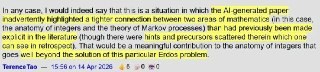
The mechanics behind GPT-5.4 Pro’s success go far beyond simple formula-crunching. As noted by Fields Medalist Terence Tao, the model proposed an unconventional synthesis of knowledge, linking the structure of integers with the theory of Markov processes. While the academic community spent decades stalled by rigid analytical estimates and combinatorics, the algorithm applied a probabilistic approach via Markov chains. Experts are already calling this a 'Book proof'—a term reserved for the highest level of mathematical elegance. The comparison to AlphaGo’s Move 37 against Lee Sedol is more than appropriate: what professionals initially mistake for an error turns out to be a new logical milestone beyond the reach of human intuition.
For the business world, this precedent should end the debate over 'hallucinations' and the unreliability of neural networks in rigorous disciplines. If a model can resolve a fundamental crisis in number theory in 90 minutes, the question of its trustworthiness in fintech architecture or complex operational modeling is settled. We are witnessing the evolution of AI from an advanced 'T9' into an autonomous logical agent. It is now capable of finding optimal paths where classical decision support systems hit a ceiling defined by pre-programmed rules. The era of reserving critical logic for humans in the name of 'non-linear thinking' is over: algorithms now think more non-linearly and more accurately than we do.
Terence Tao’s validation of the proof as a gold standard legitimizes the use of Large Language Models (LLMs) in critical engineering and financial planning. For CEOs and R&D Directors, this is a clear signal to replace rigid analytical frameworks with reasoning models. These systems can optimize business chains with an efficiency no human team of analysts can match—and they do it without the margin for human error.