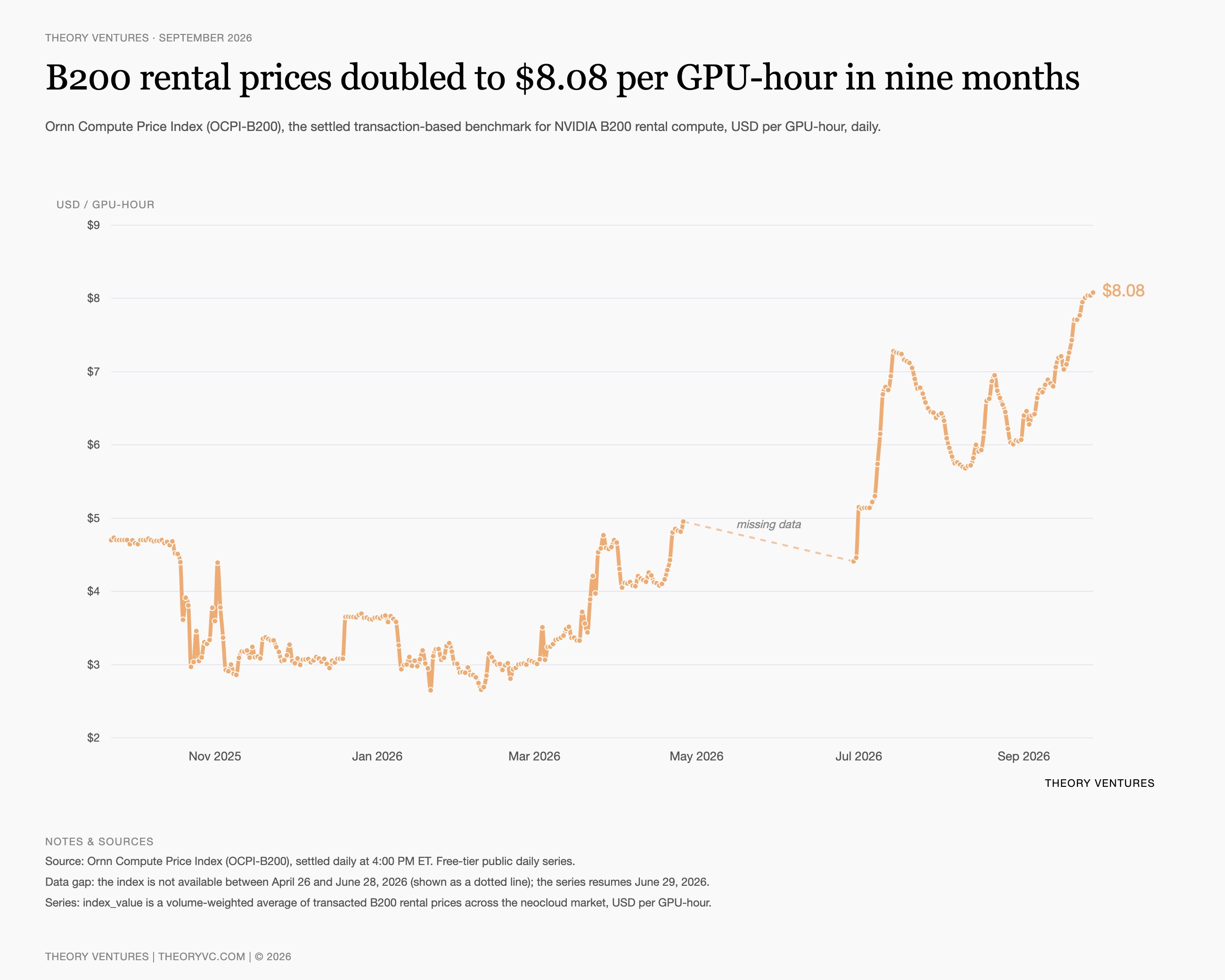
Data center expansion is slamming into stubborn physical and financial walls. Every element of the buildout is bleeding cash, from concrete and copper to financing costs, while electricity remains the ultimate bottleneck. As Tomasz Tunguz points out, raw GPU rental prices doubled in the past six months alone, rocketing from $4.40 to $8.08 per GPU-hour. Physical reality is biting hard. Consider Oracle invoking force majeure on its New Mexico data center campus after the natural-gas pipeline feeding it slipped by six months.
Algorithmic Gains Offset Rising Silicon Prices
Despite skyrocketing hardware expenses, the end-user cost of running models is plunging in the opposite direction. Algorithmic efficiency gains are advancing fast enough to swallow the soaring cost of underlying infrastructure whole.
Efficiency is the hinge that turns scarce silicon into cheap intelligence.
This dynamic is rewriting the unit economics of every major model release. Claude Opus 5.5 costs 40% less to run than its predecessor. Similarly, OpenAI slashed Luna's inference costs by 80% in July, followed by another 50% cut in September. At the macro level, a benchmark task that cost $0.55 eighteen months ago now clears for $0.0015—a staggering 377-fold reduction in price.
Macro Decoupling and Revenue Density
Financial markets are watching this bizarre divergence between physical asset inflation and the collapsing cost of software-delivered intelligence. Historically, the 10-year Treasury was the ultimate predictor of tech valuations, carrying a solid negative correlation of −0.50. Over the last two years, that relationship completely flipped to +0.39, even as interest rates climbed from 3.63% to 5.18% while the NASDAQ surged roughly 78%. Markets are no longer pricing conventional capital costs; they are betting entirely on pure growth math.
Ultimately, the only metric that separates winners from losers is gross profit dollars generated per GPU-hour. According to Microsoft, the company is churning out 90% more tokens per GPU year over year, heavily concentrated in smaller, nimble models. For now, software wizardry and architectural leaps are outpacing raw silicon inflation, but the margin for error is razor-thin.