According to Tomasz Tunguz, over the past two quarters short-term GPU rental rates surged from $5 to more than $13 per hour amid slowing domestic data center construction. Even with these price spikes, demand from model developers and enterprise engineering teams showed no signs of pulling back. The underlying crunch points to a systemic reckoning: how much will enterprise computing cost once US facilities run completely out of spare capacity?
Domestic data centers cannot keep pace with demand, and the deficit in power infrastructure threatens to turn token generation into a scarce resource that forces corporate budgets to rely on imported compute. The physical ceiling on power availability will inevitably override the financial commitments of corporate infrastructure teams, regardless of how much capital companies allocate to compute capacity.
The Efficiency Deficit and Power Walls
Silicon performance improvements are steadily compounding, yet hardware breakthroughs fail to outrun consumption. Enterprise margins face immediate pressure as infrastructure expenditures scale faster than efficiency gains can offset. When power availability hits a hard ceiling at the utility grid, the ability to deploy autonomous systems and scaled AI-agents depends entirely on securing reliable power allocations rather than raw capital.
Tokens per watt compounds about 2.9x a year, blending NVIDIA’s Vera Rubin at 5.4x over GB300, Google’s Ironwood at 2x Trillium & AWS’s Trainium3 at 4x Trainium2.
The math leaves enterprise IT leadership vulnerable because power required in gigawatts directly tracks tokens demanded divided by tokens per watt. Efficiency gains alone cannot resolve that surge when power allocation remains constrained at the utility grid, forcing organizations to re-evaluate their operational expenditure models and deployment timelines.
The Inelastic Toll on Financial Statements
Corporate balance sheets are absorbing these costs rather than scaling back AI deployments. Venture capitalist Tomasz Tunguz reviewed Anthropic's Form S-1/A disclosures, which detailed short-term burst compute surges reaching $12 to $13 per GPU-hour, and the Ornn Compute Index settled at $12.29 per GPU-hour in October 2026. Anthropic signed billions in burst compute at premium rates, and overall demand did not flinch — buyers simply paid the premium.
Can price hikes eventually force enterprise demand to fall low enough to balance existing grid capacity? Scarcity pricing has failed to cool enterprise intake because companies running agentic models and extensive pre-training simply pay the premium. Artificially restricting token production denies baseline economics: at lower production costs, workload volumes would climb exponentially higher. If domestic utilities cannot supply the electricity, companies will source tokens abroad.
Supply Pipeline Failures and Overseas Migration
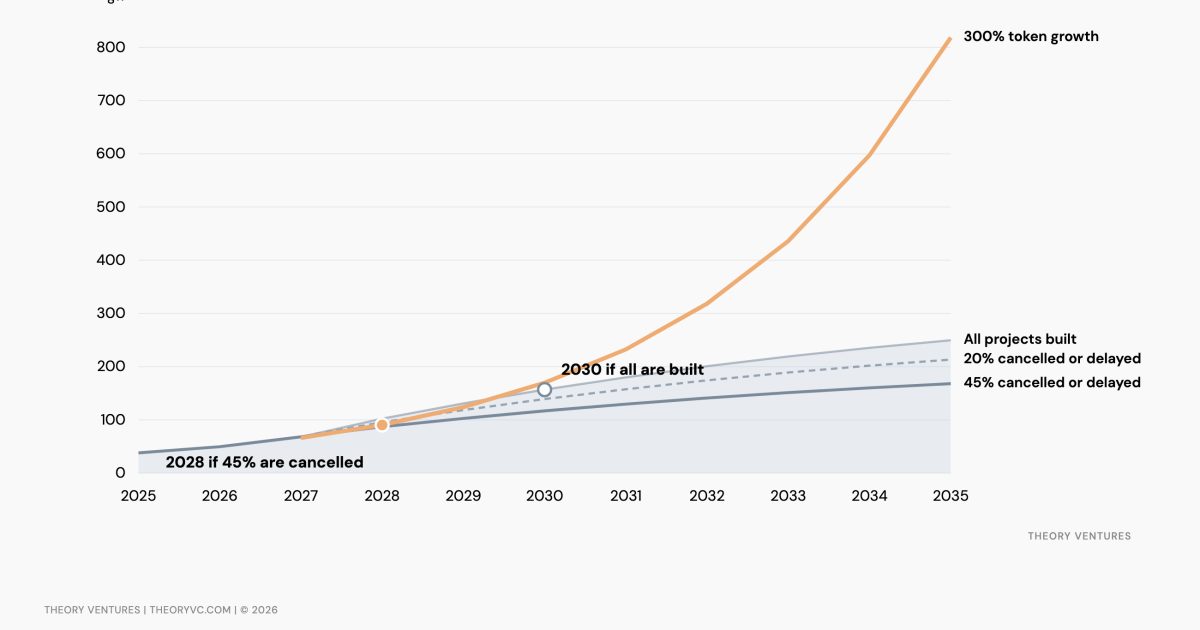
Project execution data confirms that local infrastructure buildouts are failing to arrive in time. Under a scenario where 45% of planned projects fail to connect to the grid, the deficit arrives faster. A basic model indicates that the switch to the United States becoming a net importer of tokens will arrive between 2028 and 2030, depending directly on how many proposed power projects collapse.
Even if every proposed facility gets built on time, the gap still opens by 2030.
If 45% of planned projects fail to connect, token imports will begin by 2028. Cutting cancellations down to 20% merely slips the threshold to 2029, and even if every planned data center is completed without delay, the supply gap opens by 2030. Meanwhile, gas turbines to support behind-the-meter generation remain sold out into 2030, according to findings from GE Vernova and SemiAnalysis.
The economics of moving compute abroad remain favorable. Power represents only 5% of the total cost of a GPU-hour, while capital recovery accounts for 64%. This cost structure explains why overseas hosting remains an attractive alternative for enterprises seeking to bypass domestic grid bottlenecks without sacrificing compute volume.
If domestic grid connection delays hold real capacity completions at 55% while gas turbines remain unavailable through 2030, how will enterprise margins sustain compute imports once the Ornn Compute Index moves well beyond $13 per GPU-hour?
How the picture shifted
Having cash on hand no longer guarantees the deployment of autonomous systems; infrastructure plans run directly into the physical limits of power grids rather than corporate willingness to spend. Infrastructure budgets absorb these shortages as builders commit billions to peak computing contracts without flinching at the premiums.