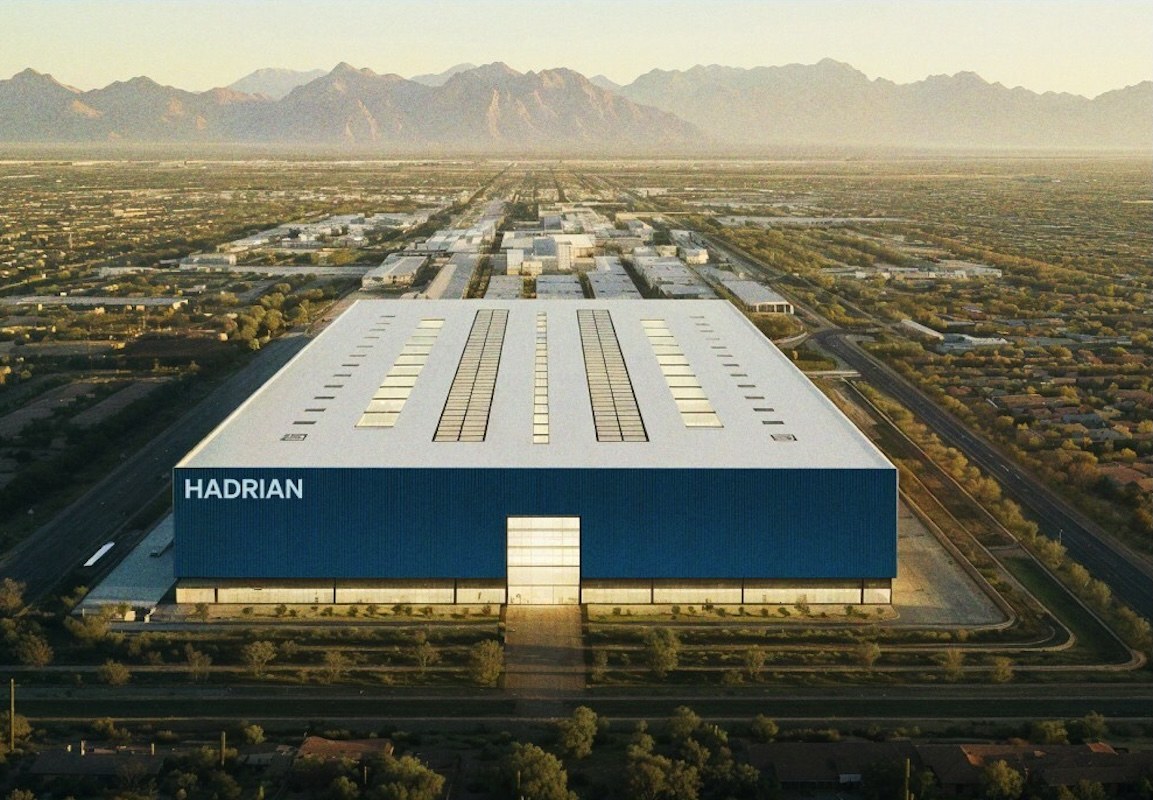
The capital structure of the American defense industry is undergoing a violent correction. Hadrian, the software-defined manufacturing upstart, has just closed a $1.37 billion funding round at a $7.87 billion valuation. This isn't another venture experiment in 'disruptive' apps; it is a massive capital injection into the unglamorous world of physical infrastructure and high-precision machining. With roughly $2 billion raised to date, Hadrian is proving that the private market is finally ready to fund the heavy metal required to fix a broken military-industrial complex.
The Rise of Software-Defined Manufacturing
Hadrian’s strategic genius lies in its restraint. Instead of chasing the hype of AI-powered killer drones, the company targets the unsexy bottleneck: the thousands of high-precision components that hold existing military platforms together. By building automated facilities that mass-produce parts for the vehicles the Pentagon already buys, Hadrian has bypassed the R&D risks of new weaponry. This isn't theoretical. In March, the company opened its fourth facility in Alabama, specifically designed to churn out submarine parts. According to company statements, the public-private partnership for this site alone is valued at $2.4 billion, a clear signal that the state is willing to pay a premium for the speed that legacy giants like Lockheed and Boeing simply can't deliver.
Hadrian is an interesting defense tech in that it’s not trying to build new AI-powered weapons. The company is building automated manufacturing facilities that will mass-produce parts for the vehicles that the military complex already relies on.
This industrial pivot is backed by a coalition of 'old money' and venture risk. The latest round, featuring lead investors like WCM Investment Management and Valor Equity Partners, notably includes institutional heavyweights Morgan Stanley, Apollo, and T. Rowe Price alongside Andreessen Horowitz. When private equity titans like Apollo join a cap table traditionally reserved for Silicon Valley optimists, it confirms that Hadrian’s technical moat—integrating AI agents with heavy machining—is viewed as a systemic asset. For these investors, the play is about industrial sovereignty and the automation of a workforce that no longer exists in sufficient numbers.
Rebuilding the Industrial Moat
The move toward 'reshoring' through automation is Hadrian’s real product. By using software to automate complex machining tasks, the company is effectively commoditizing high-precision manufacturing, turning a craftsman's art into a scalable utility. This transition moves the defense sector away from the bespoke, sluggish production cycles that have left Western stockpiles depleted and toward a model of hardware-as-code. It is an aggressive attempt to replace 20th-century supply chain friction with an automated network that can outpace global adversaries through sheer operational velocity.
Hadrian’s pitch is simple: code can mill steel faster and cheaper than a legacy contractor’s bureaucracy. While the company has secured a multi-billion dollar valuation to prove it, the real test lies in the execution. Building four factories is a start, but bridging the gap between a $2 billion investment and the decade-long backlogs of a global military-industrial complex requires more than just capital. Hadrian has to prove that its software-defined factories can survive the collision with a reality that still measures success in tons of forged steel, not lines of code.