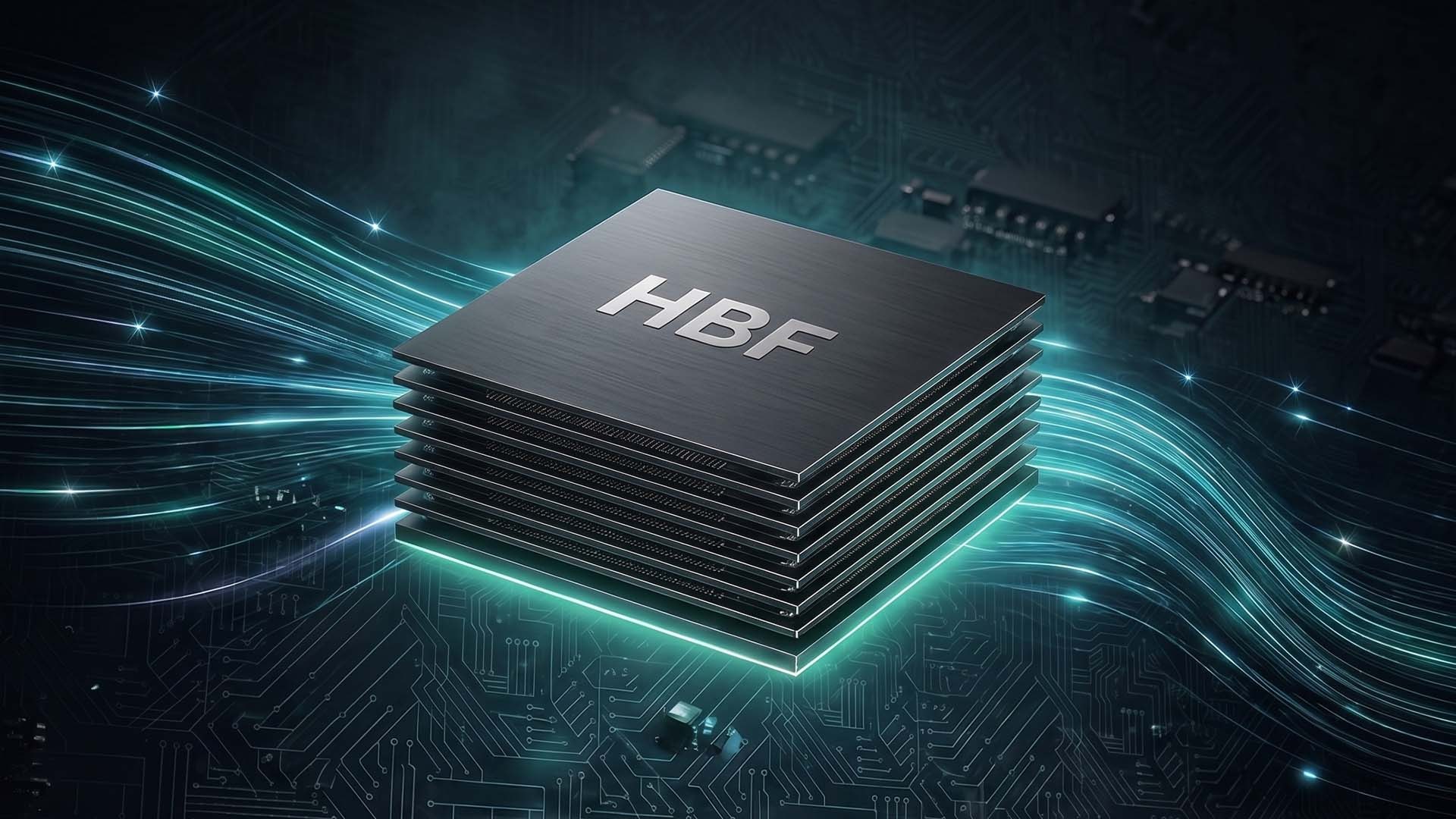
The performance gap between ultra-fast High Bandwidth Memory (HBM) and sluggish enterprise SSDs has long been the industry’s open secret—a bottleneck that turns Large Language Model (LLM) scaling into an expensive exercise in futility. While HBM provides the raw speed, its astronomical cost and physical capacity limits force infrastructure architects into a mindless cycle of GPU expansion just to house model weights. SK hynix and Western Digital (SanDisk) are finally attempting to break this loop by introducing High Bandwidth Flash (HBF). This isn't just another storage tier; it is a strategic architectural layer designed to sit between volatile memory and long-term storage, stacking NAND dies in 8 or 16 layers to create a 512GB reservoir that prevents VRAM exhaustion.
Bridging the Memory-Storage Chasm
The technical mechanics of HBF transform storage from a passive data graveyard into an active participant in the compute cycle. By enabling bandwidth ranging from 0.4TB/s to a staggering 3TB/s, the standard allows for efficient GPU offloading that was previously impossible. This architecture specifically targets the '500-billion parameter problem,' where model weights exceed the economic threshold of HBM. By leveraging dense NAND instead of thirsty DRAM, SK hynix and SanDisk offer a way to process massive models without the linear, bank-breaking increase in high-cost memory modules.
SK hynix “will expand the boundaries between memory and storage and contribute to building new architectures that enhance overall system efficiency,” as Kim Chun-sung, head of solution development at SK hynix, explained.
This shift toward systemic efficiency is underpinned by support for the Universal Chiplet Interconnect Express (UCIe) specification. For a CTO, this is the most critical detail: it allows HBF to interface directly with various CPUs and GPUs, theoretically preventing the vendor lock-in that usually accompanies proprietary interconnects while maintaining the low latency required for real-time inference.
The Economics of Inference Strategy
The strategic alliance between SK hynix and SanDisk is a transparent land grab—an attempt to establish a market standard before dominant hardware titans like NVIDIA can monopolize the entire stack. While Samsung chases its own trajectory with CMX solutions and 500-layer NAND ambitions, the HBF standard focuses on immediate, pragmatic integration through established chiplet protocols. For the business side, this translates to a direct reduction in the Total Cost of Ownership (TCO) for inference infrastructure. Instead of purchasing more AI accelerators simply to gain HBM capacity, organizations can optimize their memory hierarchy, keeping critical data in HBM while utilizing the high-speed HBF pipe for the rest. If this standard takes hold, the era of buying GPUs just to use them as expensive RAM sticks might finally be over.