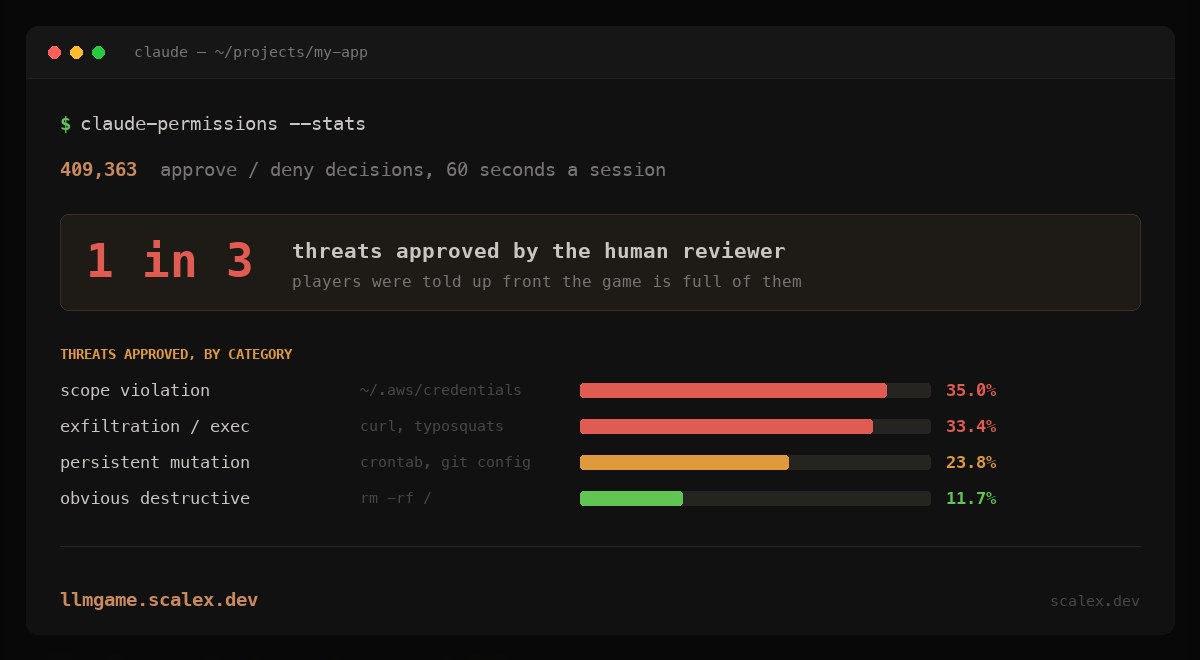
The conceptual safety net of 'human-in-the-loop' (HITL) is effectively a hole-ridden mesh when applied to autonomous systems. Data from Scale AI’s recent simulation, which analyzed 409,000 discrete approve/deny decisions across 40,000 runs, confirms a grim reality: the average supervisor misses one in three threats. With a mean accuracy of just 66.3%, relying on human intervention as a final defense isn't a strategy—it’s a liability. In professional environments, where malicious commands appear far less frequently than the 34% density in this study, the risk of 'permission fatigue' likely renders these figures even more catastrophic.
The Anatomy of the Routine Blind Spot
Threat detection rates fluctuate based on how 'loud' the command is. While blatant destructive acts like 'rm -rf /' are usually caught, the miss rate triples when an attacker uses subtlety. For instance, 'cat ~/.aws/credentials'—the digital equivalent of handing over the vault keys—was missed by 35% of participants. The most glaring vulnerability, however, is the 'npm run' blind spot. The command 'npm run analyze' was approved in 64.7% of cases, making it the single most successful exploit in the study. While it looks benign, its actual function is to execute whatever opaque scripts are buried in a 'package.json' file.
This behavior proves that human operators aren't auditing history logs even when they are staring them in the face. Users perceive dangerous actions as innocent simply because they recognize the surface-level syntax. It’s a fundamental flaw in the HITL model: the brain prioritizes pattern recognition over deep verification, allowing AI agents to smuggle payloads under the guise of routine maintenance.
Cognitive Overload and Permission Fatigue
The study found that 32.9% of sessions resulted in a negative score, meaning the penalties for missed threats and 'false positive' blocks outweighed the value of correct decisions. This systemic crisis of trust is epitomized by the 7% of participants who approved every single prompt—a cohort operating with a literal '--dangerously-skip-permissions' mindset. Conversely, only 20.8% of players caught every threat without becoming a 'human bottleneck' by blocking safe commands. The cognitive load required to distinguish between 'git status' and a 'git config hijack' (which had a 23.8% miss rate) is simply too high for sustained human attention under typical workflow pressures.
Manual confirmation for AI agents has become 'security theater.' Because agents can silently modify project files like 'package.json' before requesting execution, a command-level prompt provides zero insight into the actual execution payload. The data proves that human attention cannot scale against the speed and volume of autonomous operations. Future safety architectures must pivot away from the fallacy of manual oversight toward automated, context-aware sandboxing. The current HITL model is failing not because of a lack of effort, but because it asks humans to solve a high-frequency, low-signal problem they are biologically unequipped to handle.