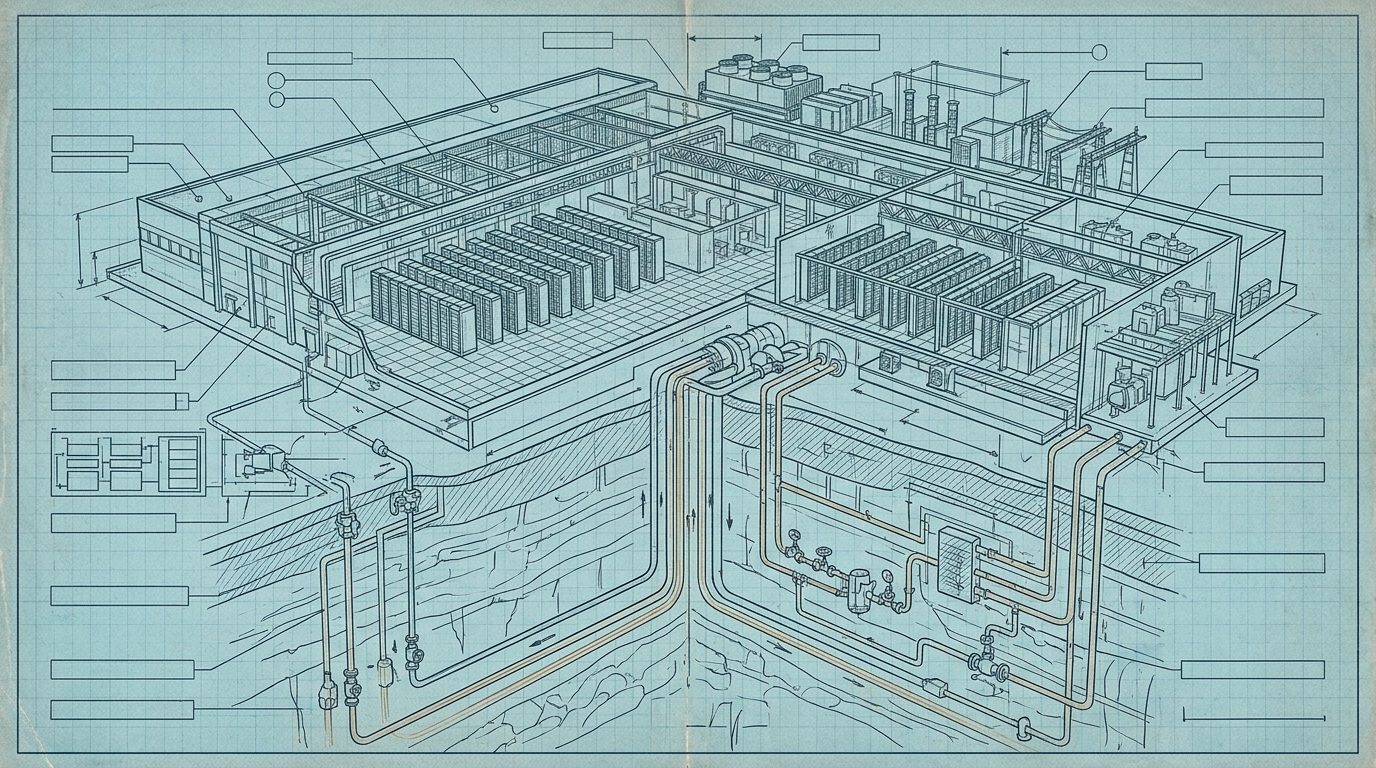
Enhanced geothermal had its public debut when Fervo Energy went public earlier this year, but tech giants are now advancing past shallow reservoirs directly toward super-hot subterranean rock. The shift targets an untapped physical baseline: the U.S. holds up to 57 terawatts of geothermal generating capacity, which is more than enough to satisfy the electrical demand projected for incoming AI data center buildouts. Traditional grid connections face mounting capacity bottlenecks, pushing infrastructure buyers to seek high-density baseload power directly at depth.
Hyperscalers are allocating capital to super-deep geothermal to secure round-the-clock power supplies independent of congested utility networks. Under the extreme temperatures and pressures found miles beneath the surface, ordinary water transforms into a supercritical fluid that carries massive volumes of energy. Tapping these conditions enables a single super-hot rock well to generate 15 megawatts of electricity or more, fundamentally altering the economics of generation.
Commercial Commitments Shift Below Ground
Google signaled the transition of this engineering concept into standard procurement by contracting for utility-scale output. The company agreed to pay more than $500 million to secure 50 megawatts of power from a Quaise Energy project in central Oregon that will harvest heat three miles underground.
Google said it would pay more than $500 million to secure 50 megawatts of power from a Quaise project in central Oregon, which will tap into searing heat three miles deep.
This commercial agreement establishes that tech buyers are willing to absorb upfront cost premiums to lock in specialized suppliers early, reflecting the playbook Google used when it backed and bought power from Fervo Energy. How do developers plan to reach these thermal reservoirs without destroying standard drilling hardware?
They are replacing mechanical components with radiation sources and novel thermodynamic cycles. Drilling accounts for roughly a quarter to a third of a geothermal power plant's aggregate project costs, and standard metallic drill bits wear out rapidly under deep thermal stress. Quaise Energy, which has raised more than $270 million from investors including Prelude Ventures, Collaborative Fund, Engine Ventures, and angel investor Vinod Khosla, addresses this limit through high-frequency energy. Starting around 2.5 miles down, Quaise Energy swaps standard drill bits for gyrotron-driven systems that vaporize crystalline formations into ash using millimeter-wave radiation.
The Thermodynamic Solutions to Tool Failure
Mazama Energy has taken an alternative engineering route focused on cooling down existing mechanical tooling rather than vaporizing bedrock. The startup, backed by $171 million from Khosla Ventures, Doerr Capital, and Bill Gates, introduced Carbon Chill, a system that replaces water-based drilling mud with liquid carbon dioxide.
At those depths and temperatures, the carbon dioxide turns supercritical, allowing it to hold significant amounts of energy.
Above the bit, the carbon dioxide flows through a rocket-style nozzle where sudden expansion rapidly cools the gas, enabling it to absorb intense heat, preserve the steel assemblies, and bring drill cuttings back to surface filtration systems. As with any unproven industrial process, technical risks remain that these drilling methods will fail to deliver commercial operating margins. Yet performance metrics indicate tangible drilling velocity gains: Mazama Energy drilled its second well 80% faster than its first, and its carbon dioxide cooling system reduced drilling duration by an additional 20%, as co-founder and CEO Sriram Vasantharajan stated to TechCrunch.
Federal backing has broadened alongside private venture rounds. Last week, the Department of Energy awarded a grant to XGS Energy to develop materials, well designs, and models that ensure mechanical durability in super-hot rock environments.
The success of such projects will show how realistic geothermal startups' ambitions are to power the next wave of data center construction.
What came before
Where hyperscalers previously relied on shallow geothermal projects for data centers, they now back deep drilling into super-hot rock to secure 15 megawatts or more from single wells. Severe grid bottlenecks are pushing corporations to fund radical engineering shifts, substituting standard bits with gyrotrons and liquid carbon dioxide cooling. With drilling consuming up to a third of total power plant capital expenditures, mastering these thermal depths determines the entire commercial viability of the approach.