The AI architecture wars have officially shifted from a competition of brute GPU force to cold, ruthless mathematics. While skeptics grumbled about the resource-heavy nature of Transformers and attempted to revive the good old Recurrent Neural Networks (RNNs), the ICLR 2026 conference has finally settled the score. As it turns out, we didn't choose the attention mechanism because it was trendy, but because it is mathematically proven to be the shortest path to the truth.
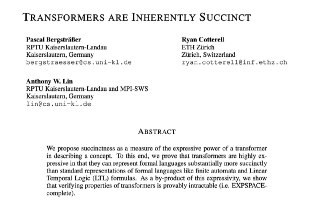
Technion and German researchers’ paper "Transformers are Concise by Nature," which earned Outstanding Paper status, effectively ends the debate. Stripping away the academic jargon, the conclusion is simple: Transformers are exponentially more compact than any classical model or logical formula when describing complex dependencies. Where RNNs or rigid algorithms require miles of code and billions of connections, a Transformer manages with a "few phrases." We pay for this phenomenal conciseness with transparency: the more densely information is packed, the harder it is to turn the "black box" into a clear compliance report. However, for business leaders, the math promises a radical reduction in Total Cost of Ownership (TCO) over the long term. Given the same task complexity, a Transformer will always require fewer parameters than any alternative.
While theorists praise the elegance of these formulas, practitioners from Red Hat AI, ETH Zürich, and Yandex Research are grounding the industry in the reality of cost-cutting. Many expected a "free" performance boost through 4-bit quantization (FP4) heavily promoted by NVIDIA, but marketing slogans have crashed against the reality of model degradation. Research shows that standard FP4 methods perform significantly worse than predicted. The situation is salvaged by the MR-GPTQ algorithm, co-developed by the Yandex team. Developers have learned to adapt compression to the specific quirks of next-generation hardware, bringing accuracy back into line. It is a classic reminder that simply buying the latest chips is not enough—to see real infrastructure savings, you have to rewrite the execution mathematics.
Against this backdrop, Apple’s attempts to jump on the receding RNN train look like a heroic effort to build a supersonic steam locomotive in the age of jet engines. Apple introduced a method to parallelize computations in LSTM and GRU networks, boosting speeds 600-fold and training a 7-billion-parameter model. It is an impressive attempt to salvage legacy investments for the sake of on-device memory savings, but compared to the proven "conciseness" of Transformers, it is merely palliative care.
We are entering a phase of mature skepticism. For CEOs, the signal is clear: any flirtation with alternative architectures for the sake of mythical short-term savings today is heavy technological debt tomorrow. The main barrier remains the gap between theoretical elegance and cloud computing bills. Until methods like MR-GPTQ become industry standards, infrastructure costs will continue to outpace model efficiency. The future lies in integrating these compact architectures with formal verification tools (such as Lean 4), turning the unpredictable "black box" into a reliable instrument for critical business processes.