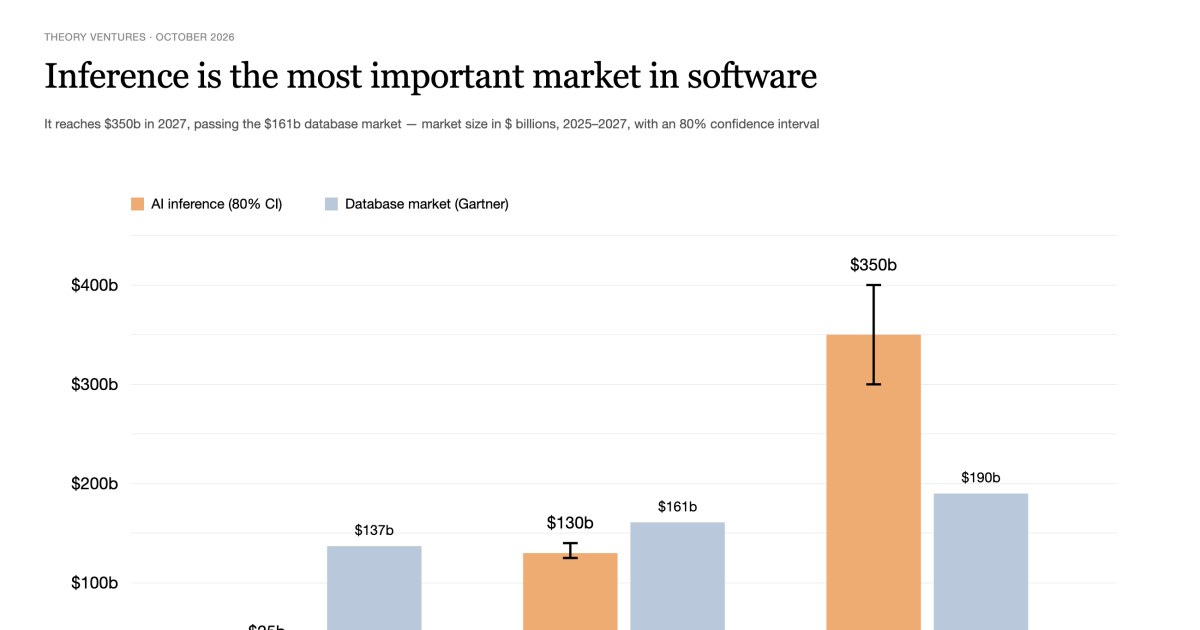
In the mid-2010s, building a startup in the database market with a modest 2% market share practically guaranteed an IPO, anchoring the database as the undisputed king of that software era. That hierarchy is now being ruthlessly rewritten by model execution workloads. As industry data shows, companies paid about $25 billion to run AI models recently, and the market is scaling toward roughly $130 billion this year alone, placing it within striking distance of Gartner's $161 billion forecast for traditional databases.
By 2027, AI inference is projected to hit approximately $350 billion, outpacing databases at $190 billion by nearly two times. This structural transformation effectively mutates every single application into an inference reseller, completely resetting the financial architecture of enterprise software.
The Gross Margin Squeeze
This rapid expansion fundamentally rewires software unit economics, as usage threatens to dwarf platform fees and gross margins compress far below classic SaaS norms. The comfortable blended 72% gross margin of legacy software faces continuous decay unless an application develops a proprietary harness to aggressively compress token overhead, or fierce model competition drives inference costs down faster than limited hardware supply drives prices up.
"Gross margins compress below SaaS norms."
At the same time, enterprise customers who bring their own keys (BYOK) by supplying their own GPU clusters or model API credentials force vendors to trade top-line revenue for gross margin protection. In those setups, software vendors book almost pure software margin, yet they must do so on a vastly smaller contract value. Infrastructure costs have turned into a dominant contributor to overall COGS, routinely swallowing more than half of total revenue.
Volatile Token Tiers
Technical leads cannot rely solely on standard deflationary tech curves to protect their unit margins. While capability-adjusted token costs fall roughly 47% each quarter, list prices for frontier flagships keep resetting upward as capability leaps occur. Over an 18-month span, the frontier blended price rose from $0.96 to $11.25 before new flagship releases reset the tier.
Just as long-haul truckers watch fuel surge and immediately question their route economics, software companies now watch price-per-token metrics and hunt for efficiencies on their rigs using smaller models, better harnesses, and advanced routing techniques. Traditional seat-license software is officially out; compute-arbitrage software is in.