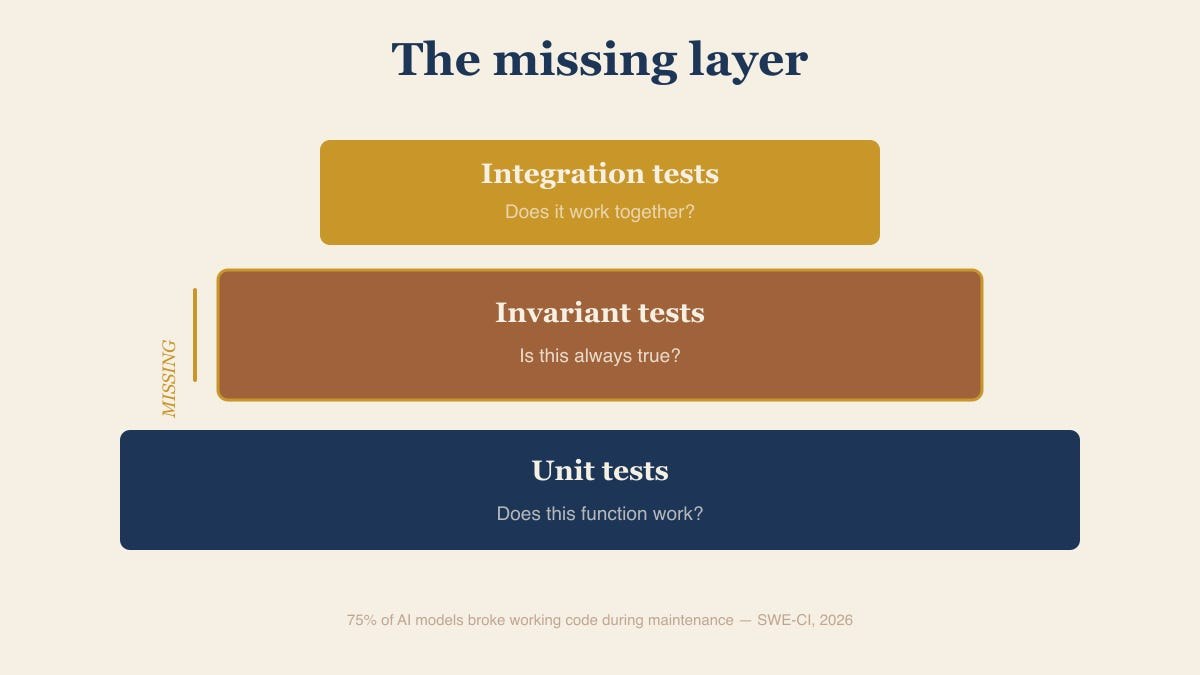
Modern software development has devolved into security theater: unit tests pass, pipelines glow green, yet the customer is hit with double charges. The issue isn't developer laziness, but a flawed methodology. As Brenn Hill points out, standard tests merely verify functional obedience—inputting 'A' to get 'B'. They remain blind to systemic catastrophes like race conditions, where a user's double-click spawns two transactions instead of one.
In an era where code is churned out by neural networks, the absence of invariant testing—verifying system properties that must remain unshakable regardless of input—is a gaping hole in business logic. According to a March study by SWE-CI (arXiv:2603.03823), 75% of tested AI models broke existing code during edits. Only two out of eighteen models surpassed the 0.5 threshold for regression-free performance. Put simply: the AI "fixes" one thing while quietly breaking another.
The Mechanics of Failure
AI-generated code failure is insidious; the code looks locally flawless but violates global rules—such as ordering constraints or idempotency guarantees. An analysis of 470 pull requests by CodeRabbit confirms that neural networks generate 75% more logic errors than humans. These aren't bugs a linter can catch. A payment handler might perform perfectly in isolation, but network latency will cause it to create duplicates. In this context, an invariant test doesn't check the math; it enforces a business commandment: no matter how many times a specific payment ID is received, exactly one record must exist in the database. Frameworks like Hypothesis or fast-check allow you to run thousands of random scenarios, identifying these semantic landmines before they blow your budget.
Standard unit tests confirm what the code *should* do. Invariant tests confirm what the system *must never* do. AI agents require rigid guardrails to prevent "hallucinated" logic in production.
It is time to move from meditating on "code coverage" to the strict enforcement of system invariants. If a CTO cannot provide an invariant map—outlining which operations must never be duplicated and what the post-crash balance must look like—the feature is not ready for release. A 2026 Amazon case study proved that even clean static analysis cannot protect against the destructive interaction of new code with a live environment.
We have built the perfect conveyor belt for scaling losses: a neural network writes code that tests love, but which systematically bankrupts the accounting department.
Without the explicit implementation of invariants, AI agents will continue to produce an illusion of stability. It is the kind of progress we have earned.