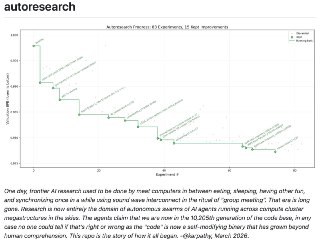
Andrej Karpathy has unveiled Autoresearch, a system that transforms ML research into a closed, autonomous loop. While Big Tech continues to inflate R&D budgets, Karpathy has distilled the core of the training process into a lean 630 lines of code running on a single GPU. The mechanics are stripped of any excess: an AI agent receives its brief in Markdown, then independently modifies Python code, refines architectures, and selects optimizers. The system delivers results every five minutes, using Git commits to log progress only when it achieves a genuine reduction in validation loss.
In effect, Karpathy has eliminated the human factor from the routine aspects of development. Where the innovation cycle once stalled due to biological constraints—food, sleep, and pointless meetings—the process is now seamless and continuous. The agent iterates on hyperparameters without fatigue, shifting the paradigm from artisanal hand-crafting to an industrial-scale "swarm." Here, the pace of progress is limited only by hardware capacity, not by cognitive burnout.
This minimalist approach challenges the traditional corporate R&D model. Tasks that previously required an entire department of specialists and hefty annual bonuses can now be handled by a well-crafted prompt and a single graphics card. Autoresearch proves that the future belongs to agent-first architectures. In this new landscape, the human role is reduced to high-level task setting, while algorithms handle the "grunt work" of code optimization.
For your business, this translates to a radical reduction in Time-to-Market. The democratization of autonomous research tools strips corporations of the monopoly on innovation they once held through sheer headcount. We are entering the era of lean teams that manage thousands of digital "researchers" rather than managing office processes.