AI · This text was generated with artificial intelligence
The Cost of Post-Earthquake Safety Checks
Following the magnitude 5.8 Gyeongju earthquake in 2016, Wolsong Nuclear Power Plant Units 1–4 sat idle for 80 days of testing and manual inspections before regulators cleared a restart. A comparable freeze hit Kumamoto, Japan, where TSMC’s Fab 1 paused operations for phased tool calibration. In industrial infrastructure, actual structural collapse is rarely the primary financial drag; the real hemorrhage is unquantified risk. Lacking instantaneous diagnostic telemetry, operators default to protracted, multi-week shutdowns while legacy simulations chew through compute over several days.
Virtual Sensing Across Complex Structures
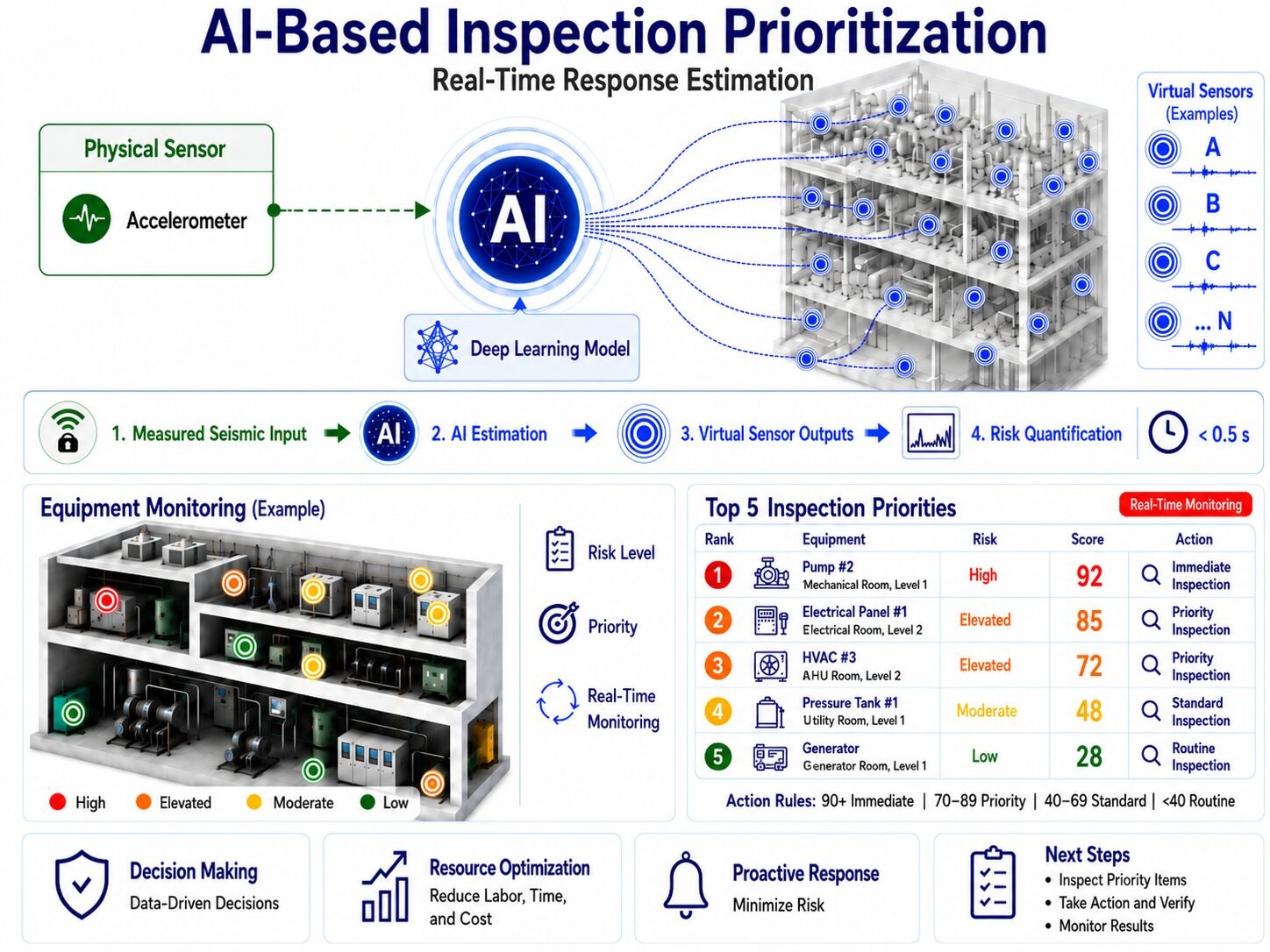
To eliminate blind, facility-wide inspections, the Korea Research Institute of Standards and Science (KRISS) developed a deep learning architecture that reconstructs localized vibration profiles across an entire plant from a single seismometer. Jointly developed by KRISS Senior Research Scientist Dr. Lee Jaebeom, UNIST Professor Lee Young-Joo, and lead author Lee Jingoo—with findings published in Reliability Engineering & System Safety—the virtual sensing pipeline infers real-time physical responses across 139 uninstrumented nodes.
Rather than outputting a binary safety status, the network calculates threshold-exceedance probabilities on a continuous 0% to 100% scale for every monitored point. This converts post-quake triage from an indiscriminate site-wide crawl into a ranked, targeted audit where maintenance crews deploy straight to high-probability anomalies.
Architecture Optimization for Industrial Facilities
Extending this pipeline beyond nuclear facilities to semiconductor fabs and mission-critical data centers hinges on structural calibration. Because deep learning surrogates must mirror the specific resonant frequencies and damping profiles of bespoke buildings, baseline transfer is not plug-and-play; each facility requires dedicated modeling to prevent false-negative classifications in sub-surface structural joints. For operators balancing heavy sensor capex against catastrophic downtime, virtual sensing provides a mathematically rigorous path to compress restart timelines from months to hours.