AI · This text was generated with artificial intelligence
The AI industry has grown accustomed to solving every problem through brute force: if a model lacks intelligence, increase the weights; if it slows down, buy another rack of accelerators. This endless expansion cycle has turned scaling into a mere derivative of budget. Sytse Schelpe of Corbenic AI argues in his latest report that such expenditures are no longer just costs—they are a bottleneck to development. The solution he proposes sounds like a bold system exploit: Byte-Exact KV-State Grafting. This method doesn't touch the model's weights or require expanding your GPU fleet, yet it enables a frozen 12B model to operate more accurately and cost-effectively simultaneously.
The Engineering of Knowledge Grafting
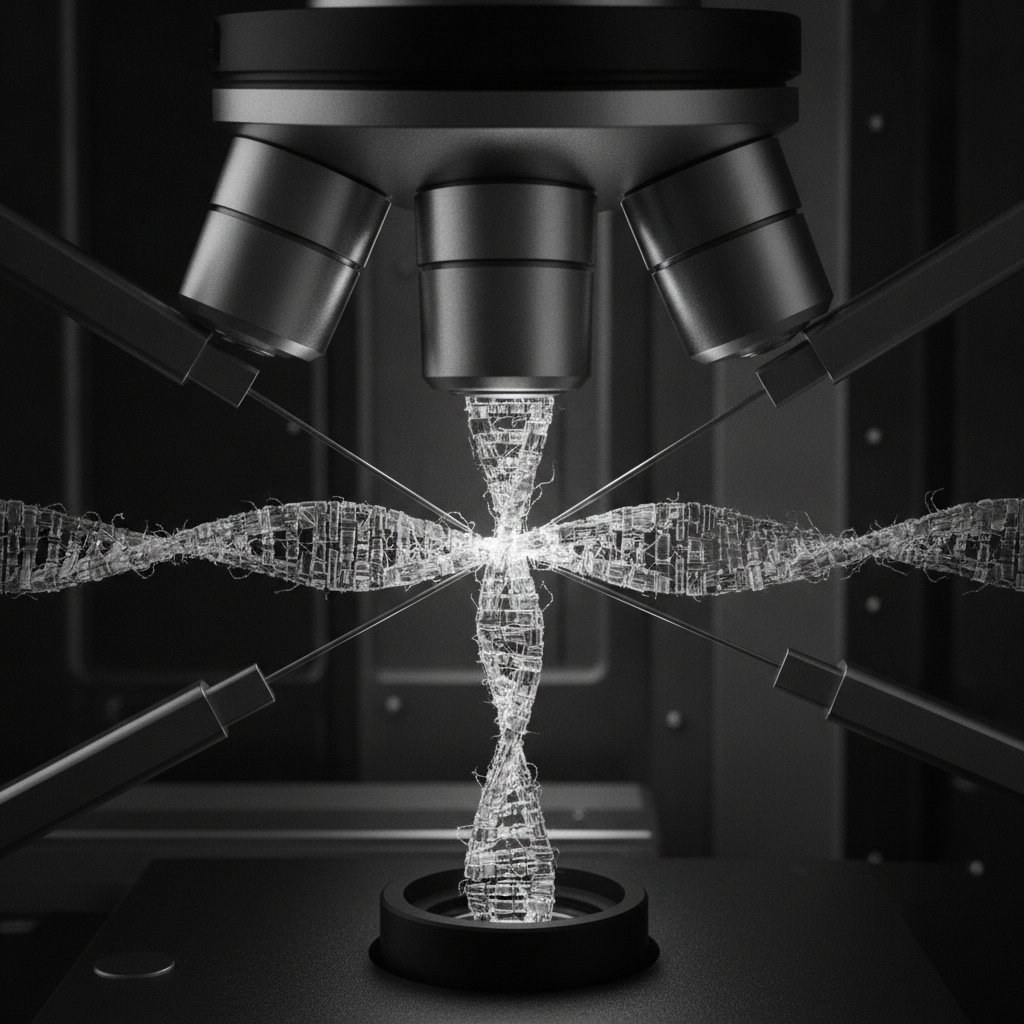
The technical core of this maneuver lies in the fact that a model's internal state—the KV cache—is a deterministic function of its input data and weights. By freezing this state and restoring it later without re-computation, verified knowledge can be "deposited" as a byte-exact artifact and then literally grafted into a new inference context. As Schelpe notes, this transfer does not alter the weights, and the restoration remains bit-for-bit identical to the original. During testing on fifty samples, the logit vector of the "grafted" model showed zero Kullback-Leibler divergence compared to a clean computation. Simply put, the model receives a perfect solution without wasting resources on repeating the logical chain.
Knowledge that required significant resources to compute can be saved once as a byte-exact KV-state artifact and later restored via "grafting" into a new context.
While transferring a data block to a different offset introduces a slight margin of error due to floating-point sensitivity to positioning, restoring it to the same position remains the only point of absolute precision. The report confirms the method’s viability on 12B and 31B models, functioning across consumer-grade hardware and server architectures like Blackwell and Hopper.
Redefining Model Performance and TCO
The economic impact and capability gains are most evident in the AIME 2025 benchmark. A base 12B model in its best self-correction configuration scored 80.0%. After "grafting" a library of verified solutions into it, the result jumped to 93.3%. This exceeds the model’s native specifications (77.5%) and even outperforms the larger 31B parameter version (89.2%). But the real reason for skeptics of GPU-burning to take note is the cost. Where the base model failed even with a 401,026-token sampling limit, the grafted system delivered the correct answer in just 61 decoding tokens.
In repetitive scenarios, the cost of a solution drops dramatically: the token count is reduced by 6,574 times, while energy consumption falls by 3,000–8,700 times.
Beyond accuracy, the repository of byte-exact snapshots expands the effective context window from 32,768 to a massive 2,854,766 tokens—an 87-fold increase. The irony is that this upgrade requires no additional accelerator memory, and the cost of data access does not scale as one dives deeper into the context. In a separate H100 test, a frozen 31B model using this "flywheel" system reached a 97.3% rating, effectively ending the debate on whether massive cloud models are necessary for specific tasks. This represents an efficient path to turning local systems into expert databases that never forget anything once it has been verified.