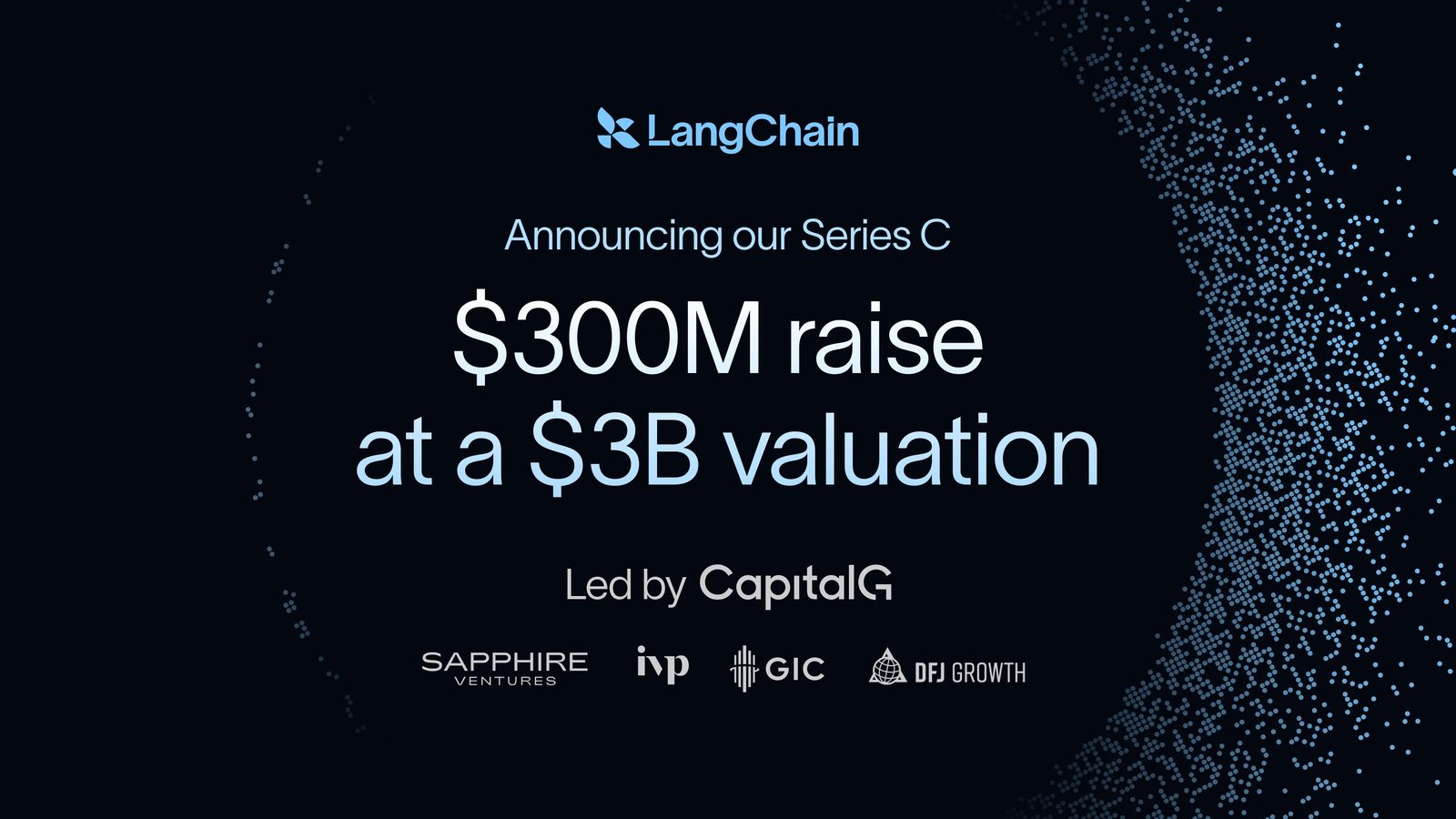
LangChain raised $300M at a $3B valuation in a Series C funding round led by existing investor CapitalG. The round included significant participation from new backers GIC and DFJ Growth, alongside existing investors IVP and Sapphire Ventures. Salesforce Ventures, Insight Venture Partners, QuantumLight, and MongoDB Ventures entered the capitalization table, while early backers Sequoia, Amplify, and Benchmark doubled down on their commitments. The capital injection targets a core corporate dilemma: can an independent orchestration platform defend its margins while foundation model providers push to commoditize execution layers?
The investment underscores that control over software agent orchestration has emerged as a high-stakes layer of enterprise IT budgets. In an announcement signed by Harrison, the team stated that domain-specific agents differentiated by knowledge, data, and user experience will transform the economy, operating both as standalone products and internal operational engines. As enterprise artificial intelligence shifts away from basic prompt interfaces toward autonomous decision-making loops, spending reallocates directly into runtime environments, continuous evaluation systems, and policy enforcement tools.
Enterprise Adoption and Operational Economics
More than 7,000 organizations currently run on LangSmith, spanning enterprise customers such as NVIDIA, Toyota, Salesforce, and Workday alongside startups like Harvey, Rippling, and Listen Labs. Production usage reflects an intensifying operational workload across data pipelines. Clay, for example, utilizes LangSmith to monitor hundreds of millions of agent runs per month, using the resulting performance telemetry to iterate and improve its autonomous software.
"We believe agents will transform the economy. That future will be shaped by domain-specific agents differentiated by their knowledge, data, and UX."
This volume demands infrastructure capable of parsing execution errors and tracking token consumption before expenses spiral. Production agents frequently trigger non-deterministic failure states, execute recursive API calls, or consume context windows inefficiently. By capturing raw traces and telemetry, orchestration software allows engineering leaders to convert operational failures directly into domain-specific evaluation sets and fine-tuning datasets.
Compressing Deployment Timelines
financial return on agent tooling hinges on reducing custom engineering overhead. Workday uses LangSmith to run and govern agents across its organization, reducing the time required to deploy a new agent from five months to under a day. That level of operational compression fundamentally alters project economics, replacing months of ad-hoc internal framework development with standardized infrastructure.
To standardize these processes across disparate architectures, the platform organizes deployment around three operational layers: Agent Runtime, Agent Improvement, and Agent Governance. Runtime architecture provides execution environments via Deep Agents, LangGraph, LangChain, the LangSmith Agent Server, sandboxes, and fully managed services like LangSmith Managed Agents and Fleet. The improvement layer automates observability, evaluation, and fine-tuning, utilizing the LangSmith Engine platform agent to monitor live production traffic, locate bugs, and generate automated code and prompt fixes. Governance controls enterprise exposure through LLM and Tool Gateways, managing model fallback strategies, budgets, tool authentication, and sensitive data access.
"Workday uses LangSmith to run and govern agents across the organization, reducing the time to deploy a new agent from five months to under a day."
Such operational acceleration provides immediate leverage, yet independent infrastructure faces pressure as model providers roll out built-in execution layers. Enterprise customers balance the risk of vendor lock-in against the cost of maintaining separate middleware. LangChain counters this vulnerability by positioning LangSmith as an agnostic governance fabric, leaving organizations free to swap underlying foundation models while maintaining persistent audit logs and budget caps across all integrated systems.
Long-Term Platform Viability
Maintaining a $3B valuation requires LangChain to translate rapid developer uptake into defensible software revenue before ecosystem incumbents absorb standard orchestration features. A special release event scheduled for next Friday, November 20th, will introduce several additional platform capabilities building upon this architecture.
A valuation multiple of this scale relies entirely on platform lock-in. If foundational model vendors reduce agent development to turnkey, zero-cost API capabilities, independent middleware risks being squeezed into a low-margin observability layer. LangChain's survival depends on making cross-model governance and multi-agent coordination so deeply embedded in enterprise infrastructure that replacing it costs more than paying for the software.
What changed
The answer is straightforward: capital is betting that the execution environment matters more than the underlying intelligence. In mid-October, the company demonstrated that deepagents-cli vaulted from 30th to 5th place on Terminal Bench 2.0 without a single modification to gpt-5.2-codex. Now LangSmith monitors hundreds of millions of runs for Clay, building a business out of catching recursive loops and wasted context windows before corporate bills run wild. A multi-billion-dollar platform essentially makes its margin by cleaning up stochastic errors and token waste caused by other people's models.
Our stories: LangChain Agent Middleware: Deeper AI Agent Customization for Business (March 30); Agent Infrastructure Trumps Raw Model Costs in AI Economics (October 14).