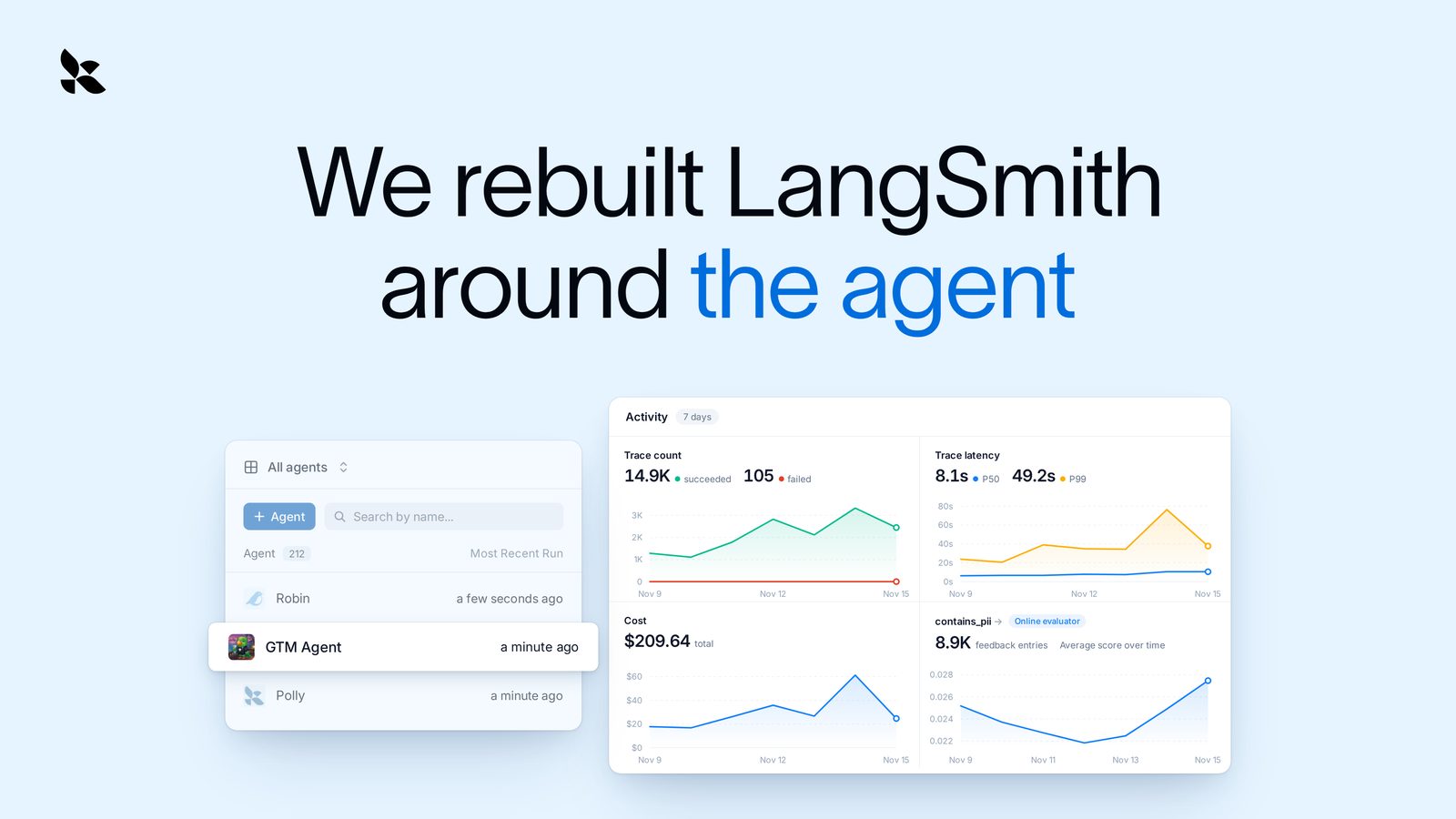
Unaccounted runtime costs and fragmented tooling are forcing enterprise software teams to overhaul how they oversee artificial intelligence systems. Following its Series C announcement, the new LangSmith Agent Platform reorganizes its architecture to treat agents as the primary record across the system, connecting disconnected developer workflows and allowing platform operators to track activity across the business.
Adoption reached an inflection point in 2026 as new harnesses, models, and engineering approaches made it possible to build systems that reliably execute complex, high-value operations. Companies now run multiple agents across separate business units: engineering teams employ coding assistants, product units deploy customer-facing interfaces, and internal groups launch tools for internal productivity. However, these systems operate across fragmented runtimes, disparate frameworks, and varied model providers, leaving leadership without an answer to a central operational question: what does this sprawling web of autonomous software actually cost, and how can an organization centralize oversight without paralyzing operations?
The Governance Deficit
Dispersed development has created critical blind spots for technical leadership. Tracing, monitoring, and deployments traditionally operated across separated environments, forcing engineers to switch contexts and frequently skip essential evaluation steps.
"AI Platform teams have difficulty answering basic governance questions. Which agents exist, and who owns each of them? What do they cost, and how are they performing? When costs spike, there is often no obvious person to ask what happened."
According to the LangChain team, these governance lapses occur because past infrastructure lacked a single point of accountability. Traces historically fed into a flat project hierarchy with no direct link to an individual agent, leaving traces from different execution stages isolated from one another.
This operational model ran into hard limits as usage scaled. While LangGraph Platform reached general availability on August 30, 2026—supporting horizontal scaling alongside 30 specialized API endpoints for state management across more than 400 early enterprise testers including Klarna, Replit, Clay, and LinkedIn—fragmented runtimes continued to generate hidden operating costs. LangSmith Engine was subsequently introduced to automate agent debugging and tracing. Yet engineering teams still faced a governance void whenever individual agents ran up token costs across uncoordinated testing and production environments.
Unified Lifecycle Architecture
The reorganized LangSmith platform addresses this structural rift by binding development, runtime hosting, optimization, and governance directly to an immutable agent record. This single identifier consolidates local, development, staging, and production environments under one profile, allowing engineers to track modifications and compare performance regressions without switching dashboards.
Each registered agent is assigned a named owner, a globally unique identifier, and a distinct functional type. The assigned type governs which telemetry appears in the central view: a general-purpose assistant displays runtime tool usage, activity histories, and operational failures surfaced by Engine, whereas a programming agent surfaces merged pull requests and direct token expenditures. Evaluation rules shift to match these specific functional duties, measuring merged code for programming tools and latency thresholds for customer support.
This framework also accounts for heterogeneous tech stacks. Engineering groups can author tools using the natural language builder in LangSmith Studio, deploy through open-source harnesses, or integrate third-party frameworks. Execution can run directly on LangSmith Agent Server or remain on external infrastructure, routing trace data back to the platform without forcing teams to rewrite operational pipelines.
"LangSmith agent registry and LLM Gateway provide org-level visibility and strict controls over every registered agent."
Through this integrated registry and the LLM Gateway, the system exposes usage patterns across all registered software, providing platform administrators with centralized operational controls.
Integration Hurdles and Infrastructure Limits
Adopting unified oversight introduces operational tradeoffs. Organizations that have already invested in mature internal orchestration pipelines may find little incentive to channel operational traces through LangSmith. While LangChain positions the architecture as composable—allowing teams to retain their custom execution runtimes while routing telemetry into the registry—achieving full lifecycle benefits requires tighter platform adoption. Capabilities such as having LangSmith Engine validate a proposed fix against a preview in LangSmith Agent Server before merging into production rely entirely on native LangSmith components.
Vendors promote agentic automation on promises of self-directed operational leverage, but actual deployments introduce sprawling API overhead and administrative confusion. The shift toward specialized registries and gateway controls exposes that running autonomous agents requires substantial compliance layers, turning what was marketed as hands-off automation into an infrastructure system that demands continuous auditing and centralized management.
What’s behind it
Autonomous software once quietly burned token budgets across disconnected testing environments, but LangSmith now binds all telemetry and hosting to an immutable account profile. The platform aims to corral sprawling developer experiments into strict corporate accounting where every dollar spent points to a specific owner. Tying every bot to a single identifier solves the bookkeeping headache, but rigid runtime governance inevitably creates friction for engineers trying to iterate fast. Will the more than 400 enterprise customers, including Klarna and LinkedIn, maintain their deployment speed once every experimental agent requires central cost accounting?
Our stories: LangSmith Engine: Automating AI Agent Debugging & Traces (September 8).