AI · This text was generated with artificial intelligence
Deploying AI agents to production invariably triggers a trace data avalanche. Engineering teams quickly find themselves burning expensive ML talent on manual log digging just to diagnose where complex workflows fall apart. While straightforward API crashes are easy to spot, silent failures—such as tool-calling infinite loops, corrupted arguments, and latency bottlenecks—remain buried across thousands of asynchronous runs where manual inspection fundamentally fails to scale.
To break this operational bottleneck, LangChain released LangSmith Engine: an autonomous meta-agent designed to sit on top of runtime execution traces, diagnose systemic failure patterns, and generate targeted engineering fixes.
"Engine is an agent that sits on top of your agent traces, spots recurring issues, and suggests what to do next."
LangSmith targets the continuous improvement loop across four operational pillars: build, test, deploy, and monitor. Instead of forcing senior developers into reactive trace triage, the orchestrator automates post-mortem analysis directly against production telemetry.
Orchestrator Architecture and the Sandbox
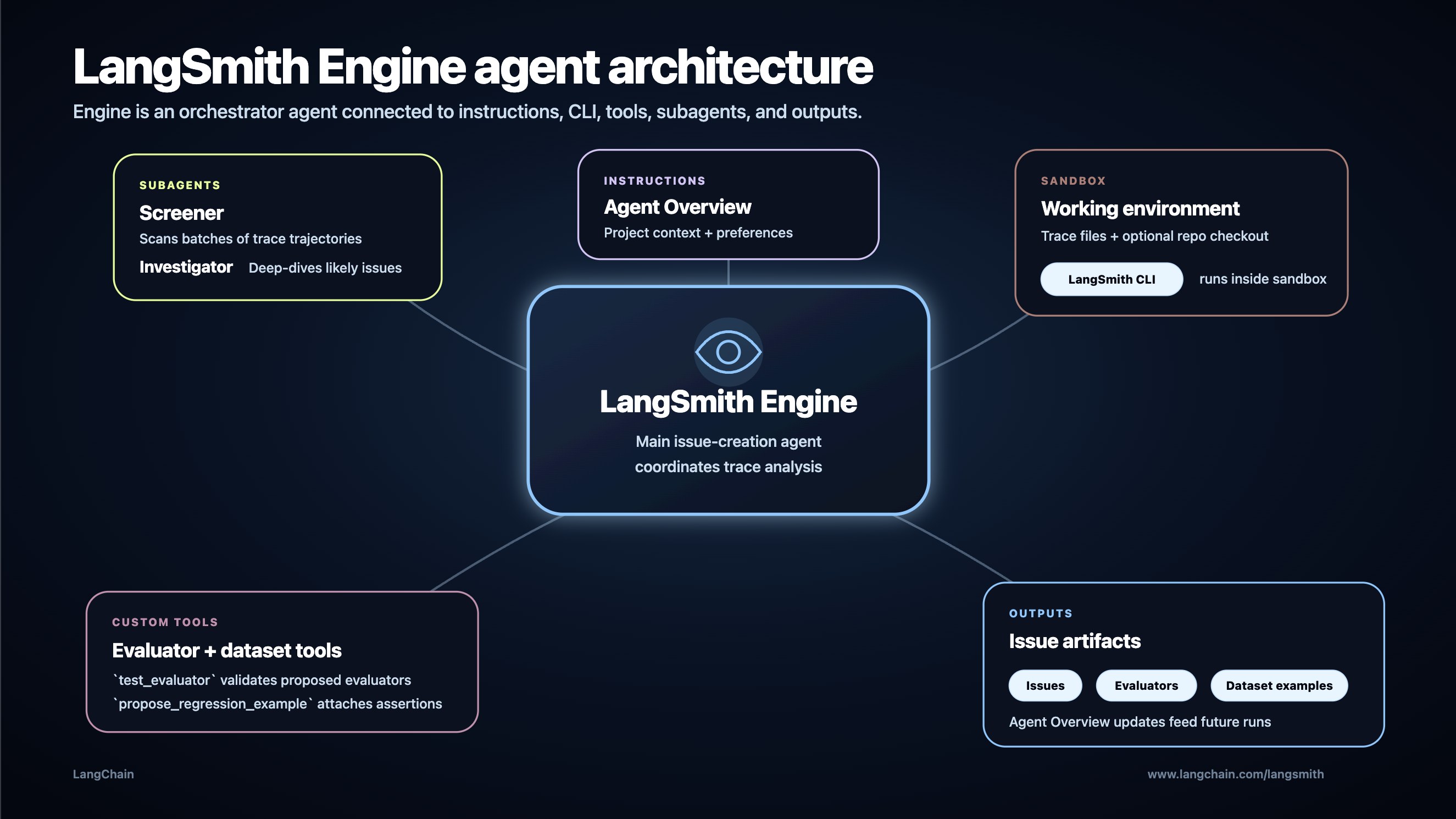
Architecturally, LangSmith Engine operates as an autonomous orchestrator managing specialized sub-agents. It ingests execution traces, inspects repository codebases when connected, clusters anomalies into structured issues, generates custom evaluators, and curates golden dataset examples to refine its baseline model understanding over time.
Transforming Failures into Actionable Issues
Raw telemetry is synthesized into actionable items on an integrated Issue Board. Each generated issue packages a technical description, predefined failure category, severity score, linked trace evidence, and triage tags.
Crucially for agent economics, Engine turns diagnostic data into remediation assets. It outputs online evaluators to intercept matching runtime regressions, expands test suites with failure-mode edge cases, and drafts prompt adjustments or code patches against connected repositories. This transforms fragile agent maintenance from manual firefighting into a deterministic CI/CD pipeline.