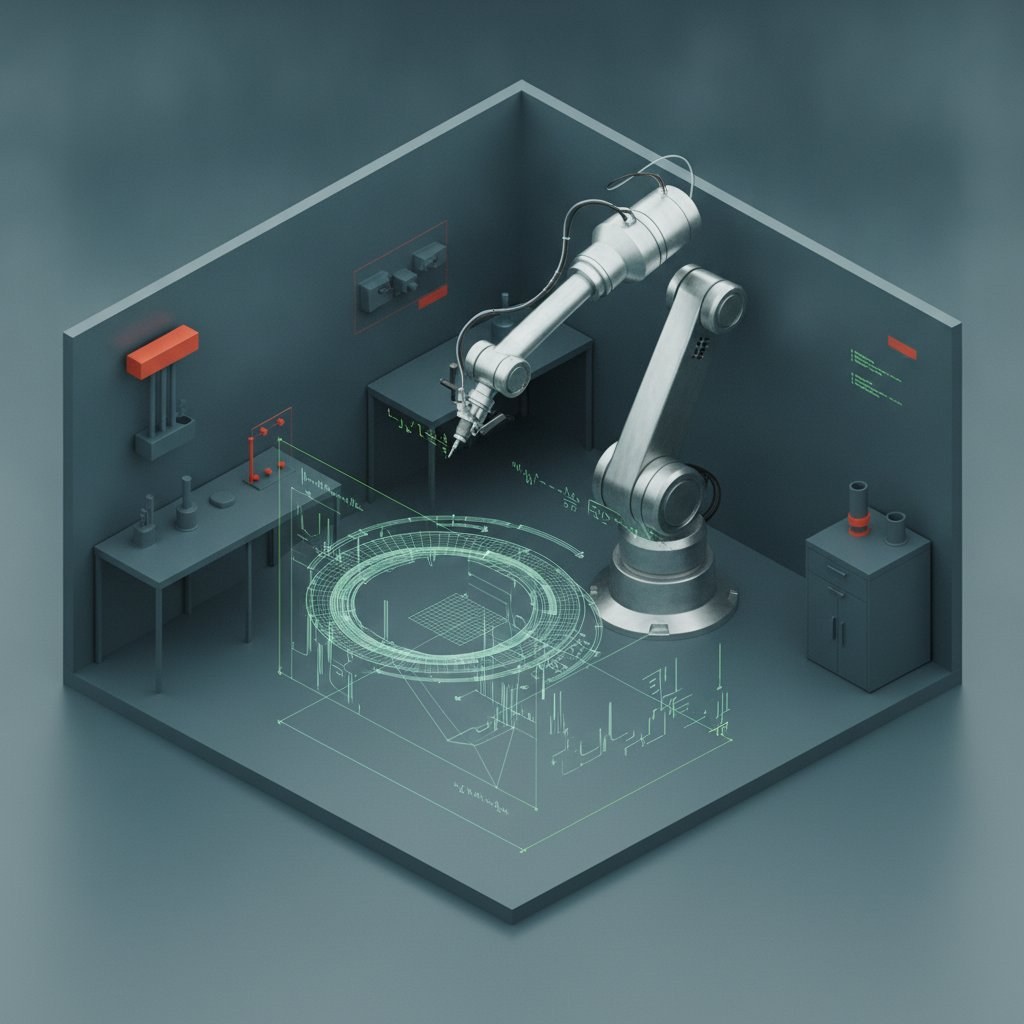
Efforts to automate the physical world have reached a critical tipping point with the release of LeRobot v0.6.0. The team—including Stephen Palmi, Thomas Wolf, and Nicolas Rabault—has introduced an update that strikes at robotics' biggest pain point: the exorbitant cost of trial-and-error in real-time training. The platform doubles down on "world models," allowing hardware to "imagine" the future before committing to a physical action. This shift from reactive behavior to predictive execution is more than a technical flourish; it is a direct business strategy to slash operational overhead.
Future imagination at zero inference cost
Version 0.6.0 introduces three policy types to test how much imagination actually helps the bottom line: VLA-JEPA, LingBot-VA, and FastWAM. The VLA-JEPA model, built on Qwen3-VL-2B, looks particularly promising for resource-constrained operations. It trains the robot to predict future frames in a latent space during the training phase. According to the report, during inference (live operation), the JEPA world model effectively disappears, leaving behind all the benefits of predictive oversight without adding computational bloat to the onboard computer.
policies that model the future before acting; reward models that track success; a deployment CLI that turns errors into training data
Universal agents and the model zoo
The integration of the GR00T N1.7 and MolmoAct2 models marks a final departure from classic manual coding for manipulators toward Vision-Language-Action (VLA) systems. GR00T N1.7 is now officially part of the LeRobot "zoo." This cross-platform foundation model allows a single architecture to control various hardware configurations—from simple grippers to complex industrial arms. Developers estimate the port covers the entire lifecycle: from fine-tuning to deployment on production hardware.
The infrastructure of scale
Scaling a robot fleet used to be bottlenecked by the need to manually define success criteria for every task. LeRobot v0.6.0 attempts to break this cycle through new Reward Models and automated labeling. The Robometer and TOPReward APIs allow the system to independently recognize whether a robot succeeded or failed. This works in tandem with a VLM-based dataset annotation pipeline that generates text descriptions for industrial-scale data. To lower the barrier to entry even further, the update enables cloud-based training via HF Jobs, utilizing Fully Sharded Data Parallel (FSDP) techniques to handle models that physically cannot fit into local GPU memory.
lerobot-rollout: deployment gets its own dedicated command-line interface
Deployment is now managed via the lerobot-rollout CLI, which supports DAgger-style (human-in-the-loop) correction. When a robot falters, an operator intervenes, and this interaction is immediately converted into fresh data for fine-tuning. With data loading speeds doubled and new support for depth sensors, a flywheel effect is created: every operational failure directly feeds the next model update. Theoretically, this should radically reduce the Total Cost of Ownership (TCO) for autonomous systems.
The transition to world models like VLA-JEPA and FastWAM means that the habit of "thinking before acting" has finally become economically viable. However, the reliance on six new simulation benchmarks in lerobot-eval leaves one question open: can virtual environments adequately mimic the chaos of a real-world warehouse or factory floor? While the scaling infrastructure—from cloud training to auto-labeling—is ready, the ultimate test remains the jump from "imagined" runs to the actual friction of the physical world.