Inside an inventory catalog, SKU BK-17 represents an A5 field notebook priced at 1,299 cents in USD, carrying a fixture flag set to true. Connecting an AI model to retrieve that single row of pricing data raises an immediate operational question for engineering teams: does a single lookup require a dedicated Model Context Protocol server? While universal specifications promise total interoperability, deploying complex protocols for straightforward data lookups creates an unforced overhead problem.
Bypassing bloated protocol stacks in favor of direct local execution or lightweight REST adapters materially lowers the total cost of ownership for AI systems. Universal architectures charge a premium in computational overhead and infrastructure complexity, even though internal functions and standard endpoints resolve the exact same workflow at a fraction of the cost. The July 28, 2026 revision of the Model Context Protocol runs over stdio on the same machine as well as over Streamable HTTP, but standardizing on it across an entire operational footprint carries hidden compute liabilities.
The Real Cost of Protocol Inflation
In practice, in multi-server environments, such an approach can consume tens of thousands of tokens per turn, overloading the context window. From our perspective, this is a classic case of poor architecture overriding common sense: when technical overhead exceeds 70% of the context, models hit fracture points where their reasoning capabilities simply shut down under the weight of technical noise. When protocol discovery data displaces actual business logic inside the context window, inference unit economics deteriorate rapidly.
"In multi-server environments, this consumes between 10,000 and 60,000 tokens per turn, bloating the KV cache to a breaking point."
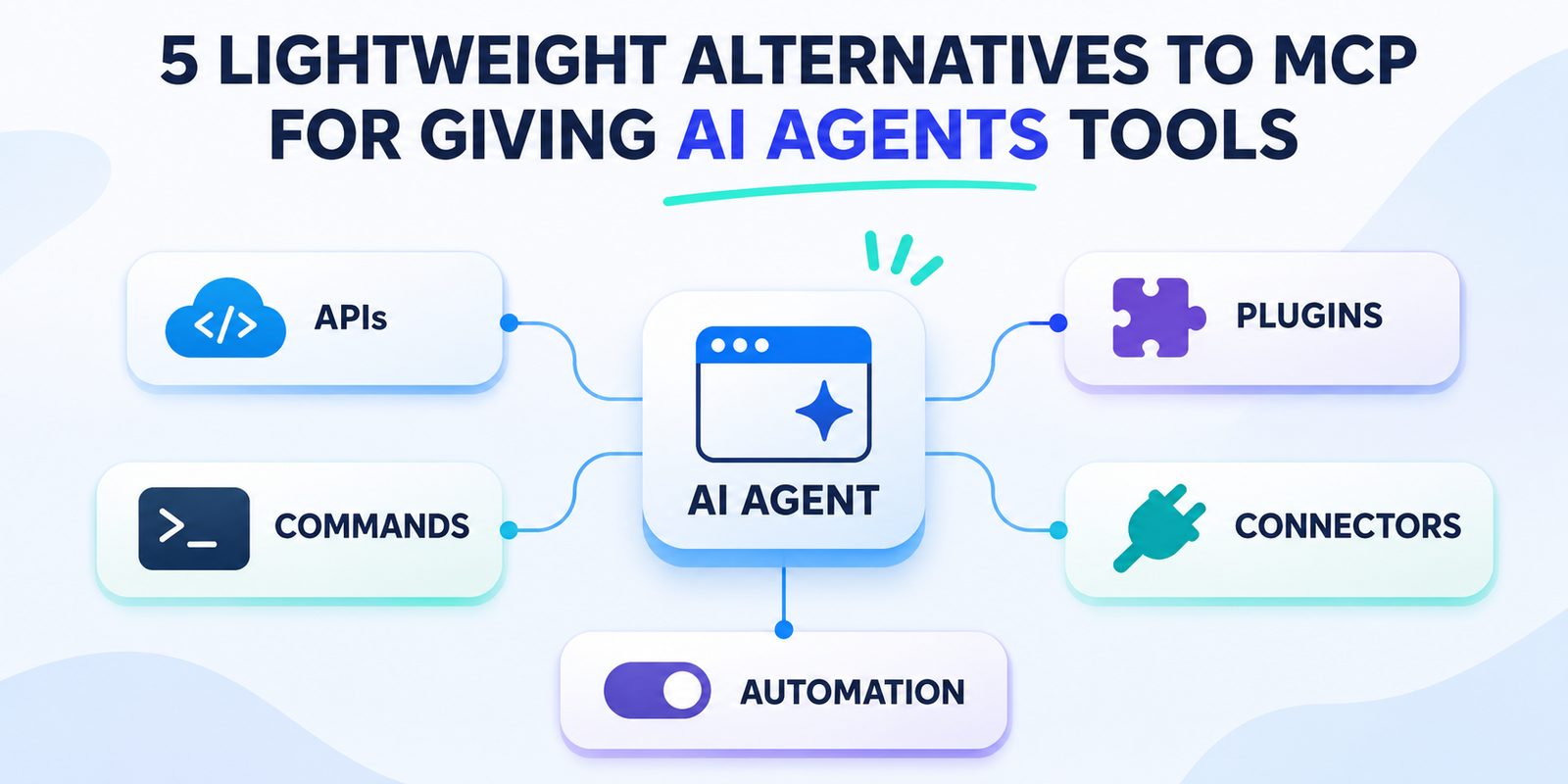
Engineering leadership frequently assumes that universal connectivity requires wrapping every operational script inside an autonomous protocol service. In fact, five lightweight alternatives exist to supply tools to agents without maintaining an MCP server: local Python dispatchers, framework tools, REST adapters, subprocesses, and webhooks. None of these pathways weakens system security or strips out regulatory controls. As an analysis by KDnuggets demonstrates, these five alternatives change who the executor is and where the function runs, but they do not alter the underlying business rules or remove the host application's validation checks.
Can an enterprise protect its perimeter when discarding standardized client-server discovery?
Security governance remains entirely anchored inside the host software. Regardless of whether an agent communicates over stdio, HTTP, or a local process, the application validates every proposed tool name against an allowed registry, verifies parameter types, and enforces user authorization permissions before execution. OWASP's excessive-agency guidance separates three ways this goes wrong: too much functionality, too many permissions, and too much autonomy. All three are decided by the application, not by the transport.
Native Tooling and Infrastructure Reality
When tool functions reside within the same process as the language model calls, the shortest implementation path relies on native tool interfaces coupled with an internal dispatch dictionary. In technical testing conducted by KDnuggets, the qwen3.5:4b model running on Ollama version 0.40.13 queried catalog records containing SKU BK-17 alongside SKU BK-18, an A4 field notebook priced at 1,799 cents in USD. The provider mechanism operates via a three-step cycle: the client passes the tool schema alongside the chat payload, Ollama returns structured tool calls rather than standard text, the local code executes the lookup directly, and the final response renders without routing through an intermediate server daemon.
Advocates of universal adoption argue that MCP provides protocol standardization that simplifies multi-host tool discovery across disparate platforms. While that cross-compatibility proves advantageous when exposing hundreds of dynamic capabilities across external vendors, applying universal protocol infrastructure to internal, single-purpose integrations introduces needless latency and hosting costs.
Maintaining financial discipline in agent deployment requires matching interface complexity to actual operational scope. Teams running fixed internal workflows preserve inference capacity by deploying direct execution pathways before introducing universal discovery protocols. The long-term return on agent infrastructure depends on controlling context token inflation before technical noise degrades core model reasoning.
How the picture shifted
Does pulling a single inventory price really justify running a dedicated Model Context Protocol server? The answer is no: lightweight alternatives handle the task directly inside the host application without wasting tens of thousands of tokens on service discovery. Burning over 70% of the context window on protocol overhead degrades the model's reasoning, whereas native dispatchers and webhooks bypass excess networking while preserving the exact same security checks. Routing tool functions directly inside local processes cuts network overhead and keeps the context window focused on actual business data.