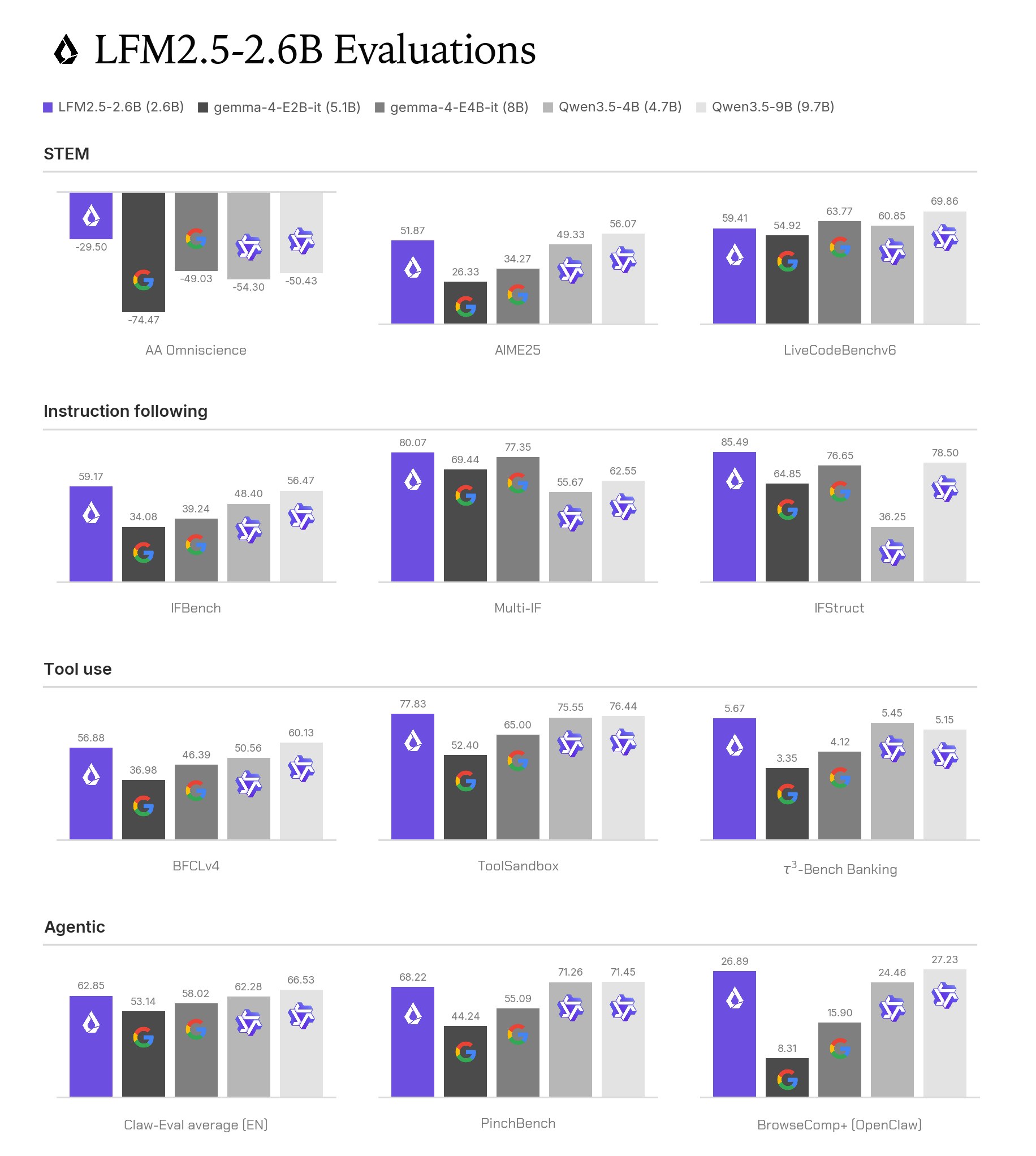
Liquid AI’s LFM2.5-2.6B release isn't just another incremental update; it’s a direct assault on the bloated economics of cloud-dependent AI. By packing high-tier agentic capabilities into a 2.6-billion parameter footprint—four times smaller than its nearest viable rivals—Liquid is proving that massive GPU clusters are often just a tax on inefficient architecture. The model was forged on 34 trillion tokens using multi-domain distillation and a specialized ‘Agentic RL’ pipeline, allowing it to dominate instruction-following benchmarks like IFBench while maintaining a tiny hardware profile.
Moving complex agents from expensive cloud instances to local smartphones and laptops is no longer a theoretical pipe dream. On an Apple M4 Max, this model screams at 220 tokens per second; even a standard AMD Ryzen chip handles 113 tokens per second while sipping less than 2.5 GB of RAM. This isn't just about speed—it’s about the death of the monthly API bill. In head-to-head tool-calling and multi-step logic tests, the LFM2.5-2.6B routinely punches above its weight, outperforming models in the 8B–9B range like Gemma-2-2B-it and Qwen2.5-7B.
The business case for this shift is devastatingly simple: it nukes the Total Cost of Ownership (TCO). By moving inference to the existing hardware fleet, companies can flip AI costs from recurring operational nightmares to fixed capital investments. Integrating seamlessly with agentic frameworks like OpenCanvas, the model maintains high-fidelity navigation and search without leaking sensitive corporate data to a third-party server. We are witnessing a decisive shift toward decentralized intelligence where edge density solves the privacy-scalability paradox without the linear infrastructure bloat that defines the current cloud era.