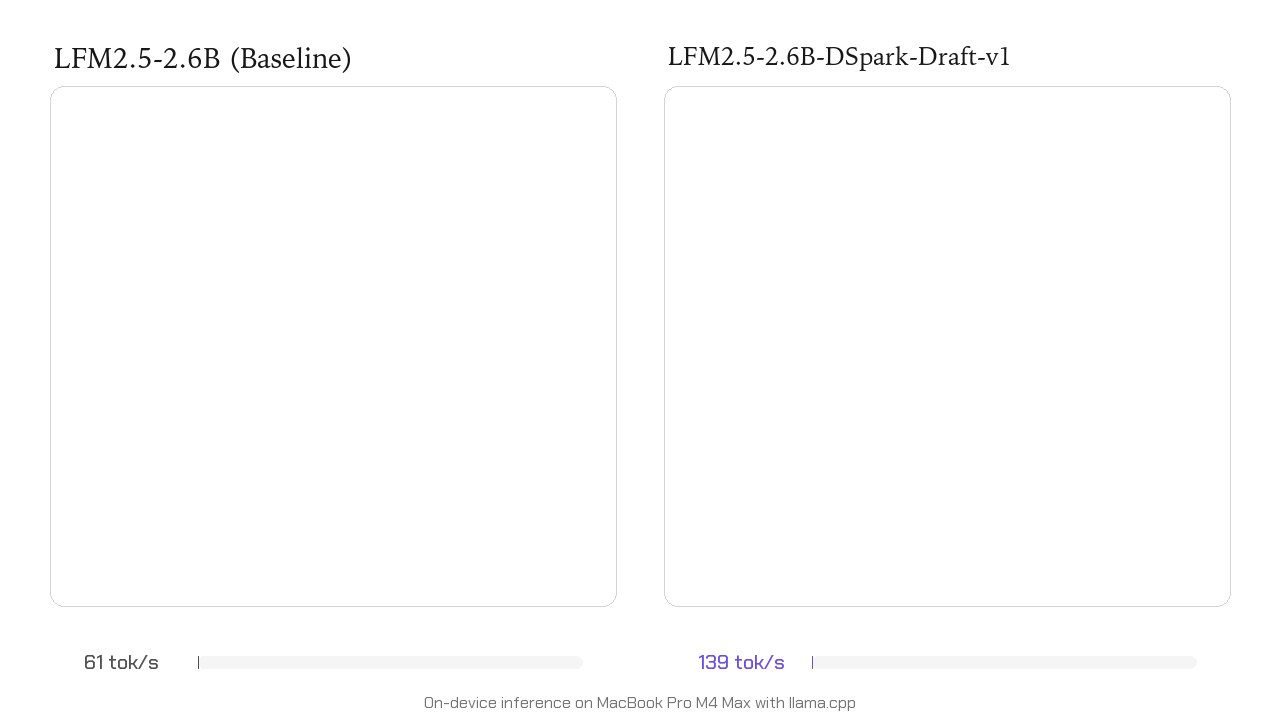
Liquid AI has rolled out its DSpark draft model checkpoints for the LFM2.5 lineup—specifically covering LFM2.5-1.2B-Instruct, LFM2.5-2.6B, and LFM2.5-8B-A1B. The speculative decoding mechanism delivers up to a 3.18x throughput increase on server GPUs and up to 2.87x acceleration on local edge hardware. Because the architecture verifies candidate tokens against the target model under strict greedy decoding, ML teams get these acceleration gains with zero output degradation or benchmark divergence.
For engineering teams building local automation loops, the operational payoff is immediate: the setup slashes function-calling latency on LFM2.5-2.6B by 57% on average. The architectural tax remains negligible, with draft checkpoints adding around 300 million parameters—295.7M for the 1.2B variant and 327.7M for the 2.6B and 8B-A1B models. In production terms, trading a fractional VRAM footprint for more than double the generation velocity is an easy trade-off.
Crucially, immediate out-of-the-box support in llama.cpp and SGLang moves Liquid's non-transformer architecture past the "interesting research prototype" stage into production-ready infrastructure cost optimization. By eliminating the latency penalty from dense function-calling workflows, teams can now run responsive agentic loops directly on edge hardware rather than subsidizing centralized, high-latency cloud clusters.