AI · This text was generated with artificial intelligence
Architectural Elegance Over Brute Force
While the industry continues to throw scarce NVIDIA chips at every problem, startup LiquidAI has chosen to swim against the current, proving that architectural elegance matters more than brute force. The company recently unveiled its LFM2.5 encoders (available in 230M and 350M parameter versions), which elegantly bypass the "transformer curse"—the quadratic complexity that plagues models when handling long context. Where traditional models begin to choke on data volume, LiquidAI maintains an impressive pace.
Technical Superiority and GPU Independence
The technical specifications read like a death warrant for legacy architectures:
Over a distance of 8,000 tokens, these encoders perform 3.7 times faster than ModernBERT-base. This performance is achieved on standard CPUs that have spent years sitting idle in server racks. By utilizing bidirectional attention and non-causal short convolutions, the model ensures that computational costs grow linearly rather than exponentially.
New Opportunities for Business
For CTOs and product owners, this is a clear signal to re-evaluate cloud budgets. Tasks such as automated policy audits, personally identifiable information (PII) detection, and heavy document classification can now be shifted from the overheated GPU market to existing in-house infrastructure.
This isn't just about cost savings; it is an opportunity to deploy a full-scale NLP stack here and now, without waiting for GPU quotas.
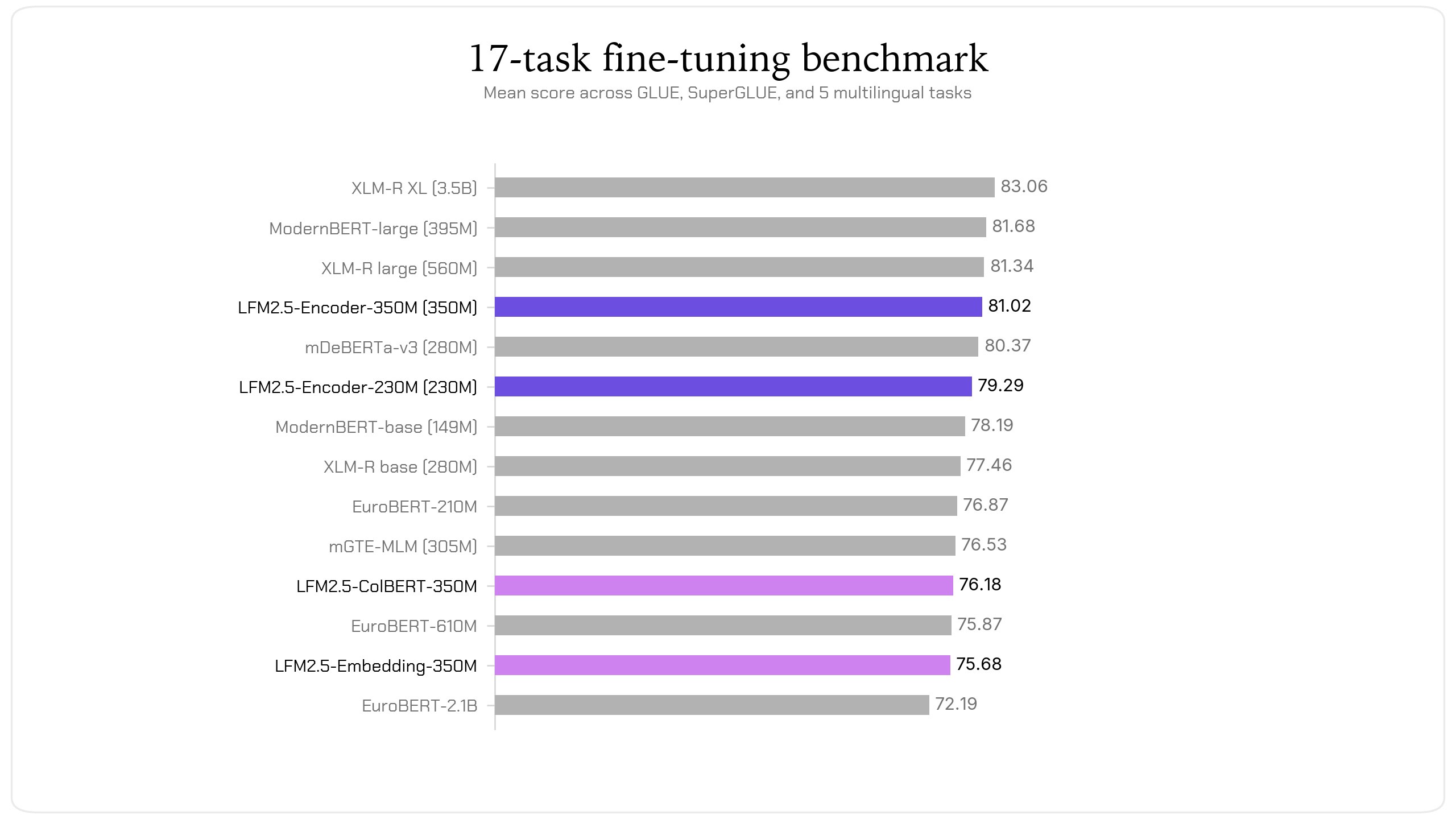
Don't let the small parameter count fool you: in GLUE and SuperGLUE benchmarks, the compact LFM2.5-Encoder-350M consistently outperforms much larger competitors.
The Bottom Line: Efficiency Over Hype
This release effectively settles the debate over whether parameter count is the sole metric of quality. LiquidAI is turning CPUs into first-class citizens of the AI stack, liberating companies from a humiliating dependence on hardware supply chains. The result is industrial-grade safety filters and classifiers that run on the hardware you already own. In a world where efficiency trumps hype, the winners are those who optimize code and manage costs rather than those who burn terawatts chasing the next billion parameters.