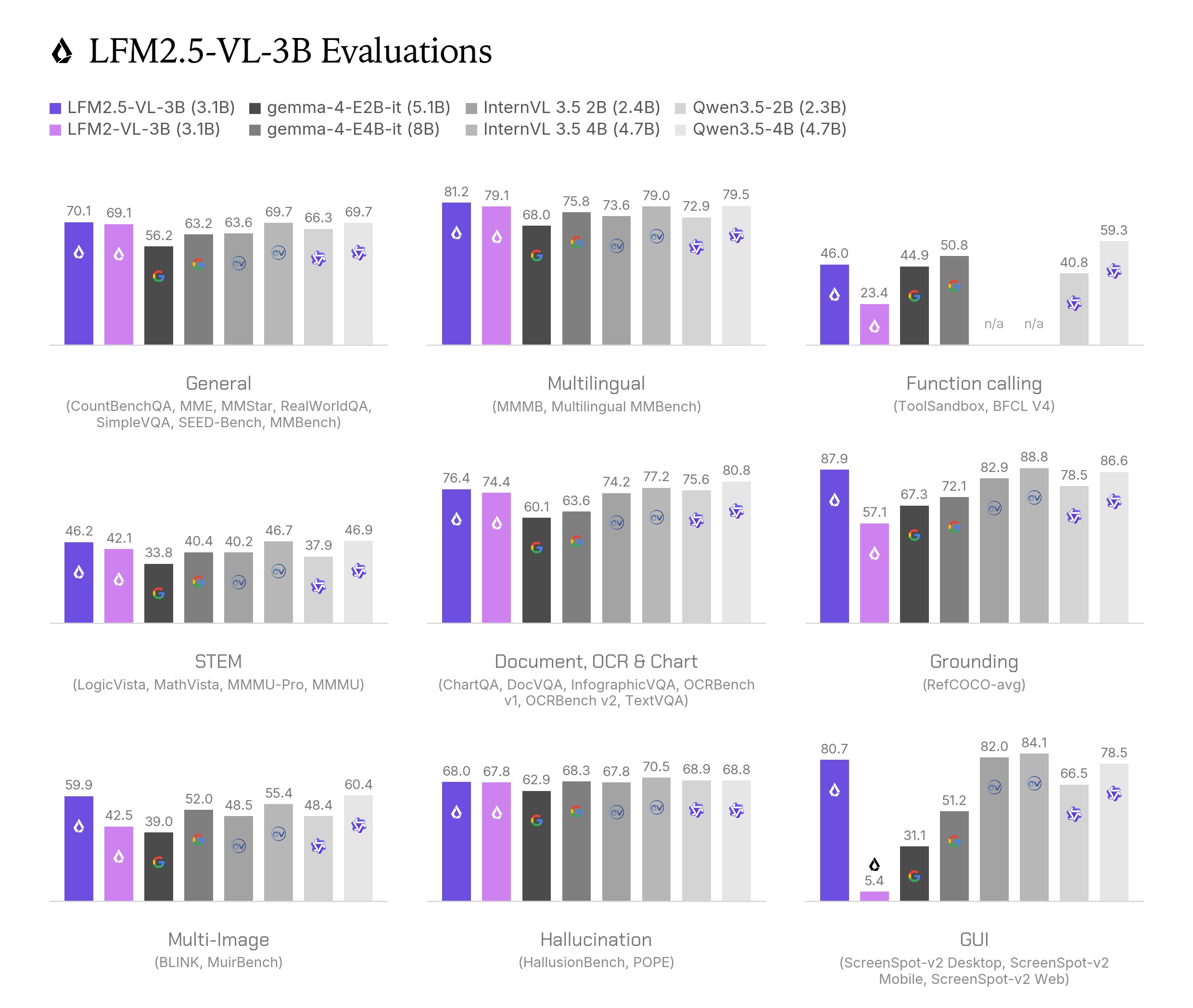
The pursuit of true autonomy is hitting a wall, and that wall is latency. LiquidAI’s latest release, the LFM2.5-VL-3B, is a 3.1-billion parameter multimodal model built for the 'edge'—a fancy way of saying it actually works on local hardware without begging a server for permission to think. While traditional transformers trap themselves in endless 'reasoning' loops before spitting out a token, this Liquid Foundation Model is tuned for direct response. For real-time robotics or industrial UI management, where a two-second network delay turns an AI agent into expensive e-waste, this architectural pivot is the only way forward.
Architectural Advantage on Edge Devices
For CTOs and system architects, the metric that matters isn't just 'accuracy'—it’s cognitive density. By integrating the SigLIP2 400M NaFlex visual encoder, the LFM2.5-VL-3B punches well above its weight class. On the RealWorldQA benchmark, it posted a 73.1 score, comfortably embarrassing larger models like gemma-2-9B-it (which managed 60.0) and InternVL 3.5 2B (61.6). This isn't just a technical win; it’s a fiscal one. Higher performance density means you can ditch power-hungry server GPUs for local silicon, slashing the total cost of ownership (TCO) for visual inspection systems.
LFM2.5-VL-3B answers directly instead of reasoning, so responses stay fast in real-time and on-device apps.
This design choice ensures stability where connectivity is a luxury—think remote industrial sites or autonomous floor-bots. By utilizing 'Antidoom' training and knowledge distillation from larger 'teacher' models during post-training, LiquidAI has managed to shrink the footprint without lobotomizing the intelligence. The model remains sharp enough for complex object detection and multi-image processing, all while keeping the data—and the compute—under your own roof.
Democratizing Autonomy and Interface Mastery
The real bridge to utility lies in the model’s grasp of digital interfaces and function calling. It doesn't just 'see' a screen; it understands the UI hierarchy well enough to execute actions. This isn't another passive observer; it’s a foundation for agents that can actually use tools. By enabling local inference, LiquidAI removes the primary security hurdle for sensitive sectors: the liability of streaming live video feeds to third-party clouds.
The shift from bloated cloud models to lean, local tools is no longer a fringe theory. The LFM2.5-VL-3B proves that for industrial application, speed of direct reaction to physical and digital stimuli beats raw parameter count every time. Moving visual intelligence to the edge of the network effectively ends the era of 'lab-only' AI, transforming autonomous systems from tethered terminals into independent operators that don't need an internet connection to be smart.