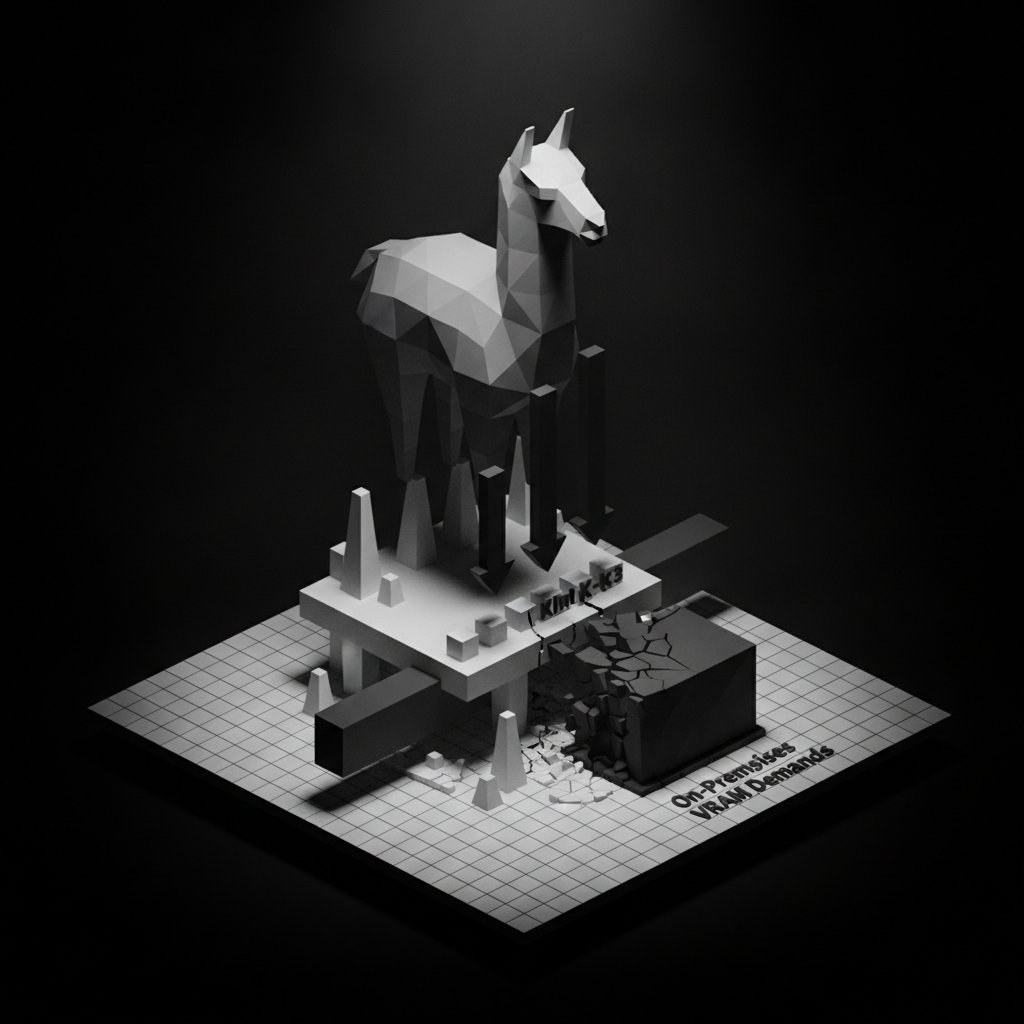
Developer pwilkin has submitted Pull Request #26185 to the ggml-org/llama.cpp repository, adding implementation support for the Kimi-K3 text model architecture. The pull request integrates a hybrid attention framework that pairs KDA (linear attention) with MLA (full attention), adapting core designs from Kimi-Linear-48B to slash VRAM pressure during massive document processing on consumer and local enterprise hardware.
According to the technical details provided by pwilkin, the implementation introduces five low-level architectural modifications over its predecessor: cross-layer residual attention, latent Mixture-of-Experts (MoE) where routed experts operate at a dedicated latent dimension, situ activation replacing standard SwiGLU, an MLA output sigmoid gate before projection, and a full-rank KDA gate. The patch also borrows DeepSeek4's HC_PRE framework to compute cross-layer residual weighted sums and introduces conversion repack support for MXFP4 quantized weights.
For enterprise infrastructure teams, this pull request marks a critical practical shift. By offloading long-context execution to a hybrid linear-attention pipeline within llama.cpp, teams gain the ability to deploy state-of-the-art Chinese ultra-long-context architectures strictly on-premise. That bypasses external cloud APIs entirely, keeping sensitive corporate data behind internal firewalls without requiring multi-node server clusters.