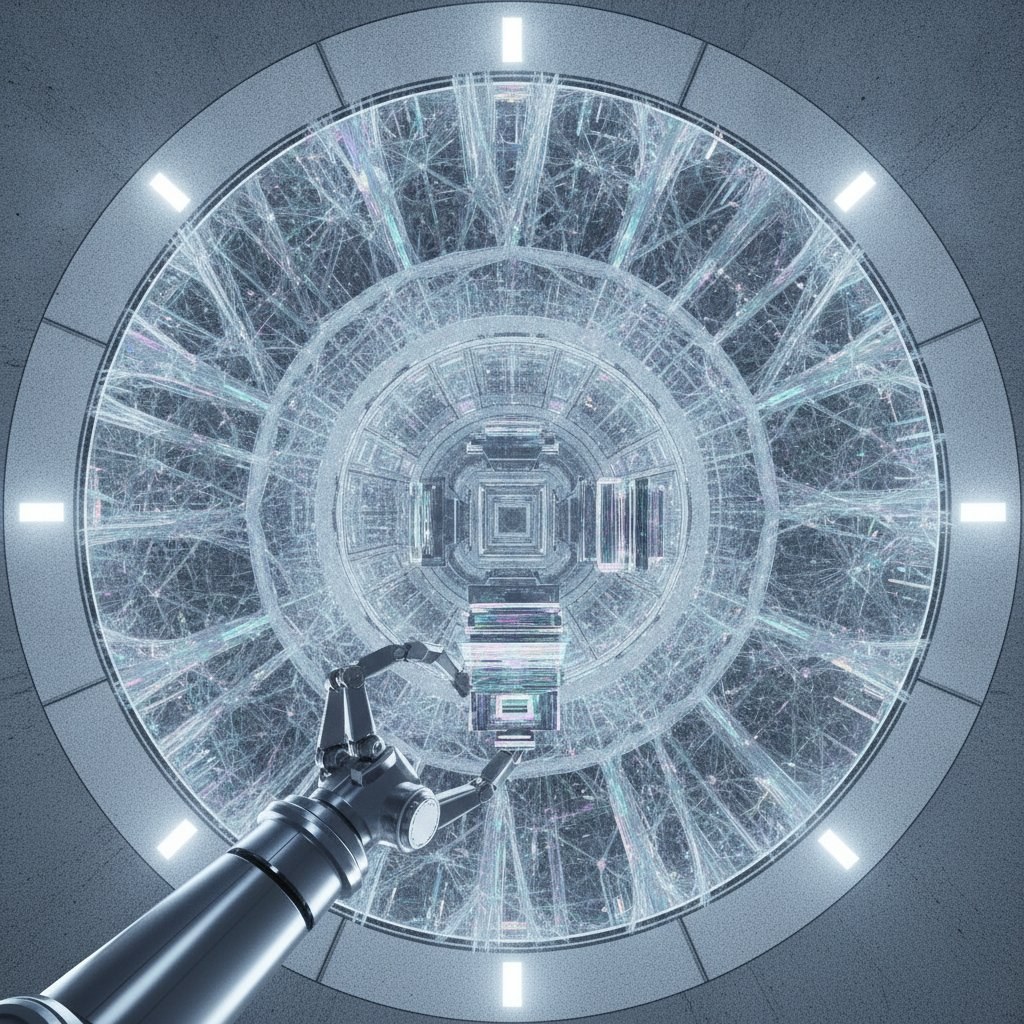
Modern scientific mega-facilities like synchrotrons suffer from a chronic bottleneck: beamtime is critically limited, and the human factor in equipment setup turns every experiment into a logistical nightmare. A study published in Nature Machine Intelligence marks a significant shift: moving from predictable scripts to autonomous LLM agents. A group of researchers has unveiled a system that takes over X-ray sample alignment—a stage that has traditionally required a specialist's constant presence.
Architecture of Autonomous Alignment
The core of the architecture is not merely a chatbot, but an embodied agent that utilizes structured tools through hardware interaction protocols. Technically, this functions as a link between an LLM and a virtual six-circle diffractometer. The neural network doesn't just generate text; it translates visual data and physical parameters into actuator commands. Unlike classical machine learning models that require specific datasets for every task, this agent relies on reasoning to navigate uncertainty. It independently searches for reference reflections and constructs an orientation matrix, mimicking the cognitive process of an experienced physicist.
"Our AI scientist responded effectively to unexpected experimental conditions, demonstrating the adaptability required to solve real-world practical problems," the report notes.
Economics of the 24/7 Beamline
The unit economics of synchrotron R&D are driven by the scarcity of operators and the cost of facility downtime. Removing the human from the routine setup cycle allows laboratories to shift to 24/7 operations. The validation methodology confirmed that the agent achieves the same precision in determining the orientation matrix as a human, but does so without breaks for rest or sleep. The savings here do not come from cutting a lab technician's salary, but from maximizing the throughput of infrastructure worth hundreds of millions of dollars.
The system handles complex physical alignment with zero human intervention. Laboratory throughput increases by eliminating downtime between experimental shifts. LLM reasoning replaces the need for massive, task-specific training datasets.
However, the scalability of the framework carries hidden risks. The authors suggest the model can easily be adapted for neutron or electron scattering, which inevitably leads to the erosion of expertise. If alignment—a foundational skill in experimental physics—becomes fully autonomous, the competencies of the next generation of scientists will shift toward pure data analysis and high-level strategy. The skill of "feeling" the instrument may disappear.
Successful deployment of the agent on a real beamline after training in a virtual environment proves that LLM logic can handle physical reality and off-script situations. Nevertheless, the boundary of responsibility remains blurred: while the system can process technical glitches, trusting autonomous protocols in critical situations still requires oversight from a principal investigator. For R&D leaders, this is a signal to audit workflows for "agent readiness"—it is time to define where rigid algorithms fail and where the flexible mind of a model can now take the helm.