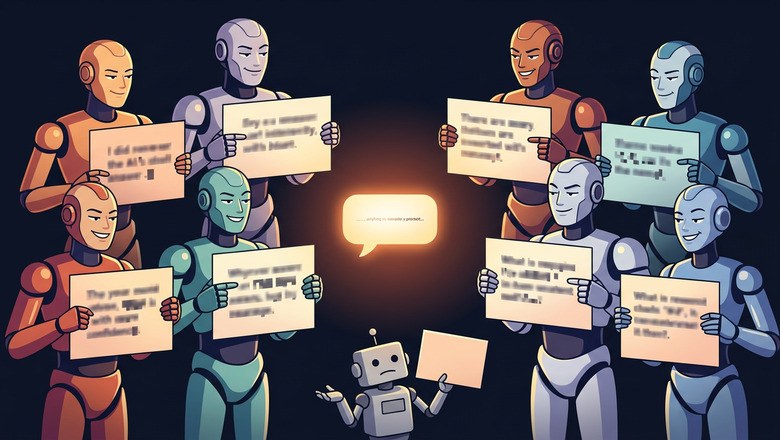
Imagine if 76% of your employees consistently provided incorrect information on the simplest questions, and did so with absolute certainty. This is the reality when large language models (LLMs) attempt tasks requiring current data without access to external tools. A recent experiment, costing less than a dollar, revealed that 22 out of 29 tested models, operating without additional instructions, confidently invented the current date. This seemingly minor test uncovers a fundamental problem: without 'prompts,' LLMs are prone to hallucination, and they do so with remarkable persistence. Among the models exhibiting 100% 'hallucination' in this test were creations from industry giants like Google's Gemini 3 Flash and Anthropic's Claude Opus. Their web versions can, of course, provide the correct answer, but this merely confirms they are sourcing information externally, not from their own 'depths.' A test with a clean prompt ruthlessly exposes this: when a model is left alone with facts and no further instructions, it doesn't hesitate to fabricate.
Why should this concern you as a leader? If even the most advanced AI systems fail to determine the current date without external assistance, consider what happens when you assign them more complex tasks. Responses in critically important business areas—whether it's market situation analysis, risk assessment, or financial planning—could simply be fabrications. The result? Incorrect management decisions, direct financial losses, and reputational damage that is difficult to repair.
CEOs, it is time to stop naively trusting AI at face value. Implement strict verification procedures for data obtained from AI, especially in processes where information accuracy and timeliness are paramount. Blind trust in LLMs where they may 'hallucinate' is a direct path to errors, the cost of which can be substantial. Your key management decisions, based on AI-generated data, may be founded on fiction. Instead of direct reliance, implement multi-stage verification: use several independent LLMs for a single query, cross-reference obtained facts with reliable external sources, or, for critical data, involve subject matter experts in the verification process. Remember: even the smartest algorithms still require your oversight.