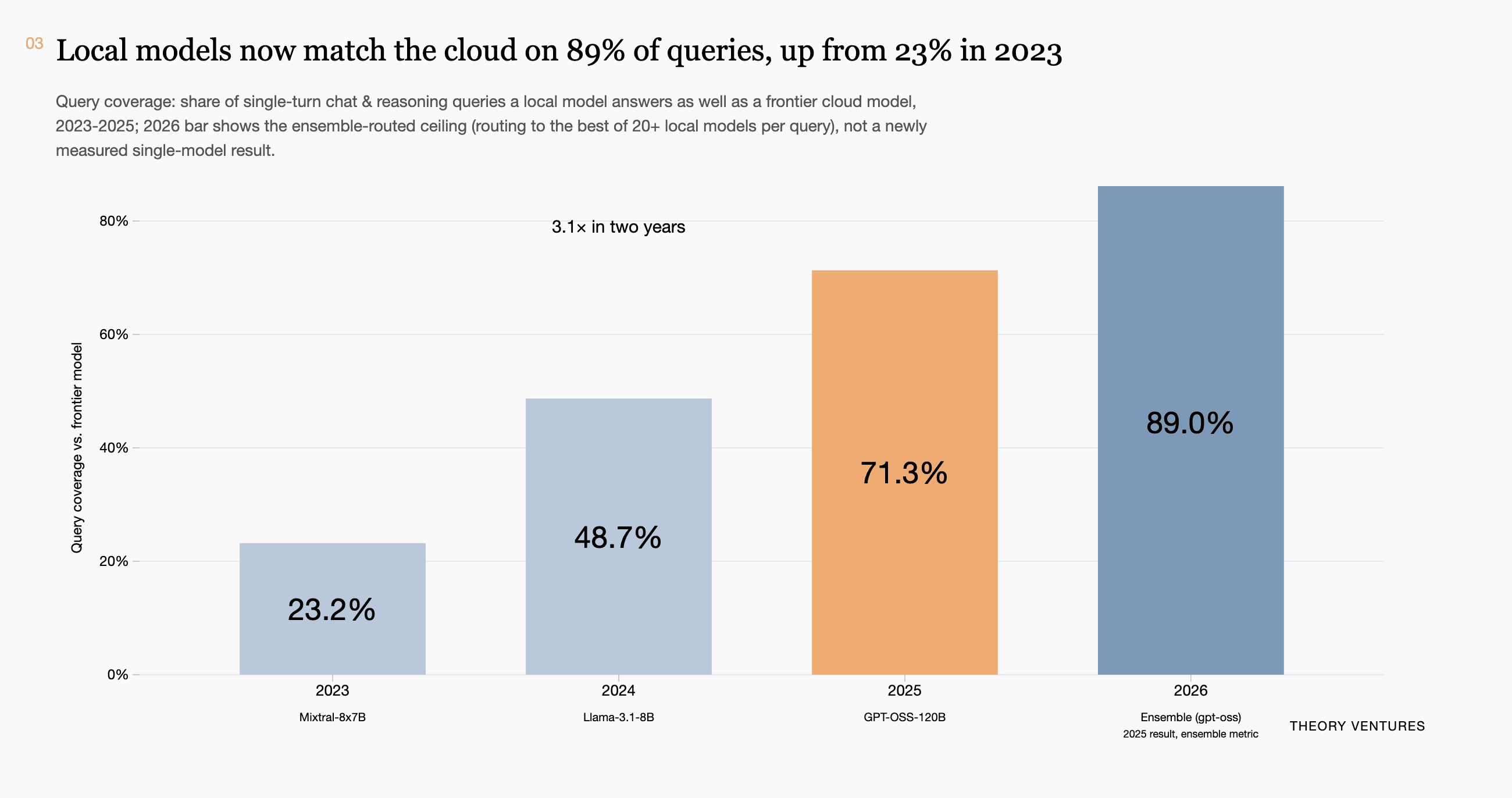
For decades, computing evolved along a predictable path from centralized mainframes to localized workstations, governed almost entirely by electrical efficiency. Artificial intelligence is now hitting the exact same inflection point. The enterprise consensus that every routine query requires round-trip latency to a multi-billion-dollar cloud cluster is crumbling under the weight of local efficiency gains.
According to analysis by Tomasz Tunguz, local AI models can resolve 89% of standard enterprise chat and reasoning tasks just as effectively as frontier cloud models. This is not synthetic optimism: the benchmark evaluated more than one million real-world queries against over 20 local models. In their research paper titled "Intelligence per Watt: Measuring Intelligence Efficiency of Local AI," Stanford University and Together AI researchers Jon Saad-Falcon, Avanika Narayan, and their co-authors mapped the technical mechanics of this decentralized shift.
"Just as performance-per-watt guided the mainframe-to-PC transition, intelligence-per-watt will guide AI’s transition to the edge."
As Saad-Falcon and Narayan noted, shrinking power envelopes inevitably expand deployment footprints. While raw GPU hardware efficiency historically doubled every 2.7 years—lagging Koomey's classic law of doubling power efficiency every 1.5 years—the compounding effect of lightweight model architectures alongside dedicated edge silicon has drastically compressed the timeline for local inference.
Quantifying the Efficiency Gains
Over a two-year span, intelligence-per-watt expanded by 5.3x. Crucially, algorithmic refinement accounted for a 3.1x boost, while chip architecture delivered a 1.7x gain. This compounding efficiency fundamentally changes competitive head-to-head dynamics. In 2023, the win-or-tie rate of the top single local model against a frontier cloud model sat at a modest 23.2%. By late 2025, that metric reached 71.3%, climbing roughly 20 percentage points annually.
That 89% enterprise parity ceiling emerges when local orchestration takes over. By pairing specialized local weights with a lightweight edge router that assigns incoming queries to targeted models, organizations eliminate the need for centralized cloud calls across the vast majority of routine workflows.
Economics of Hybrid Infrastructure
Centralized data centers retain structural advantages for edge-case computation. Hyperscale facilities still capture a 40% raw energy efficiency lead in high-throughput batching—an architectural leverage point single-user edge hardware cannot replicate. Frontier models remain non-negotiable for the 11% of workloads requiring multi-step mathematical proofs, deep domain synthesis, or expansive context processing.
For standard operational workloads, however, the math overwhelmingly favors local execution. Diverting standard traffic to orchestrated edge models slashes energy consumption by 80%, compute demand by 77%, and total operating cost by 74% against an all-cloud baseline while insulating sensitive data from external API pipes. For CTOs and CFOs, the operational verdict is clear: enterprise architecture must pivot to a hybrid model where edge inference handles daily volume and frontier cloud budgets are reserved strictly for the 11% of tasks that genuinely demand them.