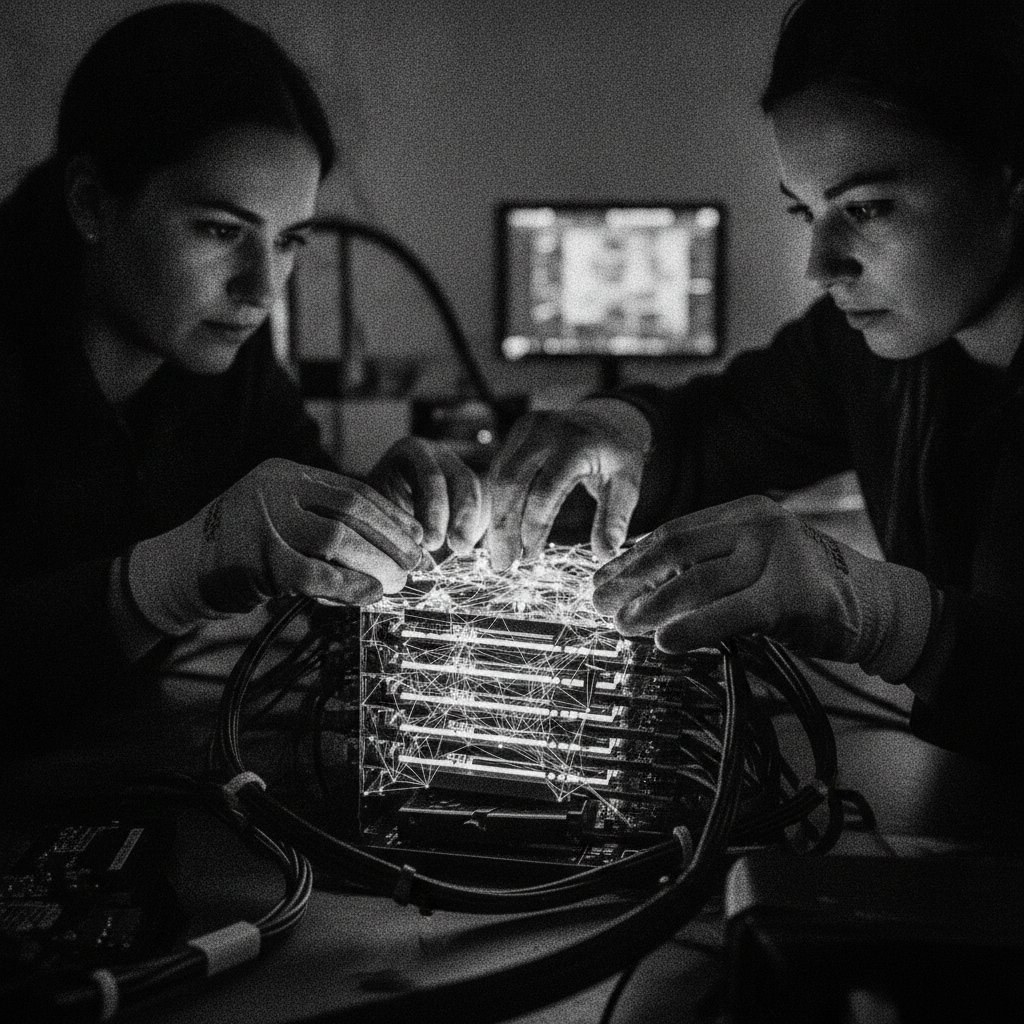
Decentralized architectures for large language model multi-agent systems distribute coordination and routing across local nodes rather than relying on a centralized orchestrator. While this setup eliminates a single point of failure, individual nodes remain vulnerable to subtle operational breakdowns where an agent continues communicating while silently returning degraded outputs. These gray failures are precisely what sabotage production pipelines long before anyone notices the ledger bleeding.
To counter these hidden breakdowns, researchers Keru Chen and Shaofeng Zou from the School of ECEE at Arizona State University, Sen Lin from the Computer Science Department at the University of Houston, Yingbin Liang from the Department of ECE at The Ohio State University, and Nathaniel D. Bastian from the Whiting School of Engineering at Johns Hopkins University developed MeshHeal. As the research team explained in their preprint, "We introduce MESHHEAL, a fully decentralized self-healing framework that couples ability-matched peer review across two timescales."
Two-Timescale Architecture and Evaluation
Under this two-timescale design, fast-timescale reviews evaluate and correct active outputs, while slow-timescale tracking isolates persistently degraded agents from standard routing until recovery probes confirm their reliability. To benchmark decentralized workflows accurately, the authors introduced Model-Backed MAS Evaluation, which ties ability assignments to execution models to avoid the hidden routing errors that sloppy, prompt-based configurations routinely mask.
MeshHeal achieves 0.839 degraded-phase accuracy using 51k total model tokens per task across standard benchmarks.
Across BBH, MATH, and MMLU-Pro, MeshHeal hits 0.839 degraded-phase accuracy while burning 51k total model tokens per task. In comparative testing, the strongest baseline, Symphony, manages only 0.807 accuracy while guzzling 115k tokens per task. That is not just a marginal improvement in output quality; it is a direct strike against runaway compute costs.
Managing silent output degradation without centralized oversight represents the ultimate engineering hurdle for scaling autonomous agent meshes. The results demonstrate that multi-tiered peer review can isolate faulty nodes and maintain system accuracy while cutting token overhead relative to existing baseline architectures, though broader evaluations across varied network topologies remain an open question for future distributed agent research.