AI · This text was generated with artificial intelligence
For three decades, enterprise software economics relied on predictable licensing fees paired with explicit privacy commitments and zero data retention. Consumer technology operated on the inverse dynamic, offering free tools in exchange for behavioral data. As the frontier model landscape matures, Meta is bridging these two operating models by launching a dual-tier pricing structure for its Muse Spark 1.3 model, introducing an explicit data-for-compute barter to commercial AI infrastructure.
The Anatomy of the Two-Tier Structure
Under the standard arrangement, Meta charges $1.25 per million input tokens and $4.25 per million output tokens for muse-spark-1.3, guaranteeing zero data retention and strict training exclusions. Alongside this private baseline, Meta introduced the muse-spark-1.3-contributor tier at $0.10 per million input tokens and $0.20 per million output tokens. In exchange for surrendering training rights on their incoming payload, API consumers receive a 92% discount on inputs and a 95% discount on outputs.
At a typical agentic ratio of 30 input tokens to one output token, the blended standard rate stands at $1.35 per million tokens, whereas the contributor rate drops to $0.103 per million tokens. Venture capitalist Tomasz Tunguz highlighted the structural signal behind the spread, citing investor Michael Mauboussin:
"As Michael Mauboussin writes in Expectations Investing, there is information in prices. When Meta charges two radically different prices for the same AI, the difference in price tells us the value of the data."
This $1.24 per million token spread establishes a clear benchmark for prompt data. Frontier labs previously offset compute losses on flat-rate consumer plans to quietly harvest training inputs. Meta has now formalized this exchange into an explicit per-token clearing price.
Bypassing External Labeling Labs
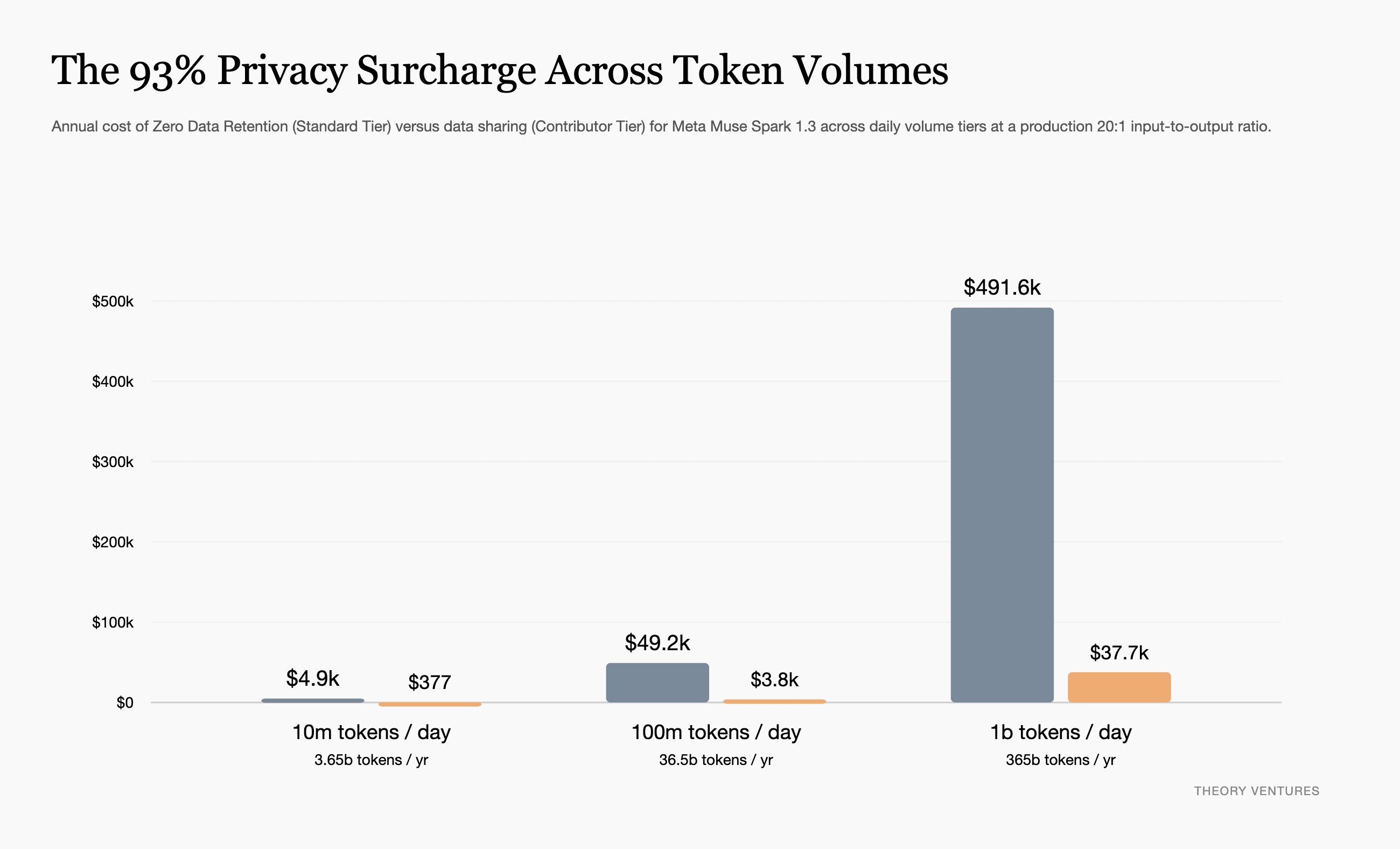
For enterprise workloads operating at scale, the unit economics diverge sharply. Processing 1 billion tokens daily on private infrastructure with zero data retention costs $491,573 annually, compared to $37,677 on the data-sharing tier. This represents an explicit $453,895 annual privacy surcharge for an enterprise maintaining complete data isolation.
This pricing architecture allows Meta to vertically integrate its post-training data supply chain, bypassing costly third-party labeling vendors. For enterprises, the trade-off is stark: commodity workflows like public-web scrapers and generic parsing can safely capture the 92% discount, while proprietary context, customer PII, and core IP must remain behind the privacy premium.
Compute is no longer priced merely as an infrastructure utility. It is operating as liquid currency traded directly for the post-training tokens required to build next-generation frontier models.