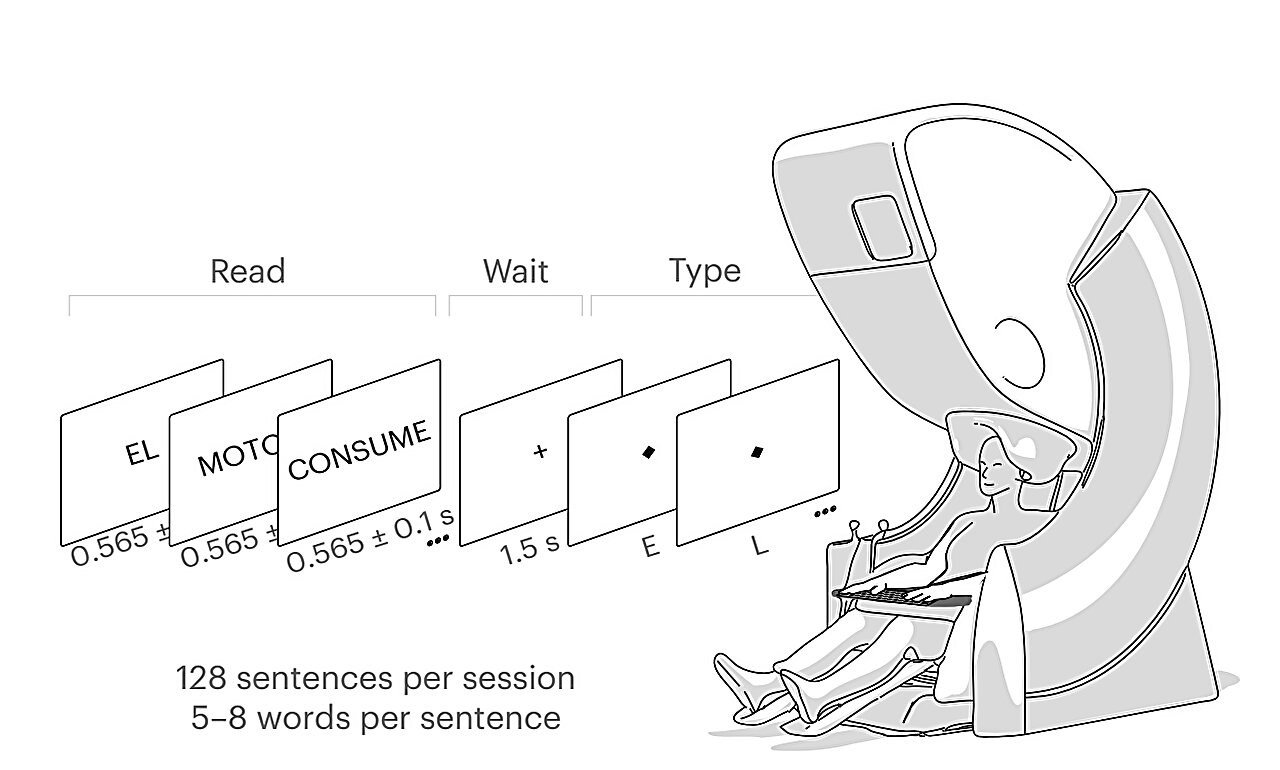
While Elon Musk’s Neuralink makes headlines by drilling holes into volunteers, a quieter but more commercially viable shift is happening in non-invasive neural decoding. A research team from Meta AI, Université PSL, and the Adolphe de Rothschild Hospital Foundation has demonstrated that we no longer need to compromise a patient’s skull to extract coherent text from brainwaves. Their system, Brain2Qwerty, utilizes deep learning to translate magnetoencephalography (MEG) and electroencephalography (EEG) signals directly into sentences, bypassing the high-stakes risks of neurosurgery.
The technical performance metrics, published in Nature Neuroscience, show a clear hierarchy: MEG is the current heavyweight champion. Lead researchers Jarod Lévy and Mingfang Zhang report a character error rate (CER) of 29% on average, with top-tier performance hitting 18%. To put this in perspective, EEG—the more portable and cheaper cousin—still lags with a 65% error rate. However, the fundamental proof of concept is there: decoding complex linguistic structures from healthy volunteers without a single incision is no longer a theoretical pipe dream.
For MedTech investors and rehabilitation providers, this is a pivot from 'experimental surgery' to 'scalable service.' The Total Cost of Ownership (TCO) for invasive BCIs is astronomical, burdened by surgical fees, long-term clinical monitoring, and the inherent liability of brain implants. By contrast, wearable hardware allows for a modular, repeatable business model. We are moving away from the 'one-off' surgical intervention toward brain-to-text as a standardized assistive tool that can be rolled out across clinics without a dedicated neurosurgery department on standby.
This isn't just about helping patients with motor impairments; it is a tactical land grab in the assistive technology market. Brain2Qwerty narrows the performance gap between high-risk implants and safe, wearable hardware. As the error rates continue to drop, the medical necessity for invasive electrodes will likely retreat into niche clinical corners, leaving the broader market to non-invasive systems that prioritize patient safety and operational efficiency over cybernetic spectacle.