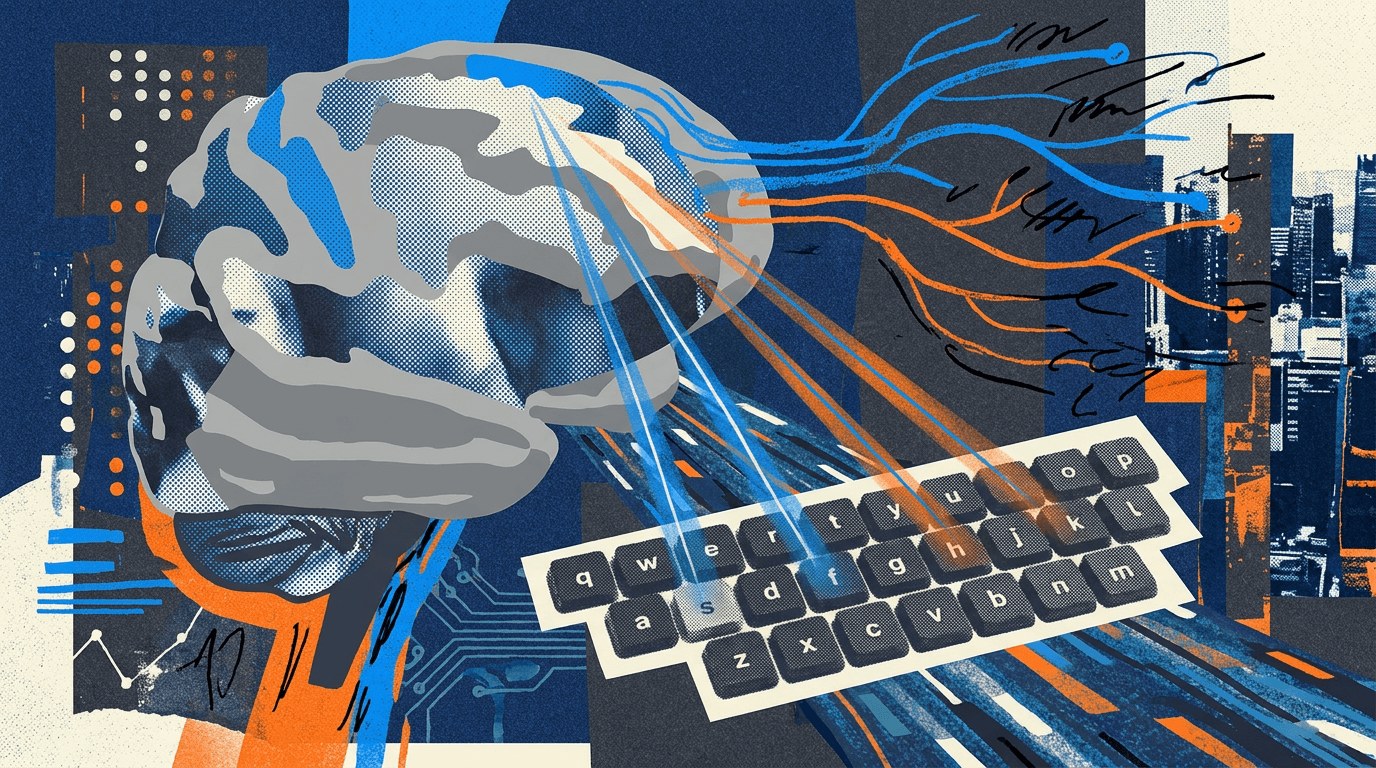
While Elon Musk and Synchron compete over who can drill into the human skull with more precision, Meta’s FAIR (Fundamental AI Research) unit is quietly proving that deep learning can compensate for signal noise passing through bone. The updated Brain2Qwerty v2 model is more than just another lab experiment; it is a direct threat to the business model of invasive interfaces. Mark Zuckerberg’s team has learned to reconstruct coherent sentences from magnetoencephalography (MEG) data, achieving an average Word Error Rate (WER) of 39%, with top performers reaching as low as 22%. For a non-invasive method where data is collected without the risk of sepsis or post-operative maintenance, this sounds like a death sentence for the high-end medical implant segment.
Decoding Without a Scalpel
The technical leap in v2 is driven by a shift to an asynchronous signal window. While the first version required precise time-stamping for every keystroke, the second iteration automatically distributes characters within the data stream. This removes a critical barrier to real-time commercial use, though developers admit the real-time threshold hasn't been fully crossed yet. The dataset has grown tenfold compared to its predecessor: nine volunteers typed 22,000 sentences while MEG sensors recorded activity in the motor cortex responsible for finger movement. For venture capitalists and MedTech executives, the unit economics here are devastatingly attractive: zero surgical risks versus the lifelong upkeep of a chip inside a patient's head.
The signal is primarily read from the motor cortex, allowing text reconstruction even when the user cannot see the screen.
The Language Model Paradox
The Brain2Qwerty v2 architecture relies on three AI blocks, with a fine-tuned Large Language Model (LLM) playing the starring role. It acts as a cognitive stabilizer, transforming raw brain "noise" into articulate speech. Statistics confirm its impact: without the LLM, the error rate spikes to 55%, but with it, the rate drops to a manageable 39%. For the most successful participant, 28% of sentences were decoded perfectly, and nearly half contained only a single-word error. Notably, to accelerate development, Meta utilized AI agents even for writing optimization code, hinting at the automation of the neural interface creation process itself.
Zuckerberg’s strategic interest here is far from purely altruistic assistance for paralyzed patients. This is a long game for control over wearable devices. If Meta succeeds in miniaturizing MEG sensors into a glasses or headphones form factor, they will secure the ultimate interface: text input without voice, hand movements, or physical buttons. While the accuracy gap compared to invasive chips remains wide, the scalability of a wearable gadget is orders of magnitude higher than neurosurgery. Meta is betting that smart software will overcome low sensor resolution, relegating Neuralink’s products to a niche solution for critical clinical cases while non-invasive AI captures the mass market.