Traditional data centers running legacy enterprise workloads—serving social media feeds or indexing search queries—have long relied on straightforward airflow to manage thermal envelopes. However, as compute density escalates to sustain large-scale AI training and inference, forcing high-velocity air across dense server racks hits a hard thermodynamic barrier. Packing tens of kilowatts into a single rack yields thermal dissipation demands that make conventional fans and facility air handlers physically and economically untenable.
Only a few years ago, ambient air cooling could still accommodate initial accelerator rollouts. At Meta's facility in Altoona, Iowa, racks populated with 16 Nvidia H100 units managed on forced air, relying on minimal evaporative water only to chill intake air during seasonal peaks without running fluid directly to the silicon. Modern high-density accelerator architectures, however, produce concentrated heat fluxes that necessitate direct-to-chip liquid cooling to prevent aggressive thermal throttling.
The Hydraulics of Closed-Loop Recirculation
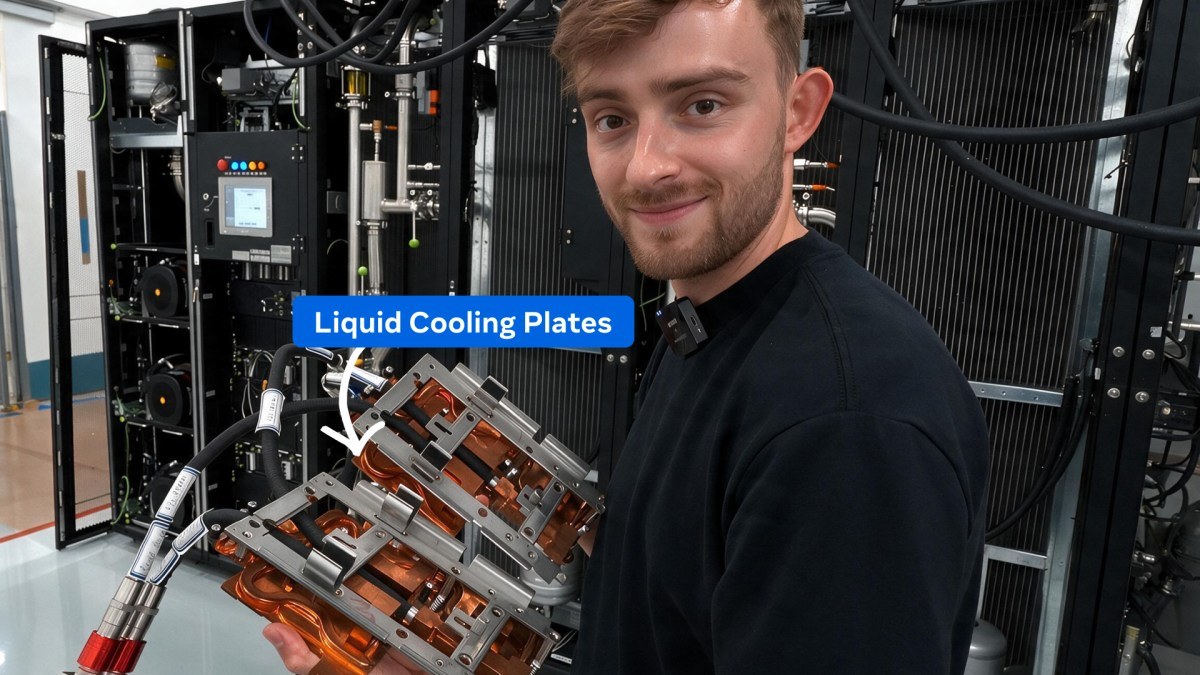
To navigate this thermal shift, Meta has engineered closed-loop liquid architectures across its newest AI-dedicated campuses, including its Texas sites. The hydraulic system routes a closed-circuit water-glycol mixture directly through cold plates mounted on server processors. Rather than venting or evaporating the heated coolant, the facility pumps the liquid through external heat exchangers and dry coolers, dissipating the thermal load into ambient air before recirculating the fluid back through the compute floor.
Because the internal plumbing is hermetically sealed, the fluid operates in a continuous ten-year cycle without replenishment, bypassing the intensive water consumption typical of evaporative cooling towers. For retrofitted sites lacking facility-wide liquid piping, Meta deploys Air-Assisted Liquid Cooling (AALC), packaging compact pumps and closed-loop heat exchangers directly inside individual server racks.
For enterprise infrastructure leaders and colocation tenants, this transition fundamentally alters high-density compute CapEx and TCO modeling. As direct-to-chip plumbing becomes mandatory for next-generation silicon, power usage effectiveness (PUE) and water usage effectiveness (WUE) metrics are shifting from sustainability PR into hard operational constraints. Sealed liquid loops prove that scaling AI compute density does not require an open tap on municipal water supplies, establishing closed-circuit thermodynamics as the baseline architecture for future high-density clusters.