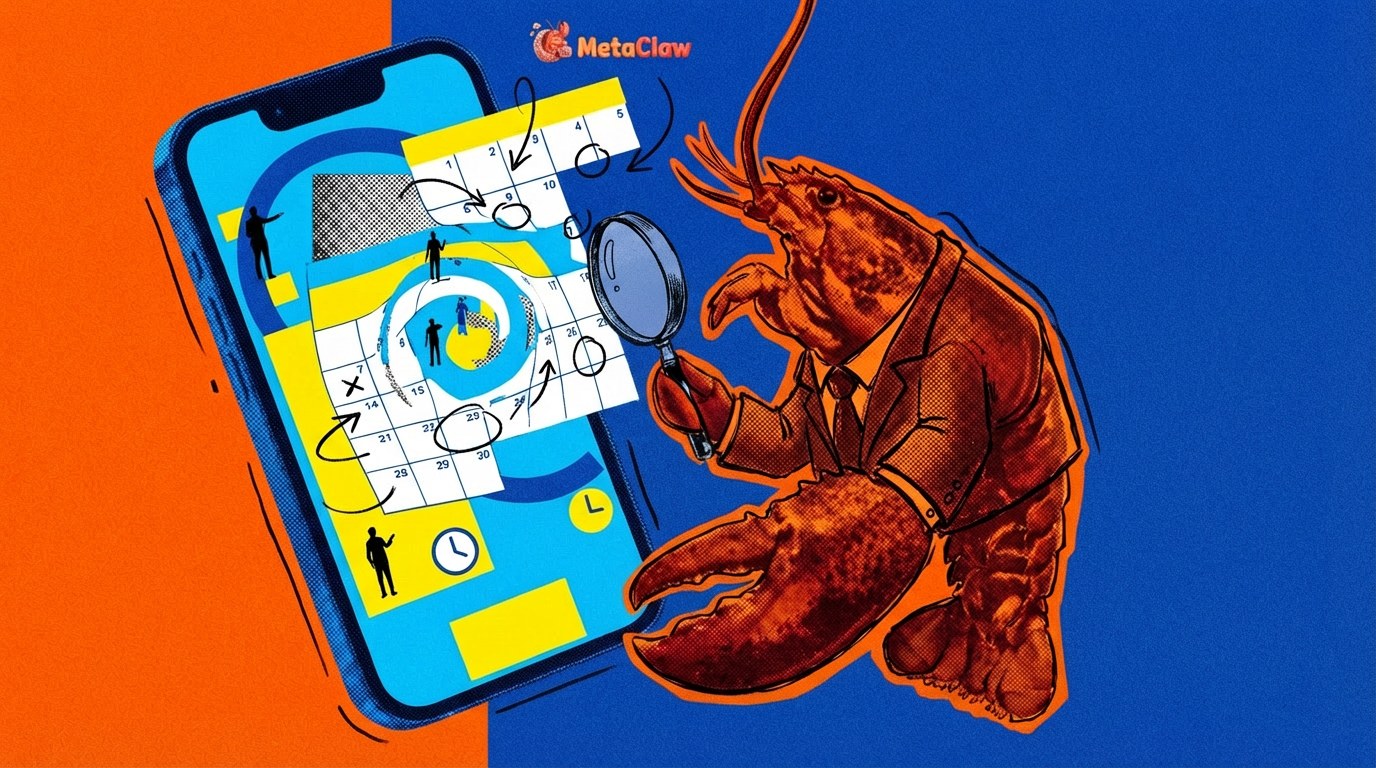
While you are focused on a meeting, your AI assistant is not simply waiting. It is actively learning from its mistakes, akin to an accelerated self-improvement course. The MetaClaw framework, developed by researchers at UNC-Chapel Hill, Carnegie Mellon, UC Santa Cruz, and UC Berkeley, offers precisely this capability. Forget one-off training; agents on MetaClaw continuously rewrite their own code, leveraging information from your Google Calendar to identify the optimal moment for an upgrade while you are occupied.
The mechanism is as follows: if an agent makes an error, a separate model is triggered to analyze the failure and formulate a simple rule. This rule is then immediately integrated into the system's prompt, ensuring all future agent actions account for this newfound wisdom. The core model remains untouched, and the service continues to operate. Researchers state that these rules can pertain to anything, from time standardization to pre-deletion file backups or adherence to naming conventions. A single mistake can potentially lead to improvements across entirely different tasks, as the rule is not confined to a specific scenario.
Core learning, involving weight updates through reinforcement learning, occurs in the background. Since this process can temporarily impede agent performance, initiating it while you are actively working is prohibited. This is where MetaClaw's Opportunistic Meta-Learning Scheduler (OMLS) comes into play. OMLS monitors your activity, checking if you are asleep, if your keyboard and mouse are active, and reviewing your Google Calendar. If it detects you are in a meeting, a training window opens. This process can be interrupted and resumed, allowing the system to capitalize on even brief periods of inactivity. The system also intelligently separates data from before and after a rule is implemented to avoid penalizing the model for mistakes that have already been corrected.
Initial tests have been impressive, with MetaClaw successfully elevating a basic language model to the performance level of a far more advanced one. This appears to be a significant step toward greater AI agent autonomy and efficiency, enabling them to adapt to your evolving needs without direct human intervention. Both mechanisms—rule generation and model training—provide feedback to each other: an improved model generates more meaningful errors, which in turn lead to the creation of even more accurate rules.
What this means for business right now: MetaClaw represents a paradigm shift from static AI models to dynamically learning systems. These agents adapt in real-time, utilizing your resources when you are not actively using your computer. This can substantially reduce training costs and enable businesses to implement flexible, self-improving AI solutions. However, questions remain regarding complete control over workflows and whether this could become another method of resource exploitation.