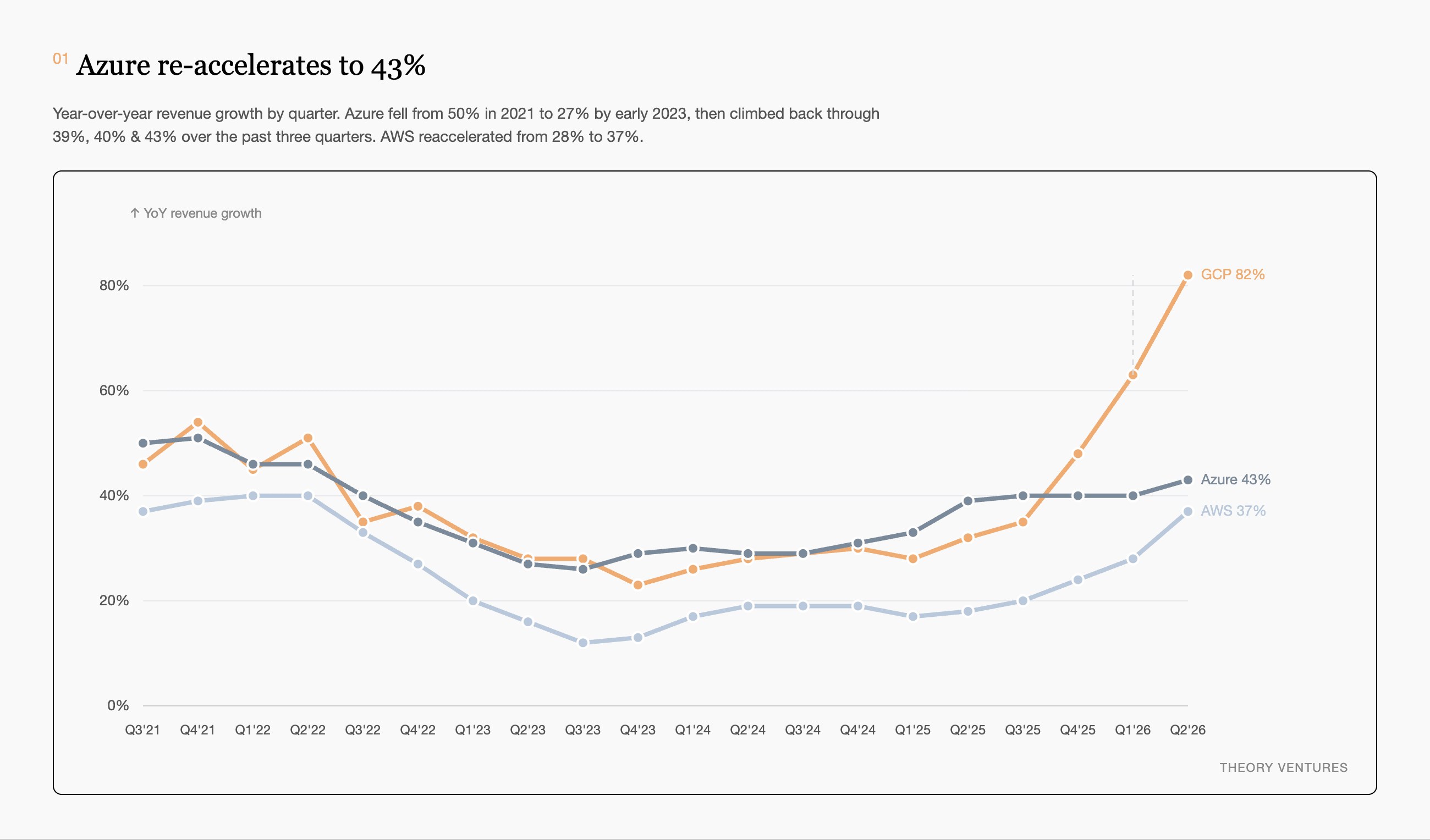
The financial gap between cloud computing leaders has exposed a fundamental rift in AI infrastructure strategy. While Alphabet builds a vertically integrated fortress, Satya Nadella’s Microsoft is assuming the role of a cautious distributor of third-party power. As analyst Tomas Tunguz notes, Google Cloud is demonstrating aggressive 82% growth by leaning on its own proprietary chips and models. This approach allowed Alphabet's operating margin to soar from 20.7% to 35.6%, even with quarterly capital expenditures hitting $44.9 billion. Owning the entire stack exempts the company from the "middleman tax" that any reseller must inevitably pay.
Strategic context
Microsoft has instead opted for the position of a flexible hedger. As Nadella asserts, any model is replaceable—a mantra that justifies avoiding a hard lock-in to a specific stack at the cost of thinner margins. Redmond remains tethered to third-party hardware, effectively renting Nvidia’s roadmap and paying Jensen Huang his generous premium. Microsoft CFO Amy Hood confirms that approximately two-thirds of the projected $50+ billion quarterly CapEx is allocated to short-term assets—chips and servers—rather than long-term real estate. In Hood’s logic, this acts as a safety cushion: if the demand bubble bursts, Microsoft can simply turn off the procurement tap without being stuck with dead data centers for decades.
Microsoft's balance sheet now depends critically on a venture-backed borrower whose future remains opaque. The "reseller" strategy allows for a quick exit but leaves the company hostage to its primary tenant's success.
However, this caution masks a massive concentration of risk. Out of $678 billion in total Remaining Performance Obligations (RPO), the lion's share is tied to a single client. Excluding OpenAI, growth would be a modest 25%. Data shows that roughly $220 billion of the backlog added this year comes specifically from Sam Altman’s startup, which has committed to purchasing $250 billion in Azure capacity.
The bottom line
The market is already growing nervous about this circular dependency. Nvidia is guaranteeing OpenAI's data center leases for that same $250 billion, while the cost of credit default swaps (CDS) on Nvidia’s debt has doubled to 82 basis points. Microsoft has chosen to minimize long-term capital risks, but in exchange, it has gained a critical dependence on OpenAI’s sustainability and the pricing power of third-party chip suppliers.