AI · This text was generated with artificial intelligence
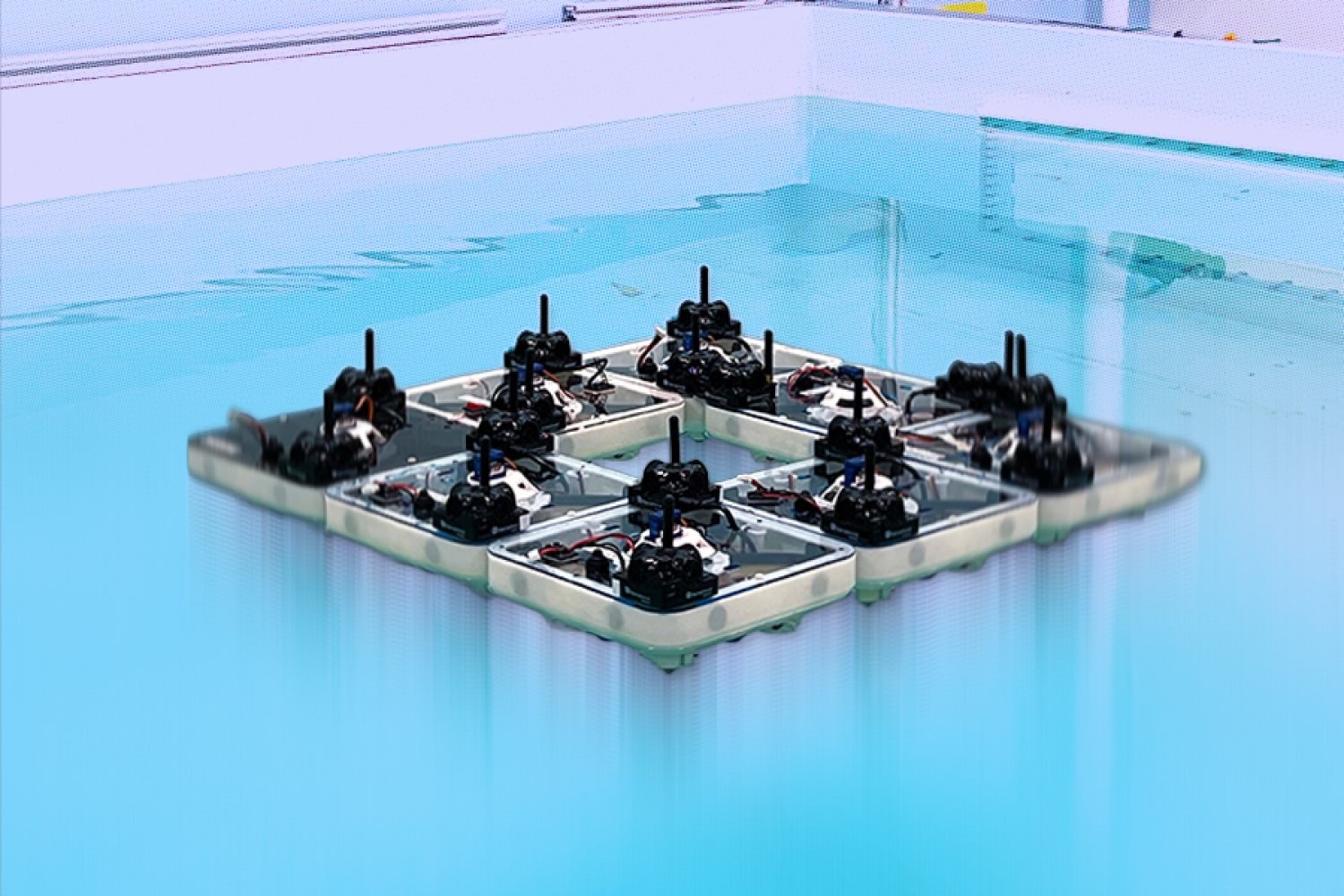
The coastline is evolving from a static boundary into a dynamic, programmable construction site. A team at MIT, led by CSAIL Director Daniela Rus, has unveiled FloatForm—a swarm of 21-centimeter modular robots capable of autonomously assembling into bridges, platforms, and floating markets. Moving away from traditional hydraulic engineering, the project treats the water's surface as a modular grid that can expand or dissolve based on immediate urban requirements.
Parallel Assembly
Instead of engineering a single massive vessel, the researchers focused on decentralization. Each FloatForm "tile" is an autonomous agent roughly the size of a pizza box, designed to solve complex positioning tasks in unstable environments. By allowing each element to act independently, the system eliminates the vulnerability of a central control node, turning chaotic movement into targeted self-assembly.
Mechanics of the Programmable Surface
The technical core of each module includes dedicated thrusters, a sensor suite, and a magnetic latching system. These latches provide the physical connection that transforms disparate pieces of plastic and electronics into a rigid structure capable of maneuvering as a single organism. The study, published in Nature Communications, is a logical progression of the Roboat project—an MIT collaboration with the AMS Institute. While Roboat focused on full-sized vessels for waste management, FloatForm operates at the micro-level, tackling the mathematical challenges of swarm organization.
"Our project, FloatForm, envisions a future where the waterfront becomes a programmable extension of the city," notes Daniela Rus.
As lead author Wei Wang, head of the Maritime Robotics Laboratory at the University of Wisconsin-Madison, points out, the goal is to convert underutilized waterways into adaptive spaces. This represents a fundamental paradigm shift: moving from static infrastructure to "on-demand" assets, whether that means a temporary concert stage or an emergency bridge in a disaster zone. Backed by Panasonic, the project is already eyeing commercialization, attempting to move beyond the controlled environment of laboratory pools.
While the current iteration of FloatForm proves that decentralized swarms can achieve the geometric precision required for serious construction, open-water deployment remains the final frontier. Currents, waves, and the high power consumption required for constant position adjustment are the primary barriers. For now, the researchers have successfully raised the stakes: the question is no longer how to make a boat sail, but how to make the water itself a functional, reconfigurable floor for the modern metropolis.