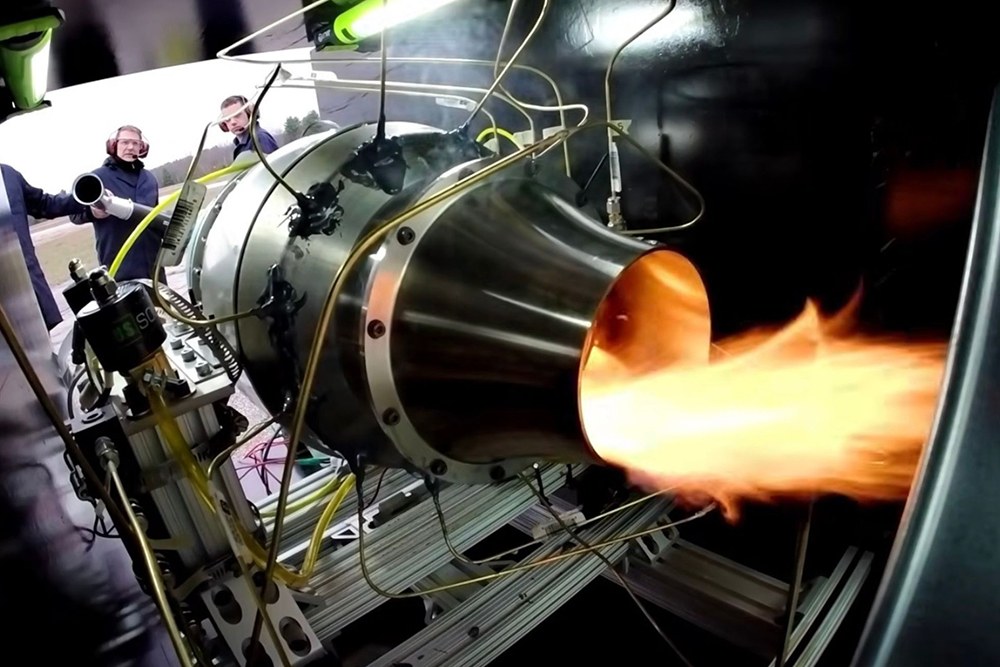
Artificial intelligence has already rewritten the rules of software development, but its entry into the physical world is a high-stakes game. MIT recently tested these limits through the JARVIS sprint (Jet-engine AI Research and Validation Intensive Sprint). The goal was surgical: to compress the design-build-test cycle for a small-scale gas turbine engine. This wasn't a theoretical exercise in a digital sandbox. A group of students was given just four weeks to design, manufacture, and fire up a single-rotor jet engine on a test stand, capable of 45 kg of thrust and five full runs on Jet-A fuel.
The Architecture of the JARVIS Methodology
The experiment involved 31 students, many of whom lacked any prior experience in thermodynamics or turbomachinery design. To bridge this competence gap, MIT deployed Parley—a unified interface for advanced large language models that tracks prompts, costs, and algorithmic behavior in real-time. AI became the teams' primary engineering partner, helping them navigate complex industrial software like Concepts NREC and SolidWorks. Supported by MIT Lincoln Laboratory and industry giants like Safran and Boom Technology, participants had nearly unlimited access to compute resources as they attempted to turn raw calculations into functional hardware.
"The JARVIS sprint demonstrated that AI can significantly accelerate the design of critical systems, but engineering judgment remains the ultimate deciding factor."
Professor Zolti Spakovszky, Director of the MIT Gas Turbine Laboratory, notes that while AI generated designs and crunched massive datasets, the human remained the only effective safety filter. In an environment where a mistake is far costlier than buggy code, the role of the human "circuit breaker" proved indispensable.
Barriers in Material Reality
As the project progressed, the hard ceiling of neural network capabilities became apparent. AI excelled at optimizing geometry and computational schemes but faltered when faced with physical production. Spakovszky observed that the manufacturing stage—not design—remains the fundamental bottleneck. A neural network can produce a perfect blueprint in seconds, but it cannot expedite machine shop logistics or replicate the nuance of manual assembly for complex components. Here, material science and thermodynamics present a bill that cannot be paid in tokens.
"The AI-native engineer is defined not by their use of AI, but by how they manage it—knowing when to trust the output and when to interrogate it."
The experiment forced students to realize that the modern engineer is evolving from a "human calculator" of stress and flow into an operator-auditor. This new role requires even more skepticism than before; the price of an AI hallucination in a jet engine is twisted metal, not just a compilation error. The engineer of the future must stay tethered to physical reality to validate the mountain of data generated by autonomous systems.
The JARVIS sprint proves that AI can radically democratize specialized knowledge, enabling novices to design complex machinery. However, it does not eliminate the need for "engineering intuition" and physical testing. For business leaders, this means AI will drastically shorten the Design phase, but the Build and Test stages will still be dictated by the laws of physics. Future tech leads must shift their focus from the speed of idea generation to the rigor of verification protocols and the ability to challenge model outputs.