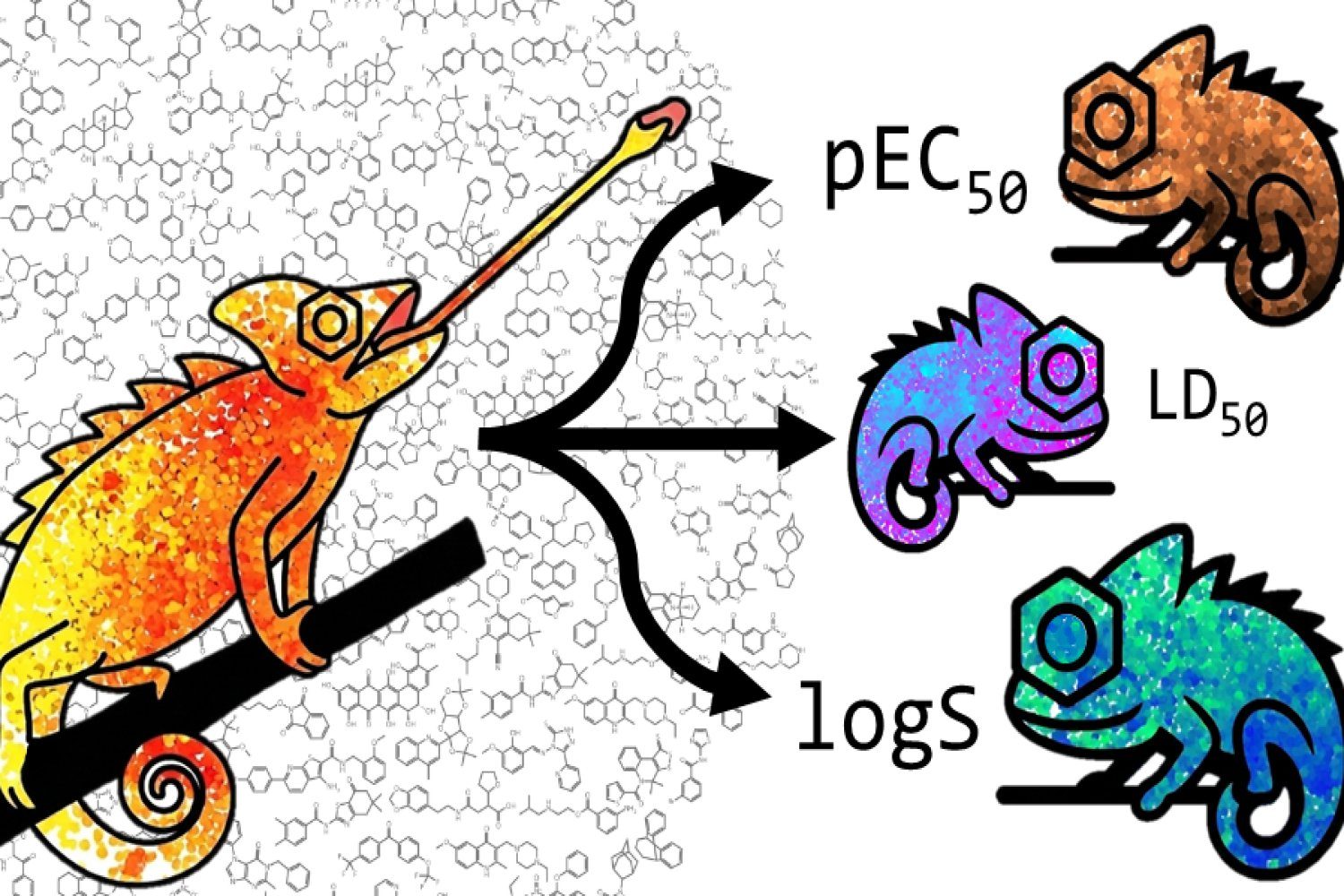
Discovering new molecules has long forced chemical and pharmaceutical developers into a trial-and-error cycle of synthesizing compounds, yet nine of the top 20 entries in a recent OpenADMET contest used an unreviewed open-source model called CheMeleon to bypass physical testing.
Developing specialized molecules remains an essential growth driver across pharmaceuticals, electronics, and energy. However, because chemical behavior cannot be predicted across myriad physical properties, conventional discovery pipelines burn through corporate capital on wet-lab screening. The core financial question for decision-makers evaluating generative pipelines is clear: how can a predictive algorithm reliably cut down expensive laboratory runs when target data are practically nonexistent?
Pre-trained models that generalize from sparse experimental records alter the core unit economics of molecular discovery. As reported in the Sept. 14 issue of the Journal of Chemical Information and Modeling by MIT graduate student Akshat Shirish Zalte, recent graduate Jackson Burns PhD ’26, Research Scientist Charlles Abreu, Professor William Green, and three researchers from chemical manufacturer BASF, a new machine-learning framework outperforms existing predictive tools precisely when property data are scarce.
Moving Past Trial-and-Error Chemistry
Traditional physical modeling relies on tedious baseline calculations to indicate which candidates warrant physical synthesis. When corporate R&D teams evaluate newly isolated drug targets, data on ligand affinities are typically minimal, leaving standard computational screening ineffective. CheMeleon directly targets this operational bottleneck.
Built on top of ChemProp, an open-source machine-learning package maintained by the Green group at MIT, the architecture allows internal research teams to download the weights and fine-tune them for proprietary targets. While an earlier draft had circulated online since last year, real enterprise adoption began before formal scientific validation was completed.
Earlier this year, the OpenADMET competition tasked participants with predicting characteristics for newly synthesized candidate molecules. When the final results were tallied, nine of the top 20 contestants had integrated CheMeleon into their computational pipelines. How did an unreviewed academic model spread through competitive enterprise pipelines before completing formal peer review?
Pre-Training on Molecular Descriptors
Commercial adoption accelerated because the underlying architecture decoupled property prediction from expensive wet-lab datasets. The Green group pre-trained CheMeleon on detailed structural data representing one million distinct molecules drawn from PubChem, the freely accessible chemical repository maintained by the U.S. National Institutes of Health.
Instead of parsing scientific literature or requiring bespoke lab trials, the architecture maps structural correlations across approximately 1,600 historical descriptors established by chemists. As co-author Akshat Shirish Zalte explained, the engineering team deliberately avoided scraping academic texts to train the weights.
"We don't look at the literature at all. We just calculate a bunch of molecular descriptors like molecular weight or number of oxygens, among others."
Calculating basic features such as atomic counts and molecular weight creates a generalized structural baseline. That foundation enables corporate teams to fine-tune the system toward complex target properties, spanning solubility, viscosity, and specific enzyme reactivity.
Commercial researchers routinely question whether pre-training across only one million molecules can reliably generalize against infinite chemical possibilities. Benchmarks indicate that this sample provides sufficient structural variety for the system to identify recurring patterns on its own.
Corporate Integration and Capital Efficiency
The economic implication of CheMeleon rests on minimizing physical laboratory validation. William Green, the Hoyt Hottel Professor of Chemical Engineering at MIT, confirmed that the model has established regular operations across multiple pharmaceutical companies.
Corporate commitment reached the operational level at one enterprise, where leadership directed research divisions to deploy the framework across all early modeling workflows. As William Green noted, the leadership instructed teams that whenever they model a property, they must begin with CheMeleon as formal corporate policy.
Cutting the volume of physical synthesis drastically curtails wet-lab overhead, accelerating candidate prioritization before physical synthesis begins.
Deploying open-source foundation models trained on public structural descriptors allows R&D organizations to substitute high-risk physical synthesis with accurate computational filtering. Companies that integrate sparse-data pre-training into their pipeline design can systematically compress discovery timelines while insulating R&D balance sheets from the runaway costs of physical trial and error.
What it means
Screening budgets no longer dictate molecular research timelines once open architectures bypass wet laboratory runs entirely. By mapping roughly 1,600 historical descriptors, the framework delivers functional predictions even when proprietary drug targets offer almost no experimental measurements. Adoption across nine top competitors in OpenADMET proved that corporate pipelines will deploy unreviewed open-source models the moment they cut physical bench tests.