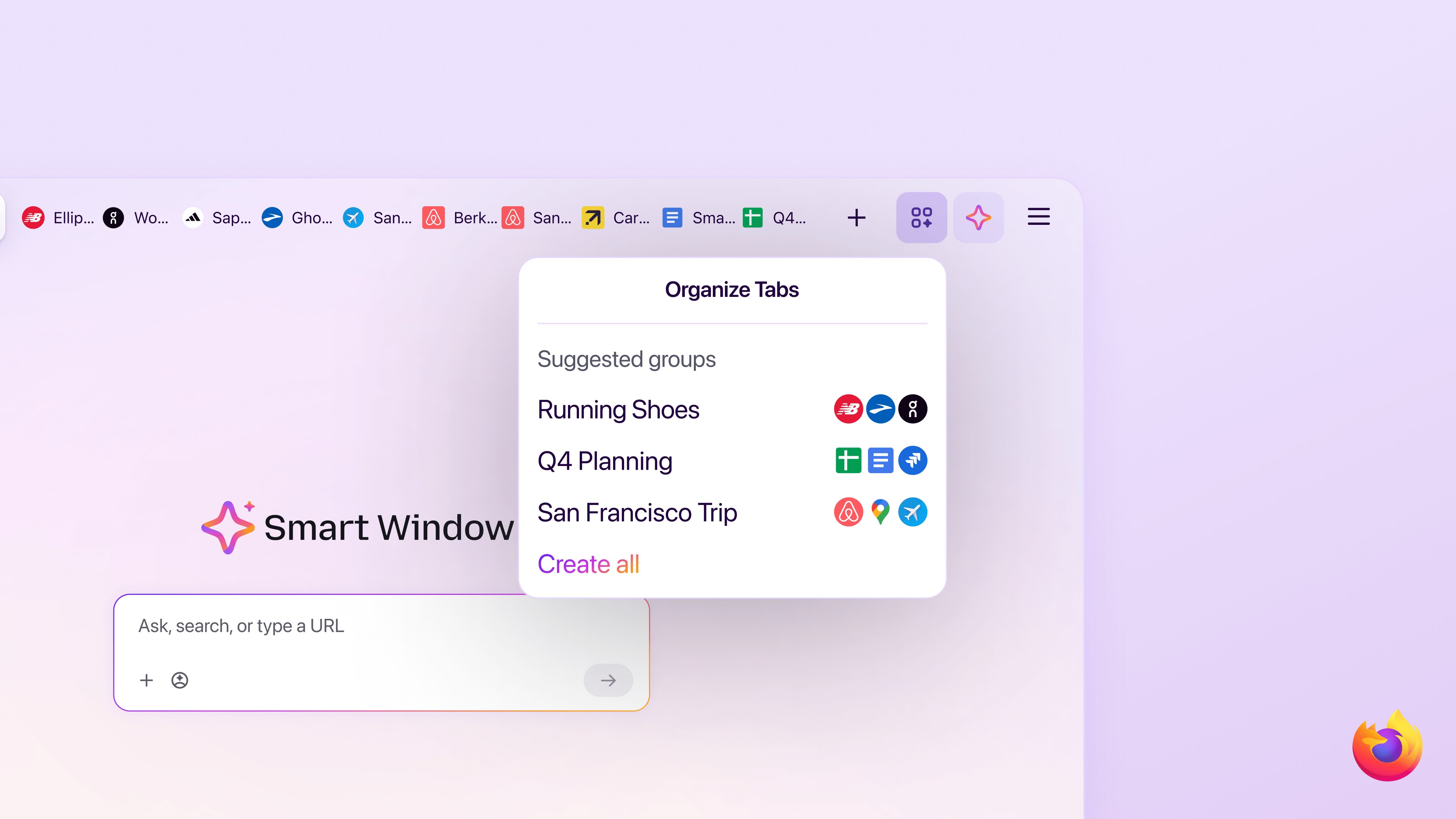
Modern enterprise web browsers have quietly devolved into corporate tollbooths designed to funnel enterprise data into closed AI flywheels. As Microsoft and Google aggressively wire proprietary models into edge navigation, enterprise leaders face a clear risk profile: context leakage, forced telemetry, and inescapable vendor lock-in. Mozilla is now testing an explicit counterweight with its opt-in Smart Window experimental feature in Firefox, prioritizing pluggable modularity and data sovereignty over closed corporate ecosystems.
Search Grounding and Context Retrieval
Firefox’s Smart Window connects conversational AI directly to live web data through an integration with neural search engine Exa. Instead of black-box summarization, this pipeline pulls verifiable, real-time web citations directly into the workspace, grounding outputs in auditable context. Simultaneously, the system processes local browsing history via natural language processing—indexing past research sessions, surfacing viewed items with imagery, and automatically deduplicating tabs to streamline fragmented analytical workflows into an autonomous workspace hub.
To decouple these operations from Big Tech lock-in, Mozilla engineered the reasoning tier to be model-agnostic, supporting a spectrum from cloud endpoints to fully on-device weights running locally on enterprise hardware. As Ajit Varma, head of Firefox at Mozilla, noted in an interview with The Verge, this architecture is a calculated defense of organizational autonomy.
“We’re looking at making sure that there is a possibility for digital sovereignty, so you can choose local AIs and AI from companies that are maybe based in your region that have different views than maybe some of the big tech companies,” Varma said.
This agnosticism allows corporate teams to execute sensitive search and summarization workflows without handing operational logs or proprietary query patterns over to hyper-scalers.
Privacy Controls and User Choice
A centralized AI Controls dashboard in Firefox settings lets administrators and users selectively disable individual automated subroutines or strip out AI tooling browser-wide.
Rather than forcing a mandatory interface overhaul, Mozilla is treating the browser as an unbundled, verifiable operating layer. By pairing Exa's search architecture with local reasoning and hard kill-switches, the approach demonstrates that contextual enterprise intelligence does not require surrendering proprietary workflow data to centralized platform monopolies.