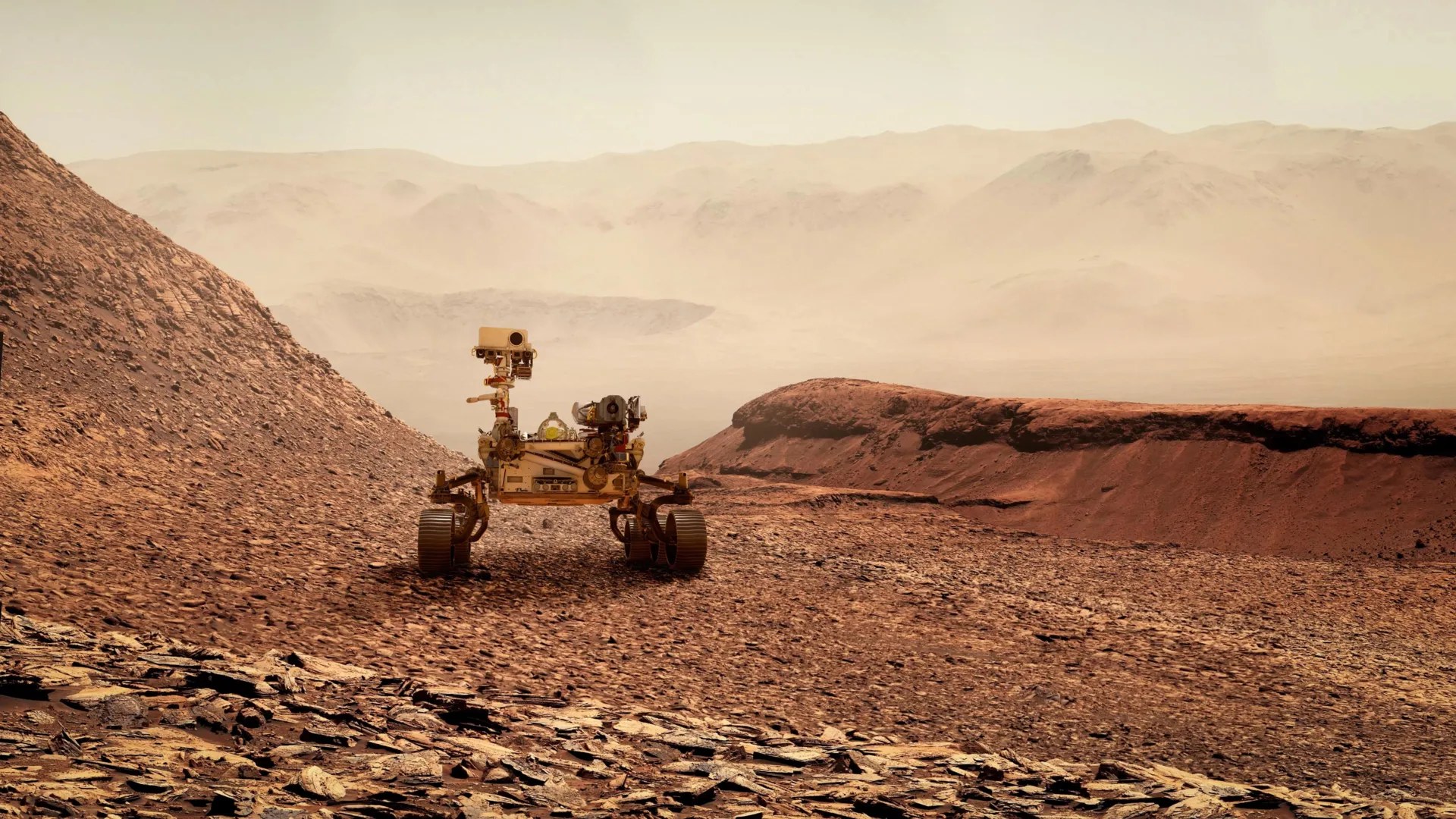
On December 8 and 10, the Perseverance rover completed the first-ever drives with routes planned entirely by artificial intelligence. While the six-wheeled rover previously relied on autonomy only to navigate local obstacles, the responsibility for selecting key waypoints—a strategic task handled for decades by experts at the Jet Propulsion Laboratory (JPL)—has now been delegated to a multimodal system. This milestone is more than just another notch in the history of space exploration; it is a rigorous stress test of the "latency economy." In an environment where stable communication with an operator is physically impossible, AI ceases to be a novelty and becomes a prerequisite for survival.
The Engineering of Delegation
For nearly thirty years, Martian navigation was a grueling cycle: operators on Earth spent days analyzing images and marking waypoints in increments of no more than 100 meters to avoid risking billion-dollar hardware. Command packets were then sent via the Deep Space Network. The transition to AI planning, implemented by JPL in collaboration with Anthropic, removes this human bottleneck. Multimodal models now recognize terrain, synthesize data, and plot paths through hazardous zones autonomously. Moving away from rigid algorithms toward adaptive vision allows the system to localize itself in real-time, transforming the robot from a remote-controlled puppet into an independent agent.
"Autonomous technologies of this caliber allow missions to operate more efficiently and increase scientific returns as we move further from Earth," noted NASA Administrator Jared Isaacman.
When your target is 140 million miles away, the concept of "real-time" becomes a joke. The real value here lies in the verification process: NASA engineers do not take the model's word for it. Before any command is uploaded to Mars, instructions are run through a digital twin of the rover. This serves as a blueprint for terrestrial industrial AI: trust in the system is built not on the "intelligence" of the algorithm, but on the depth of the simulation that proves the model will not make a fatal error.
Shifting Responsibility: From Tactics to Strategy
The long-term goal is to fully migrate decision-making logic from Earth-based servers to edge computing hardware: rovers, drones, and automated platforms. The autonomy triad—perception, localization, and planning—is being optimized to minimize the operator's cognitive load. The system isn't just spinning wheels; it assesses risks, identifying boulders and treacherous sand dunes faster than any flesh-and-blood expert.
This creates a clear hierarchy of responsibility: AI handles tactical safety and route optimization, while humans remain at the strategic level. We decide the "why" and "where," while the algorithm determines the "how." This architecture, refined in digital twins and executed at the edge, is the only viable scenario for any system in a harsh environment, whether it be deep-sea mining or warehouses in areas with unstable connectivity.
NASA has demonstrated that mission-critical tasks can and should be offloaded to AI, provided the simulation layer is sufficiently robust. When the price of failure is the loss of a billion-dollar mission, the consumer AI mantra of "move fast and break things" is discarded. It is replaced by a high-precision digital double validating every step—the only mature path to full autonomy in the physical world.