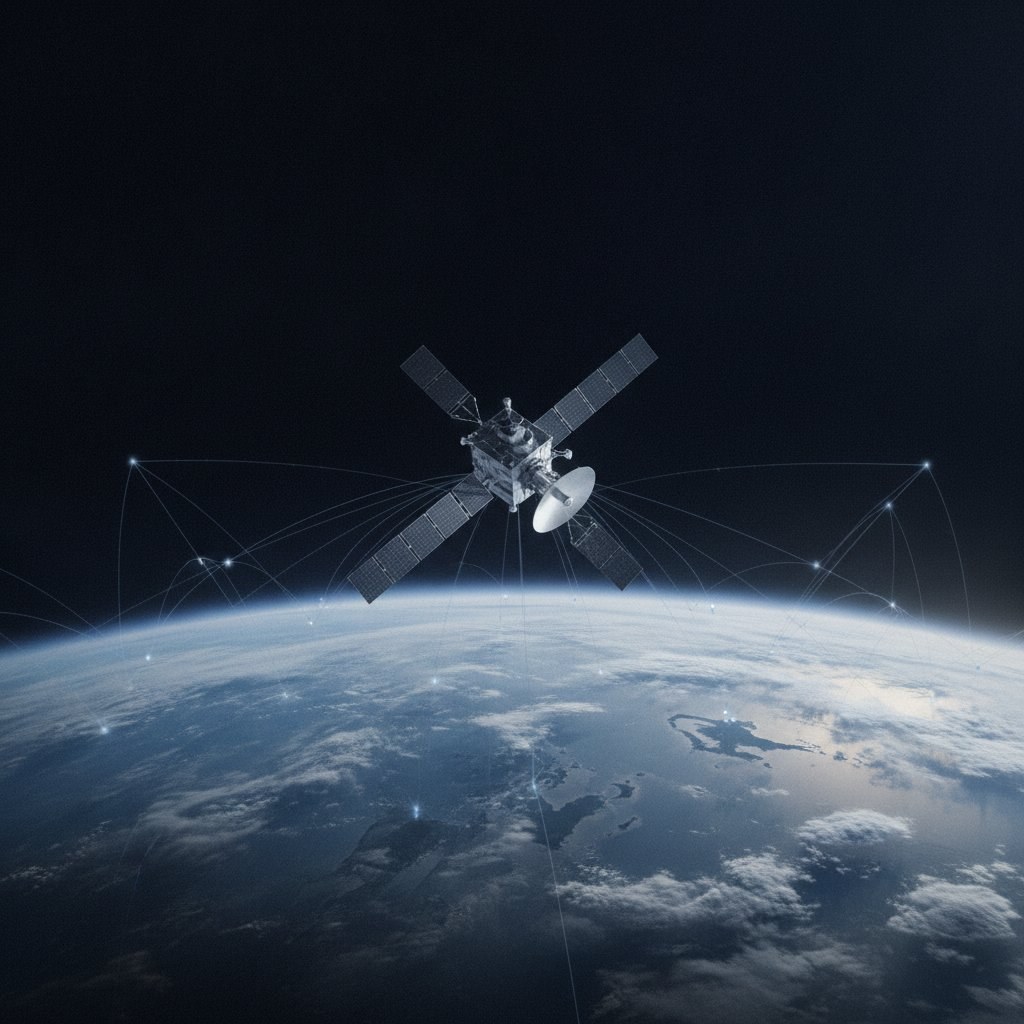
Modern Earth observation has hit a physical ceiling: sensors generate data faster than narrow communication channels can transmit it, or human operators can review it. On April 16, 2026, NASA’s JPL and Loft Orbital demonstrated how to break through this barrier. The NAVI-Orbital software framework, deployed on the YAM-9 satellite, marked the first successful launch of multimodal Vision-Language Models (VLM) directly in orbit. Running Google’s Gemma 3 model, the satellite has evolved from a mere "flying eye" into an active analyst capable of autonomous reasoning based on visual data.
The Semantic Analysis Revolution
The fundamental shift here is the transition from narrow, specialized detectors to open-vocabulary autonomy. Previously, identifying a new type of object required long retraining cycles and software updates; NAVI-Orbital relies on zero-shot learning. Effectively, an operator can now assign tasks using natural language prompts instead of writing complex code.
During AID benchmark tests, the system achieved 88.16% accuracy. In real orbital conditions, the AI successfully processed raw imagery without needing pre-calibration for specific optics. The system understands context: it identifies complex scenes, such as "a highway passing through a forest," rather than just isolated pixels.
"Instead of offloading gigabytes of data in the hope of finding a useful frame, NAVI-Orbital uses LangGraph-based agents to generate compact, actionable text reports."
Streamlining Communication and Rapid Response
This architecture flips the traditional "download first, figure it out later" model, which routinely bottlenecks communication channels. Operators receive only the information they actually need. This enables near-instant responses to anomalies—whether natural disasters or troop movements—without the delays inherent in ground-center processing.
The Future of Orbital Intelligence
NAVI-Orbital proves that foundation models can survive the harsh environment of space and solve the bandwidth deficit. For tech professionals, this signals the dawn of autonomous semantic data processing.
Prompts are becoming the new command sequences for spacecraft. On-board intelligence is becoming standard for missions where the speed of intelligence is more critical than having original RAW files. Satellites are evolving from passive sensors into fully-fledged AI agents.